
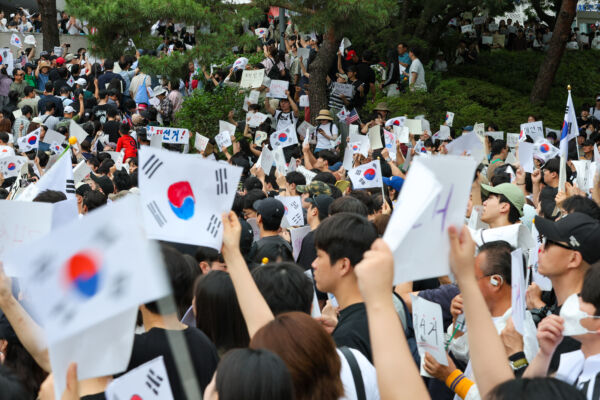
On June 3rd, following the shortage of ballots in South Korea’s local elections, the protests that had been ongoing in the Samsan-dong area of Seongbuk-gu in Seoul shifted over the weekend to the front of the counting center.
According to the police estimation, as of June 6th, around 3:30 PM (Saturday), the number of people demanding a re-election at the handball arena of the Seoul Olympic Park had increased to approximately 20,000. The protesters at the site were waving South Korean flags (Taegeukgi) and banners, calling for a re-election.
On June 3rd, South Korea held the 9th local elections and parliamentary by-elections. On voting day, several polling stations in Seoul suddenly faced a shortage of ballots.
According to the National Election Management Committee of South Korea, a total of 67 polling stations nationwide required emergency additional ballot distribution, with 22 polling stations briefly interrupting voting; Seoul had 14 polling stations experiencing ballot shortages, including 12 in Songpa-gu, 1 in Gangnam-gu, and 1 in Gwangjin-gu.
Of particular attention was the 2nd polling station in Chamsil 7-dong. Due to the ballots running out, a large number of voters were forced to wait in long queues, extending the voting time from the original 6 PM to as late as 10 PM. Some citizens were still unable to cast their votes even after queuing for hours.
The protests on June 6th were not organized by a specific group but were decided by the people present through discussions and exchanges at the site.
A young man named Park in his twenties, who had been volunteering since the morning, guided people from the entrance of the Olympic Park towards the counting center all day, his voice hoarse from shouting. He stated that upon seeing the police riot squad removing the ballot boxes from the polling station in Chamsil 7-dong the previous day on social media, he decided to come to the site to lend a hand.
Park said, “What impressed me the most today was seeing citizens of different political views engaging in discussions on-site, respecting each other’s opinions. Witnessing everyone calmly resolving issues through communication gives me hope for Korean society.”
The banners held by the protesters were mostly handwritten with demands using markers rather than the printed slogans or flags commonly seen at rallies. Many had written “re-election” in Korean on their papers, while some believed that the electoral chaos was linked to China and expressed related demands in Chinese.
Notable figures like the history lecturer Jeon Han-gil and the elected member of the National Power Party in Daegu Dalseong-gun, Lee Jin-sook, along with the party’s chief executive, Kim Min-soo, had shown support during the previous day’s protest. However, on the 6th, the event was mainly led by ordinary citizens rather than political figures or celebrities.
The National Power Party, South Korea’s main conservative party and the largest opposition party in the parliament, has taken a firm stance on the ballot shortage incident, advocating for “re-vote” or “postponement of elections” even earlier than some protesting citizens.
The party believes that some voters had effectively lost the opportunity to vote due to long waits or being forced to leave, leading to not just administrative lapses but a significant event affecting the fairness of the elections.
The party asserts that the National Election Management Committee should take responsibility, thoroughly investigate the reasons for the ballot shortage, and consider remedial measures like a re-vote.
During the on-site interviews conducted by the Epoch Times, the citizens emphasized that they were not there based on left-wing, right-wing, or support for a particular political party but as Korean nationals standing up to defend their constitutional right to participate in elections.
For this reason, they surrounded the handball arena serving as the counting center. The citizens blocked around a dozen entrances, attempting to prevent the ballots from being taken out.
According to the South Korean Electoral Law, “ballots” refer to blank voting papers that have not been stamped, whereas “voted ballots” are those that have been completed, regardless of their validity, expressing the voter’s will.
The citizens trying to prevent the removal were not targeting blank ballots but the voted ballots. They believed that once the National Election Management Committee completed the ballot transfer and concluded all election procedures, it would be challenging to gather further evidence of electoral malfeasance and push for re-election demands.
The citizens argued that their actions constituted “peaceful supervision activities.” In light of the voting delays and cases where some voters were unable to cast their votes and left due to the ballot shortage at the Chamsil polling station, they felt it was necessary to not solely rely on the Election Commission and the government to handle the situation.
At 4 PM that afternoon, the Chairman of the National Election Management Committee, Lu Tae-yeok, publicly apologized to the nation, taking responsibility for the poor election management and resigning, promising a thorough investigation of the truth.
However, some citizens felt this was still far from sufficient. A man in his seventies even raised his voice, stating, “He shouldn’t just resign; he should go to prison.”
The gathering at the polling center in Songpa started around 9:30 AM the previous day (5th). At that time, two ballot boxes from the 2nd polling station in Chamsil 7-dong in Seongbuk-gu were transported to the counting center under police escort. While there were only around 100 to 200 people at the scene then, the number had increased to around 2,000 by 5 PM. By the weekend of the 6th, the attendance continued to grow to thousands, even tens of thousands.
The crowd consisted of youth, middle-aged, and elderly citizens, with many families bringing their children to participate. A 37-year-old woman named Kim from Suwon City in Gyeonggi Province brought her 6-year-old daughter and husband to the event. She mentioned, “Because my daughter might fall asleep at the venue, I specifically brought a stroller and a blanket.” She added, “Although I don’t plan to stay up late, I hope to stay until late to voice out for the citizens.”
Another citizen remarked, “During the Mad Cow Disease protests in the past, many mothers pushed baby strollers onto the streets. This time, seeing so many baby strollers surprised me.” Indeed, there were numerous women with baby strollers at the scene.
Some individuals had laid down mats preparing to stay overnight as they did the previous day, while others had been distributing snacks and water for free since the morning. They mentioned that these were all “personal donations.” As mainstream media did not extensively report on the event, they considered sharing news from the scene on social media to be the best feedback.
A 52-year-old man named Pyo brought his elementary school child to the gathering. He believed that an unexpected gain from the event was the renewed respect for the Taegeukgi, South Korea’s national flag.
Pyo said, “In the past, the Taegeukgi was often viewed as a symbol exclusive to the so-called ‘Taegeukgi troops’ of the elders, thereby facing a certain level of depreciation in society. But that’s completely different today.”
He continued, “What’s more meaningful is that today is Korean Patriots’ Day. I’m also grateful that it was led by the younger generation.”
As of now, there have been no major physical clashes between the police and the protesters at the Songpa polling center. Some citizens noted that while a few police officers had a more rigid attitude the previous day, there was a noticeable relaxation on the 6th.
However, sporadic disturbances continued on-site. For instance, some citizens demanded that men leaving the arena undergo personal item checks, or checked the goods being taken into the convenience store one by one. In addition, some media reporters were verbally abused by certain citizens during the interview.
On the other hand, to prevent any sudden incidents, the police maintained communication with the citizens while enhancing on-site vigilance. Furthermore, as there was a K-pop concert held nearby that day, the police also adjusted the audience flow to ensure order at the venue.