
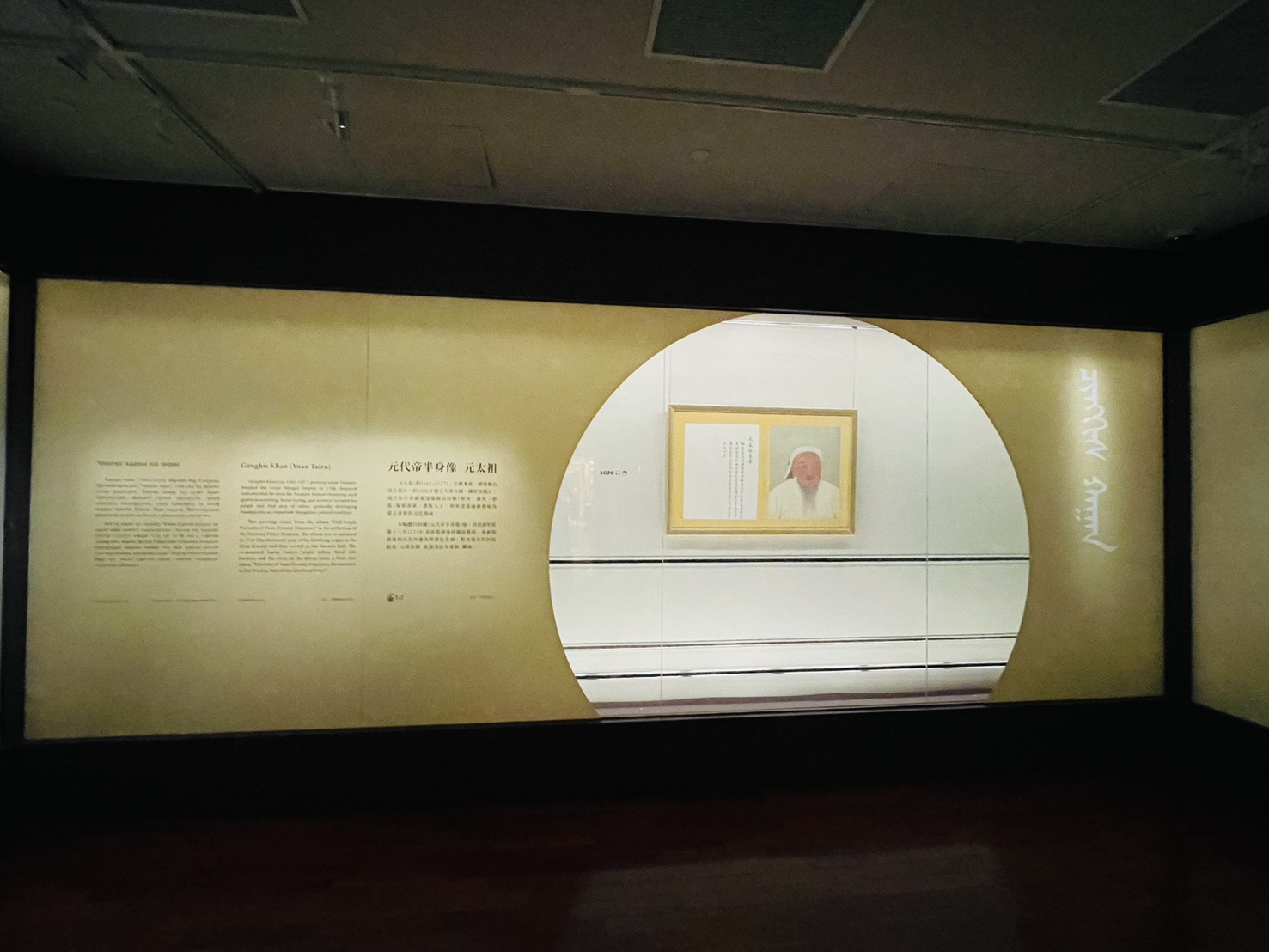
The National Palace Museum’s Northern Branch in Taiwan has launched a special exhibition titled “Skill and Exercise – Physical Activities in Calligraphy and Painting” during the summer vacation, featuring the rare display of the treasured national artifact from the Yuan Dynasty, the “Half-Portrait of Emperor Taizu of the Yuan Dynasty” (a portrait of Genghis Khan), which has not been exhibited for 13 years.
According to the National Palace Museum in Taiwan, this special exhibition aims to showcase the body postures and technical performances depicted in calligraphy and painting through a contemporary perspective of “exercise,” allowing the audience to explore the rich aspects of ancient skills, competition, performance, and physical activities.
Director Hsiao Tsung-huang of the National Palace Museum in Taiwan mentioned that 820 years ago, Genghis Khan established the great Mongol Empire, promoting exchanges among different ethnic groups, religions, cultures, and knowledge across Eurasia, thus contributing significantly to the history of human civilization exchanges. The spirit of cross-regional and cross-cultural exchanges has provided inspiration for contemporary museum endeavors and international cultural cooperation.
Hsiao Tsung-huang pointed out that the museum’s collection of the “Half-Portrait of Emperor Taizu of the Yuan Dynasty” is one of the most representative images of Genghis Khan today, serving as an important symbol connecting historical memory and ethnic culture for Mongolian friends. The museum is honored to preserve this precious cultural heritage and aims to enhance awareness of the history and culture of the Mongol Empire through research, exhibitions, and educational outreach.
In recent years, the National Palace Museum has collaborated with institutions such as the Mongolian Academy of Sciences, the Bogd Khaan Palace Museum, and the Chinggis Khaan National Museum to promote research exchanges, museum visits, and the sharing of cultural resources. Both sides look forward to further deepening their cooperation to make museums vital bridges connecting different cultures and promoting mutual understanding.
Representative Te Mu’er from the Taipei representative office in Ulaanbaatar expressed that this year marks the 820th anniversary of the establishment of the great Mongol Empire by Genghis Khan, making the exhibition of the “Half-Portrait of Emperor Taizu of the Yuan Dynasty” at the National Palace Museum highly significant. Genghis Khan remains a crucial historical memory for the Mongolian people and a figure of profound influence in world history and cultural exchanges.
Curator and Assistant Researcher Pu Lian from the National Palace Museum in Taiwan explained that the “Half-Portrait of Emperor Taizu of the Yuan Dynasty” depicts the founder of the great Mongol Empire in 1206, later known as Genghis Khan. The portrait shows Emperor Taizu dressed in a white robe, wearing a warm hat, and traditional Mongolian braids visible behind his ears. The intricate lines and layered colors capture the texture of the skin, while the detailed depiction of facial hair and hat material showcases the realistic features of Yuan dynasty imperial portraits.
Pu Lian also highlighted another national treasure, the painting “Emperor Liu Guandao’s Hunting Scene of Emperor Shizu of the Yuan Dynasty,” which portrays scenes of Emperor Shizu of the Yuan Dynasty, Kublai Khan, and others traveling in the desert. The painting shows Emperor Shizu adorned in a gold cloud dragon-patterned crimson robe, draped in a white fur coat, and wearing red boots. Surrounding him are camel caravans, attendants with bows and arrows, falcons on display, and leopards for hunting, vividly illustrating the royal hunting and archery activities of the Yuan dynasty. These two artworks, depicting imperial portraits and royal hunting scenes, introduce viewers to the artistic expressions and cultural characteristics of the Yuan-Mongol era.