
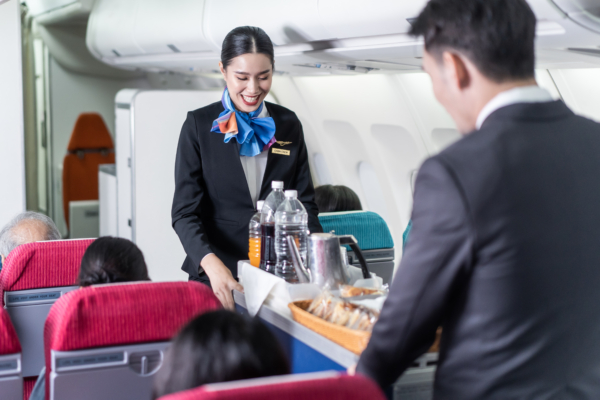
While traveling by plane, it’s common to snack and have a drink at an altitude of thousands of meters. However, flight attendants point out that some foods are best avoided on airplanes, particularly a popular beverage that might surprise you.
According to flight attendants, it’s best to avoid drinking water from the taps on the plane as it originates from the aircraft’s storage tanks, which are rarely cleaned. The same goes for coffee, tea, and ice. Scientists and health experts also recommend avoiding alcoholic beverages and mixed drinks that contain artificial sweeteners.
In addition, a flight attendant recently revealed to “Travel + Leisure” magazine that passengers should consider adding Diet Coke to their list of beverages to avoid. But why?
“Pouring Diet Coke for passengers during the flight is one of the most frustrating things for a flight attendant because when pouring this soda, the foam tends to overflow constantly.” Flight attendant Luke Gary recently told “Travel + Leisure” magazine, “The bubbles take a full 60 seconds to settle, and during that time, the cup is not even a quarter full. You have to keep pouring repeatedly while trying to engage with passengers. Most of the time, passengers have already put on their headphones and don’t want to interact with you at all. So what am I supposed to do during that minute? Awkwardly stand there?”
Gary’s frustration stems from a characteristic of diet sodas like Diet Coke – they tend to produce more bubbles than regular sodas; this difference becomes especially noticeable when pouring dozens of cups consecutively.
An article released by McGill University in 2022 indicated that the level of carbonation in soda depends partly on how easily the carbon dioxide bubbles form in the beverage. When bubbles form more easily, the fizziness increases. The ease of bubble formation primarily hinges on two key properties of the liquid: surface tension and viscosity.
“When the liquid has high surface tension, it means that the bond between the liquid molecules is very strong.” The report explained, “High surface tension is why some spiders can walk on water – the spider’s weight is not enough to break the bonds between water molecules. In substances with higher surface tension, bubbles are less likely to form.”
Due to ingredients like aspartame and potassium benzoate (a preservative) working as surfactants, the surface tension of diet soda is not strong, allowing more bubbles to be released.
Viscosity is another factor affecting bubble performance: liquids with higher viscosity produce fewer bubbles, but once formed, these bubbles tend to last longer. While the viscosity of Diet Coke is slightly higher than regular cola, the bubbles it produces are “relatively more stable.” This explains why Diet Coke generates more bubbles than classic cola and why its foam dissipates more slowly.
For some passengers, enjoying their favorite diet soda during a flight, even if it means waiting (possibly frustrating flight attendants in the process), is worth it. However, if it’s not your usual choice of beverage, perhaps opt for the flight attendants’ preferred and tried-and-tested drink – water. Just remember to bring a bottle of water purchased at the airport (or refilled) along with you.