
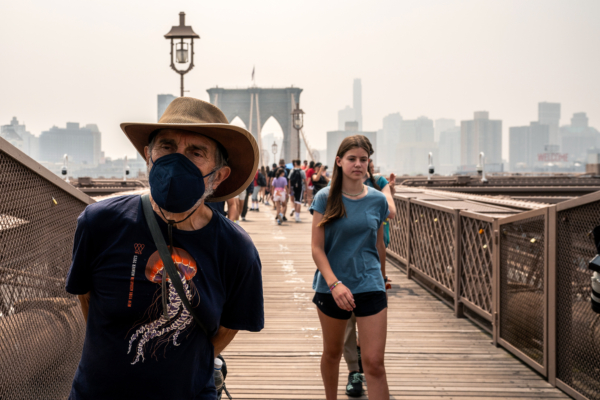
Continuous smoke from forest wildfires in Canada is drifting south, leading to a deterioration of air quality in the eastern United States. On the 16th, the state government of New York expanded the air quality health alert to cover the entire state, including New York City, Long Island, and the Hudson River Valley. Nearby New Jersey was also affected by the smoke, with a grayish haze filling the skies of the tri-state area, and air quality index (AQI) levels in some areas briefly reaching “unhealthy” levels.
As the summer vacation weekend approaches and outdoor activities peak, coupled with major events such as the World Cup soccer final set for this weekend, it is expected that a large number of people will be going outdoors to watch games, gather, and participate in various outdoor activities. Health and meteorological departments are reminding the public to check the latest AQI information before heading outside. If outdoor activities are unavoidable, individuals are advised to wear N95 or KN95 masks and try to avoid vigorous exercise. Link for AQI information: https://www.airnow.gov
The current air pollution is primarily due to the impact of forest wildfires in Ontario, Canada, with a large number of fine particulate matter (PM2.5) being carried into the eastern United States by the wind. Coupled with high temperatures and poor atmospheric diffusion conditions, pollutants continue to accumulate. The late afternoon to early evening of the 16th was noted as the period of worst air quality, with a noticeable haze over the sky of New York City, diminishing visibility of distant structures, reminiscent of the orange-tinted skies caused by wildfires in Quebec, Canada in 2023.
The Emergency Management Bureau of the city stated that PM2.5 and other pollutants in wildfire smoke could irritate the eyes, nose, and throat, leading to symptoms like coughing, throat discomfort, and shortness of breath. Medical experts point out that PM2.5 particles, about thirty times smaller than the diameter of a human hair, can penetrate deep into the lungs and even enter the bloodstream, potentially causing respiratory discomfort and exacerbating chronic conditions such as asthma, chronic obstructive pulmonary disease, and cardiovascular issues. Older adults, young children, pregnant women, and individuals with pre-existing heart or lung conditions are at a higher risk and should limit their time spent outdoors. Guidelines for handling air quality index: https://tinyurl.com/3us3kuv9
In response to the worsening air quality, the New York City government has initiated protective measures. Residents can obtain free KN95 masks at over 200 branches of the New York Public Library (NYPL), Queens Public Library (QPL), and Brooklyn Public Library (BPL) throughout the city. Various police precincts, designated fire department locations, and some major transportation hubs across the city also provide masks for public distribution.
New Jersey has similarly implemented protective measures. The New Jersey Transit announced the distribution of free KN95 masks at major customer service centers statewide until supplies last. Commuters can simply visit the customer service offices at Newark Penn, Hoboken, and Trenton stations and request masks from staff. The state government also shared that toll service plazas on interstate highways and certain transportation facilities under the Port Authority of New York and New Jersey have joined in mask distribution efforts to assist commuters in reducing smoke exposure risks.
Apart from wearing masks, officials recommend that individuals during periods of poor air quality should keep doors and windows closed, use air purifiers, minimize unnecessary outdoor activities, and avoid high-intensity outdoor exercises such as running or cycling. If continuous coughing, breathing difficulties, chest tightness, or pain are experienced, individuals should promptly move indoors to rest and seek medical attention if necessary.
According to the latest weather forecast, on the 17th (Friday), the smoke from Canadian wildfires could still affect the New York-New Jersey area, with limited improvement in air quality. On the 18th (Saturday), as a frontal system approaches, showers and thunderstorms are expected in the New York area, which could help cleanse suspended pollutants in the air, with air quality potentially starting to improve gradually, although some areas might experience brief heavy rainfall and gusty winds. On the 19th (Sunday), weather conditions are expected to stabilize, with the maximum temperature dropping to the low 80s Fahrenheit (around 27 to 28 degrees Celsius), lower humidity, and further improvements in air quality. Sunday would be relatively suitable for arranging prolonged outdoor activities.