
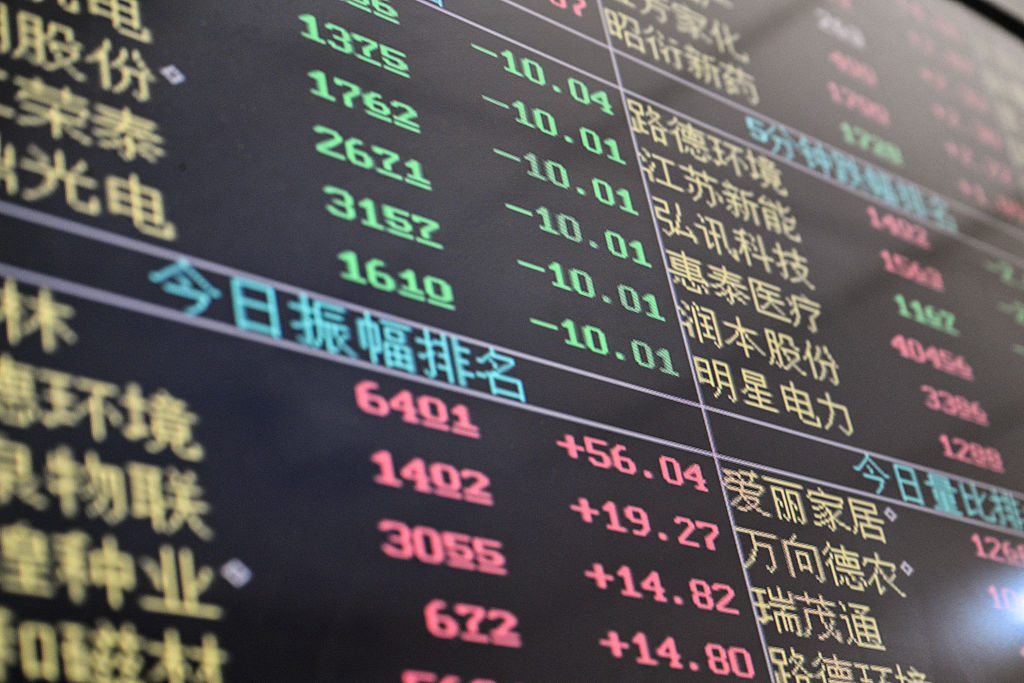
Recently, mainland listed companies have successively released their performance reports for the first half of 2026. However, many companies with significant increase in net profit have experienced a drop in stock prices upon the release of their financial reports, many of which are popular tech stocks.
The performance reports for the first half of 2026 of listed companies are a mix of joy and sorrow. Many companies that have seen their net profits grow several times or even tens of times year-on-year are not in a celebratory mood because the stock prices of these companies have plummeted following the financial reports’ publication.
DeMingLi (DeMingLi Technology Co., Ltd., Shenzhen) announced on July 14 in its semi-annual report that the estimated net profit for the first half of the year ranged from 5.7 billion to 6.5 billion yuan, with a year-on-year growth of 4932.74% to 5611.02%. However, on the 15th, the A-share price hit the limit down immediately after the market opened, closing at 662.4 yuan per share.
According to a news report by Dongfang Finance on July 16, DeMingLi’s stock price closed at 596.160 yuan per share on the 16th, down by 10.00%, hitting the limit down again. This marks the stock’s consecutive two days of limit down.
Dongfang Finance pointed out that the reason for DeMingLi’s consecutive limit down was likely related to the company’s previously disclosed forecast for the first half of 2026, especially because the company predicted a quarter-on-quarter decline in net profit in the second quarter, which deflated earlier optimistic expectations.
In the A-share market, the phenomenon similar to DeMingLi is not isolated. “First Financial” reported that the entire storage sector is facing a situation where earnings are rising but stock prices are crashing.
Changhong Technology announced on the 14th that the estimated net profit for the first half year-on-year increased by 63.48% to 101.7%, but the company’s stock price hit the limit down on the 15th. Huatian Technology disclosed on the 13th that the estimated net profit for the first half-year increased by 231% to 275%, and although the stock price rose by over 6% on the 14th, it hit the limit down on the 15th.
Furthermore, in the battery industry chain enterprises, Tianqi Lithium announced on the 14th that the estimated net profit for the first half-year increased by 3276.35% to 4934.91%; however, after the market opened on the 15th, Tianqi Lithium surged and then fell back, closing with only a slight 0.17% increase. Tianci Materials expects a year-on-year growth of 907.84% to 1019.82%; Duofudu projects a year-on-year growth of 776.68% to 990.98%; and Xinzhoubang also expects its profits to double in the first half of the year. But on the 15th after the market opened, Tianci Materials, Duofudu, and Xinzhoubang each fell by around 9%, 13%, and 18%, respectively.
Before the earnings release, the leading storage company, Zhaoyi Innovation, expected its net profit for the first half of the year to increase by 1099% year-on-year. However, after the earnings announcement, Zhaoyi Innovation’s stock price had dropped by approximately 24.5% by the 15th. Another leading storage company, Jiangbolong, projected a year-on-year net profit increase of 622 to 744 times for the first half of the year. Although the stock price rose by 10.32% the day after the announcement, it subsequently began a one-way decline and had fallen by about 31.7% by the 15th.
The unsettling trend of companies seeing explosive performance while their stock prices fall is largely attributed to the companies experiencing a decline in performance in the second quarter of this year. For instance, DeMingLi’s net profit in the second quarter fell by 5.74% to 29.65% quarter-on-quarter. Jiangbolong’s net profit growth in the second quarter was significantly lower than its overall first-half performance. Many companies in the lithium battery industry also saw that their profits in the first half of this year primarily came from the first quarter, with a significant drop in the second quarter.
“First Financial” pointed out that the market believes that the advantageous period of low-priced inventory accumulation for these companies is fading, and as future procurement costs gradually rise, profit margins will narrow, leading to investors’ concerns about the sustainability of profits for module manufacturers.
Market concerns have spilled over to the entire semiconductor sector in A-shares. Shortly after the market opened on the 15th, several individual stocks in the semiconductor sector switched from gains to losses, with some stocks quickly hitting the limit down, leading to a nearly 6.5% intraday decline in the sector index, which ultimately closed with a significant 5.65% drop.
Secondly, the popular tech sector has experienced significant gains this year, leading to internal needs for digestion and revaluation correction. A private equity investment director in Shanghai analyzed for “First Financial” that earnings forecasts are akin to a “valuation calibration’: “After the earnings are revealed, everyone recalculates, realizing that the valuations of tech stocks compared to the overall market indeed seem ‘expensive’. Funds are profit-seeking, and when the risk-return ratio of high-level sectors decreases, there is a natural drive to seek out relatively undervalued positions.” Moreover, with leveraged funds clustered, any slight disturbance could easily trigger a stampede-like escape.
In fact, the phenomenon of soaring performance and falling stock prices is not limited to the A-share semiconductor sector. Lotus Holdings Corporation Limited (Lotus Holdings) announced on July 13 in an official statement that the net profit attributable to the parent company for the first half of 2026 is expected to increase by 48.75% to 61.14% year-on-year. However, on the 14th, Lotus Holdings’ stock price fell by 9.95%, hitting the limit down.