
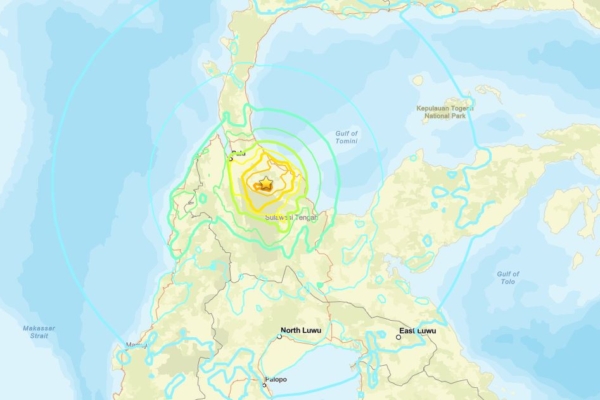
On Tuesday, June 16, a strong earthquake measuring 6.7 on the Richter scale struck the island of Sulawesi in Indonesia, followed by intense aftershocks.
According to reports from the Associated Press, the main quake caused Palu, the capital of Central Sulawesi province, to experience sustained violent shaking for over a minute. Palu has a population of approximately 400,000 residents.
The earthquake resulted in scattered damage; as a safety precaution, hospitals evacuated patients, including some who were receiving intravenous fluids. Currently, there have been no reports of casualties.
The epicenter of the main quake was located 43 kilometers (27 miles) southeast of Palu, with a depth of approximately 10 kilometers (6 miles) according to the United States Geological Survey (USGS). The strongest aftershock recorded was of magnitude 5.2.
The earthquake did not pose a tsunami risk.
Sulawesi is situated between Borneo and Papua New Guinea and is one of the larger islands of Indonesia, a Southeast Asian country composed of over 17,000 islands.
Indonesia is located in the Pacific Ring of Fire, known as the most seismically active region on Earth where earthquakes and volcanic eruptions frequently occur.
In January 2021, a 6.2 magnitude earthquake near Mamuju in Sulawesi resulted in at least 100 deaths; thousands of people were forced to camp outdoors for days due to fear of aftershocks.
In September 2018, Palu and surrounding areas experienced a 7.5 magnitude earthquake that triggered a 3-meter (10-foot) high tsunami, causing over four thousand fatalities.