
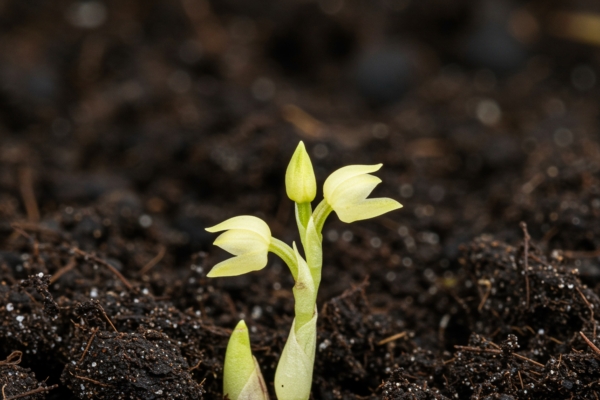
The Western underground orchid (Rhizanthella gardneri), also known as the “Western underground orchid,” is one of the world’s most mysterious and rare orchids, growing underground in Australia.
This underground orchid is one of the most unique plants globally, with its entire lifecycle, including flowering, taking place underground. The orchid is native to Western Australia, growing beneath the leaf litter and soil of broom honey-myrtle (Melaleuca uncinata) and Acacia shrublands.
Lacking chlorophyll, the underground orchid cannot photosynthesize to produce nutrients and instead relies entirely on a symbiotic relationship with fungi for survival. Initially, the orchid establishes connections with specific fungi, then through the fungal network, it links to the roots of the shrub Melaleuca uncinata, indirectly obtaining necessary nutrients, carbon sources, and energy from plant photosynthesis.
The flowering period of this orchid begins in late May and lasts until early June. Each plant can produce up to 100 small, inward-growing flowers, ranging in color from milky white to light pink, surrounded by 6 to 12 large bracts in milky white or pale pink shades.
These bracts, resembling tulip-shaped flower heads, curve upwards, enclosing the flowers and forming a small opening on the soil surface. Typically, a layer of leaf litter and bark debris covers the opening. The flowers are usually located 5 to 10 centimeters below the ground surface and can sometimes be faintly observed through the soil or debris.
Pollination and seed dispersal of the underground orchid occur underground. The flowers emit a strong, slightly musty odor attracting small insects in the soil, such as flies or white ants, which carry and spread pollen and seeds or facilitate local dispersal through soil disturbance by insects. The seeds of the underground orchid are extremely tiny, a typical characteristic of orchids.
The underground orchid was discovered in 1928 by Western Australian farmer Jack Trott near Corrigin. While digging near a shrub, Trott found something unusual in the soil: a cluster of plant-like small pink flowers completely buried, representing a rare and unique morphology.
Trott later brought the flowers to physician and botanist Richard Sanders Rogers, who identified it as a new species. In the same year, it was formally published in the Journal of the Royal Society of Western Australia and named by then Western Australian Assistant Government Botanist Charles Gardner, in commemoration.
The Western underground orchid is classified as “critically endangered.” Currently, only three known populations are protected within natural reserves located between Corrigin and Babakin, and in the northwest of Munglinup. Much of its habitat in the central and southern wheat belt of Western Australia has been cleared due to agricultural development or gradually disappearing due to drought impacts.
Kingsley Dixon, a professor of botany at the University of Western Australia and former director of Kings Park and Botanic Garden, has witnessed the underground orchid during a field survey in Babakin at the age of 24 in 1982.
He recalled, “We stopped for a cup of tea… I wandered into the shrubland, casually kicked the soil, and saw a few colored bracts peeking out. It was definitely a ‘Eureka!’ moment.”
Dixon mentioned that the species’ numbers fluctuate yearly, with recent sightings as low as three plants, or sometimes not seen at all. He stated, “In my lifetime, I have witnessed the journey of this species from being observed to gradually disappearing.” He is now working on artificial conservation methods to prevent the extinction of the underground orchid.
This article referenced reports from the website “Amusing Planet” and the British Broadcasting Corporation BBC.