
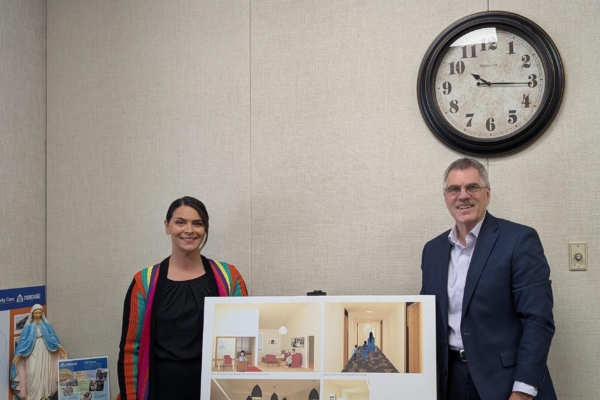
In October 2024, a public hearing at the Rosemead City Council in Southern California stirred up controversy within the Chinese community regarding the Los Angeles-based children’s charity organization, Maryvale. Rumors circulated on social media suggesting that the organization was planning to build a “400-unit homeless shelter,” leading to a protest by a large number of Asian residents at the scene.
This incident, after a nine-hour review and clarification by the city council, eventually ended with the project being approved. However, the conflict sparked by cultural barriers revealed deeper concerns within the Chinese community in the San Gabriel Valley: facing increasing life pressures and the adaptation difficulties of new immigrants, there exists an invisible wall between Chinese families and the abundant local charitable resources that is difficult to overcome.
“Seeking help is not a sign of weakness, but the deepest love of parents for their children,” said Steve Gunther, President and CEO of Maryvale, in an interview with Dajiyuan on Wednesday.
Gunther, without delving too much into the organization’s nearly 170-year history, focused on some key issues that Chinese families are reluctant to address but urgently need to confront: adolescent mental health, the crisis of adapting to new immigrant life, and the deeply rooted concept of “endurance” in the Chinese community.
“In addition to bearing heavy academic pressures, students nowadays are also influenced by multiple factors such as social media, self-expectations, and peer competition, leading to increasing levels of anxiety and depression,” Gunther said. He observed that the changing dynamics of modern society have pushed the mental stress of teenagers to unprecedented heights; however, many parents often mistake their children’s feelings of loss and anxiety as merely “lack of resilience” or “adolescent rebellion.”
Gunther noted that many families only seek external help when problems escalate into irrecoverable crises, such as self-harm or severe mental breakdowns. He emphasized that early intervention, providing professional counseling and emotional support, often can prevent more family tragedies and harm.
Apart from the psychological issues of children, the pressures of the adult world also gnaw at the stability of families. Gunther analyzed that high housing prices and living costs place a heavy economic burden on many families in Southern California. And for newly settled immigrant families in Southern California, this pressure is significantly magnified.
“For new immigrants, life challenges are multifaceted,” Gunther said. New immigrant families often face the triple dilemma of language barriers, unfamiliarity with the U.S. education and healthcare systems, and a lack of community support networks; in an unfamiliar environment, once they encounter adversity, they can easily fall into a situation of isolation with no support.
The expansion project of Seton House, which caused misunderstanding, was originally aimed at sheltering these helpless mothers on the verge of despair. Currently, Seton House accommodates nine single mothers and their children; Maryvale assists them in temporarily settling for six months to find employment and set goals for their next steps in life.
Gunther shared a poignant real-life case that has stuck with him: a mother who lost her home due to domestic violence arrived at the institution with her two young children. Through case management and long-term psychological counseling support, this mother gradually rebuilt her life and moved into her own two-bedroom apartment on New Year’s Day, officially ending her days of being displaced.
“What moved me the most was that two weeks after moving in, the two-year-old son of this mother told her for the first time, ‘Mom, we’re home,'” Gunther said with emotion. This statement remains a motivation for all staff members and proves that with proper support, newly immigrant families facing crises are fully capable of regaining their footing.
Since the resources are readily available, why do Chinese families often choose to suffer in silence behind closed doors?
“We honestly acknowledge that many Chinese and Asian families are influenced by traditional culture, tend to endure difficulties on their own when faced with challenges, are reluctant to seek external help, and may even fear being looked upon differently,” Gunther stated. He pointed out that there remains a certain stigmatization within Chinese society regarding “mental health” and “seeking assistance,” fearing airing dirty laundry in public or mistakenly believing that seeking help from government agencies may affect one’s status or lead to privacy breaches.
To address this, Gunther made clear and promised to the Chinese community: “Maryvale is a private charity organization, not a government entity, and all information provided by families will be kept under the strictest legal confidentiality.” He emphasized that seeking help will not leave a record of interfering with immigration status, and residents can feel completely at ease.
To break down this barrier, Maryvale has been actively improving its “cultural sensitivity” in recent years. This goes beyond providing translation in Mandarin, Cantonese, and Vietnamese; it involves a deep understanding. “Cultural sensitivity is not just about translating languages but understanding the values that different families hold dear, such as the importance Chinese families place on education, the dedication to family relationships, respect for elders, and protecting privacy,” he said. “Only by establishing on a foundation of respect, will families be willing to open up and accept assistance.”
For over a hundred years, Maryvale has upheld the principle of “First the heart, then the work” as its mission of caring for and serving families.
Colette Schultz, Maryvale’s marketing and communications officer, said, “We hope to actively engage with the community rather than wait for families to come to our offices.” The organization has established service points in Rosemead, Duarte, and South El Monte, aiming to reduce the barriers caused by inconvenient transportation through campus visits, home visits, and remote services.
If faced with services that the institution cannot directly provide, Maryvale will assist in referring to other suitable Asian community organizations.
Schultz expressed that Maryvale looks forward to deepening its cooperation with local Asian American and Pacific Islander (AAPI) community organizations and religious groups. She said, “If organizations serving these families wish to connect community residents with our services, our doors are always open.”
In conclusion, the Maryvale team, through Chinese-language media, sincerely appeals to all Chinese-speaking families who are struggling and silently bearing pressures in a foreign land: “No matter how long you have been in the United States, where you come from, what language you speak, you are a part of this community. Do not bear all the pressure alone; often, a simple conversation can change the future of a family.” ◇