
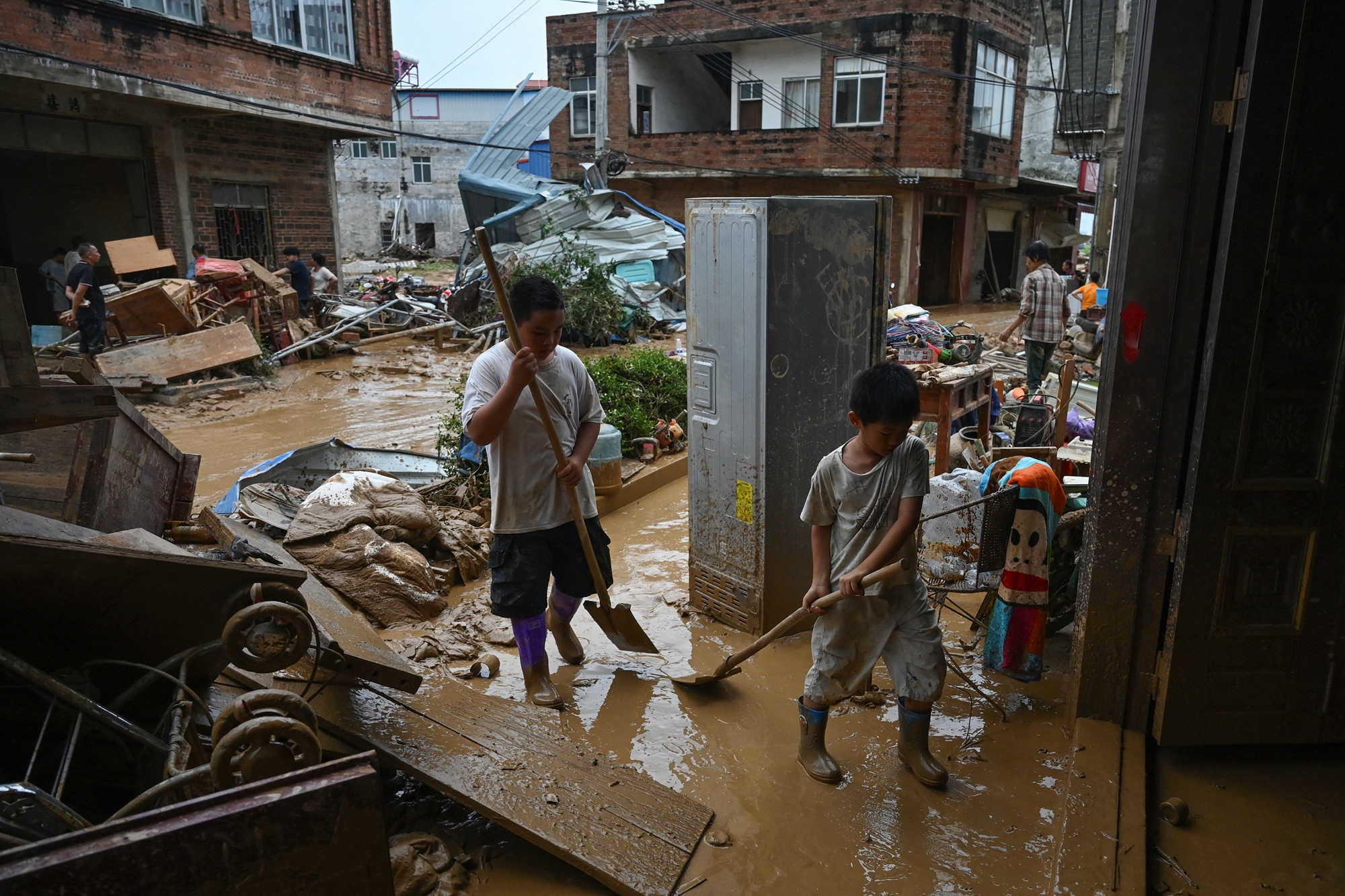
After the serious flooding caused by the dam breach at the Liu Lan Reservoir in Hengzhou City, Guangxi, a German water expert named Wang Weiluo believes that this disaster cannot simply be attributed to extreme weather conditions. Instead, he suggests that different types of disasters should be distinguished and responsibility should be examined from various aspects such as engineering design, flood season scheduling, risk warning, and more. He points out that from construction to operation management, and emergency response, there are serious problems exposed at every stage. Wang expressed that the flood disaster in Guangxi is a man-made disaster, regardless of which aspect it is viewed from.
Affected by Typhoon “Meisake,” from July 4th to 6th, Guangxi experienced continuous heavy rainfall in many areas including Nanning, Hengzhou, Guigang, Qinzhou, and Fangchenggang, with accumulated rainfall exceeding 600 millimeters in some places, leading to historical extreme rainfall events. 14 prefecture-level cities and 63 counties were affected in Guangxi, with around 375,000 people affected. Many people were trapped, facing water and power cuts, as well as communication interruptions.
The dam breach at the Liu Lan Reservoir in Hengzhou City on July 6th caused flooding, impacting severely affected villages downstream such as Liulan Village and Yunbiao Town.
Regarding the rare flood in Guangxi, Wang Weiluo stated in an interview with Epoch Times on July 15th that this flood cannot be solely blamed on the typhoon. He mentioned that it is related to changes in regional hydrological conditions after the Pinglu Canal was opened for navigation.
According to the emergency notice issued by the Liu Lan Reservoir service station in Hengzhou City titled “Emergency Notice on Advanced Flood Discharge Warning of the Liu Lan Reservoir in Hengzhou City (No. 2)”, it revealed an important message that “due to much greater rainfall than predicted, the water level of the Liu Lan Reservoir is rapidly rising.” This indicates that the meteorological department did conduct rainfall forecasting in advance, but it was based on past natural terrain conditions.
Wang pointed out that there used to be a natural watershed between the Qinzhou River basin and the Yujang River basin, providing some protection to the Yujang River basin, hence predicting relatively smaller rainfall amounts. However, after the opening of the Pinglu Canal on June 3, 2026, this watershed was destroyed. This allowed the moist warm air brought by Typhoon “Meisake” to enter the Yujang River basin more smoothly, leading to unexpected heavy rainfall on the southern slope, resulting in the situation mentioned in official notifications of “much greater rainfall than predicted.”
Public data shows that the Liu Lan Reservoir was built in 1958 and completed in 1960, being one of the early key water conservancy projects in Guangxi.
The reservoir had undergone multiple repairs: in 2009, a project for reinforcement and modernization with an estimated total investment of over 380 million yuan was initiated, and in 2023, the construction of modern equipment like hardened dam top roads and intelligent monitoring devices had been put into use.
In other words, this old dam that has been in operation for over sixty years had just completed a round of systematic repairs before the breach occurred.
Wang pointed out that Guangxi itself is one of the provinces with a higher number of reservoirs in China, with a concentration of large and medium-sized reservoirs. Simultaneously, many rivers in the region have been altered through human intervention, increasing the risk of floods.
He indicated that the flood damage caused by the Liu Lan Reservoir should be classified into two different types. The first type is the flooding caused by the reservoir’s flood discharge or eventual dam breach, causing disasters to downstream residents. The second type is before the dam breach, where the water level in the reservoir area continues to rise, leading to flooding affecting residents upstream of the dam and within the reservoir area.
He stressed the importance of distinguishing between these two types of disaster scenarios to investigate the responsibility properly.
Wang further questioned the design changes made after the implementation of reinforcement projects from 2009 to 2011 at the Liu Lan Reservoir.
He mentioned that the original normal spillway of the reservoir was an open practical weir with an inlet elevation of 108.10 meters, a width of 100 meters, and a maximum discharge capacity of 2240 cubic meters per second, equivalent to discharging 8.064 million cubic meters of floodwater per hour.
He highlighted that with a total storage capacity of 93.19 million cubic meters in the Liu Lan Reservoir, theoretically, “it would only take a little over 11 hours to completely discharge all the reservoir water.” However, after the reinforcement, the normal spillway was changed to a water-blocking gate-type spillway, reducing the design gate flow to 1469 cubic meters per second.
Wang mentioned that “from 2240 cubic meters per second to 1469 cubic meters per second, a reduction of about 35%, this is a fundamental error in change.” He explained that with the reduced discharge capacity, only about 5.288 million cubic meters of floodwater can be discharged per hour. During extreme rainfall, this would significantly diminish the reservoir’s ability for rapid water clearance. Also, Wang noted that important parameters like the inlet elevation after the reconstruction were not openly disclosed, preventing a comprehensive evaluation of the engineering safety. He raised concerns over the lack of many engineering technical data for the Liu Lan Reservoir dam project and the reasons behind it.
Wang believed that more critical than engineering design is whether the reservoir followed flood season scheduling legally. He mentioned that official data showed that flood discharge was initiated as early as 8:30 PM on July 5th, which was the earliest release notice he had seen. Yet, he emphasized that what’s worth investigating is whether the reservoir had lowered the water level to the regulation level before the flood season according to the Flood Control Law. Typically, the regulation level is much lower than the flood level design. However, currently available public data does not indicate whether the Liu Lan Reservoir had completed this regulation as required, which he deemed as crucial.
According to public data, the water level at the Liu Lan Reservoir reached 111.20 meters by 2 AM on July 6th, exceeding the flood design water level of 110.29 meters by approximately 0.91 meters.
He pointed out that in the original design, the inlet elevation of the normal spillway was 108.10 meters, which meant that once the water level surpassed 108.10 meters, there should have been conditions for flood discharge. However, the authorities only notified the advance flood discharge on the evening of July 5th, prompting the need for further clarification on the actual scheduling process.
Analyzing the location of the eventual dam breach, Wang stated that besides the normal spillway, the Liu Lan Reservoir had an emergency spillway designed as well. The emergency spillway employed a self-cohesive earth dam design, situated in a mountain depression on the east bank of the main dam. It was designed to be activated when encountering a flood above the once-in-a-thousand-year event, with the reservoir water level reaching 113.17 meters.
“It should be the location of the dam breach this time,” he mentioned.
Regarding concerns over the reservoir being contracted for fish farming, Wang clarified that it is not against regulations to assign the reservoir for individual aquaculture operations, and forbidding fishing by others falls within the scope of the contract agreement. However, he stressed that reservoir operation rights and flood control scheduling rights are two separate matters. Wang explained that many small and medium-sized reservoirs in China can be contracted to legal entities or individuals for operation, with maintenance, inspection responsibilities outlined in the contract. However, once the flood season begins, “the water level control of the reservoir returns to the local government.”
In conclusion, Wang believed that the issues exposed by the Guangxi flood event are not merely a single engineering accident.
He stressed that a comprehensive review should be conducted on engineering design, reservoir reinforcement projects, weather forecasts, reservoir scheduling, dam breach early warning mechanisms, accident emergency preparedness, and post-disaster rescue operations among various stages.
“This flood in Guangxi, regardless of which aspect you look at, is a man-made disaster,” he stated. If the engineering data, scheduling records, and accident investigation results are not completely disclosed in the future, it will be challenging for the public to truly understand the causes and responsibilities behind this significant disaster.