
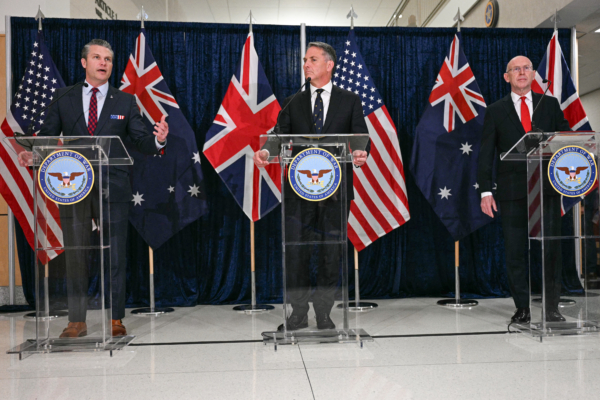
On Saturday (May 30th), US Secretary of Defense Pete Hegseth announced at the Shangri-La Dialogue in Singapore that as part of the AUKUS defense agreement between the US, UK, and Australia, the three countries are jointly developing unmanned underwater vehicles (UUV) with deliveries expected to commence in 2027.
AUKUS stated in a joint declaration that this project is the first landmark initiative under its “Pillar Two” proposal. “Pillar Two” focuses on pioneering advanced defense technologies, including quantum computing, underwater capabilities, hypersonic, artificial intelligence (AI), and network technologies.
Formed in 2021, the AUKUS alliance aims to collaborate on developing nuclear-powered submarines and sharing military expertise. The agreement is widely seen as a counterbalance to China’s growing maritime presence in the Indo-Pacific region and addressing escalating tensions in disputed territories like the South China Sea.
Hegseth stated, “This landmark project will provide a highly adaptable suite of multi-mission UUV payloads designed to support underwater operations and maintain our collective edge in the maritime domain.” The project will enhance the reconnaissance and strike capabilities of the three countries and reinforce their advantages in anti-submarine warfare, anti-surface vessel warfare, mine countermeasures, electronic warfare, and contested littoral maneuvering.
Although the total cost of the project has not been disclosed, UK Defense Minister John Healey announced that the UK will invest £150 million (approximately $201 million) towards this effort.
Emphasizing the joint production of cutting-edge sensors and weapon systems for underwater drones, Healey stated that it will “swiftly deliver advanced battlefield technology to our armed forces” and enhance the capabilities to counter threats to underwater cables and infrastructure. Addressing earlier criticisms of slow progress within AUKUS, Healey candidly stated, “We have talked far too much and delivered far too little in AUKUS’s past progress. But under the leadership of our three governments, that is changing now.”
Moreover, Hegseth noted that the deployment plan for nuclear-powered submarines under the “Pillar One” of AUKUS is “getting back on track,” with the first batch of US Navy personnel expected to arrive later this year. Australian Defense Minister Richard Marles confirmed that the navy base of the “HMAS Stirling” in Western Australia will be ready by the end of 2027, and construction of the submarine shipyard in South Australia is progressing rapidly.
During his keynote address at the Shangri-La Dialogue, Hegseth reiterated a “natural vigilance” towards China’s expanding military capabilities but stated that Washington aims for a “stable equilibrium” throughout Asia.
Hegseth said, “As we look around the region today, there is a natural vigilance towards China’s historic military expansion and growing military activities both within and beyond the region.” He emphasized that the US is not seeking unnecessary conflict but aiming to establish a lasting power balance where no party, including Beijing, can impose dominance or threaten the security and prosperity of allies.
For the second consecutive year, Beijing chose to send a delegation composed of academic experts and military analysts to the dialogue, rather than the Defense Minister attending. In contrast, Hegseth led a large US delegation, leveraging opportunities for open debates and confidential diplomatic talks, displaying a clear stance in diplomatic maneuvering.
The acceleration of unmanned underwater vehicle technology by the US, UK, and Australia is driven by the urgent need to counter increasingly severe threats posed by China and Russia to global underwater infrastructure. Healey specified that these defense efforts will bolster deterrence capabilities in the Pacific, Atlantic, and High North waters to protect the critical underwater cables and pipelines upon which daily life heavily relies.
Just a month ago, Healey accused Russia of clandestinely targeting cables and pipelines in the waters north of the UK, despite Moscow’s denial. In December of last year, the UK signed an agreement with Norway to patrol for Russian submarines in the North Atlantic. British officials revealed around 60 underwater cables connect in the UK, with a 30% increase in Russian vessels detected in UK waters in recent years, posing an escalating threat.
Meanwhile, maritime threats from China extend to underwater infrastructure as well. In other regions, Chinese ships have been suspected of damaging submarine cables in waters around Taiwan and encroaching on Swedish territorial waters. Furthermore, reports of cable damage in the Baltic Sea have been frequent. Faced with the coordinated underwater security challenges from China and Russia, the rapid deployment of AUKUS unmanned underwater vehicles undoubtedly becomes a crucial tool in countering China’s Indo-Pacific expansion and upholding global maritime security.