
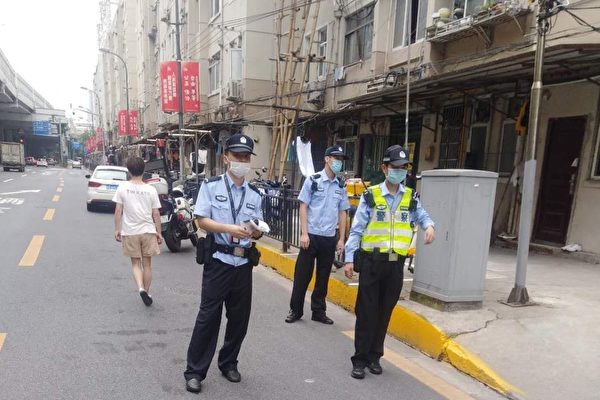
The Chinese Ministry of Justice recently announced a special operation to adjust and remove over 300,000 administrative law enforcement personnel who do not meet the qualifications within a year, and clean up over 7,000 non-compliant law enforcement entities. Many analysts point out that this move is not a genuine institutional optimization, but a passive contraction due to financial crisis, also a common practice for officials to shift and cut responsibilities under the pretense of “reorganization”.
According to reports from media outlets like the “New Beijing News”, on May 21st, the State Council Information Office of the Communist Party of China held a press conference where Deputy Minister of Justice Hu Wei revealed that authorities have adjusted and removed over 300,000 unqualified administrative law enforcement personnel and resolved over 400,000 unnecessary law enforcement matters.
Hu Wei mentioned that fines totaling over 11 billion yuan were waived across various regions. However, instances of law enforcement inaction, misconduct, excessive penalties, and lack of enforcement were still observed.
In an interview with The Epoch Times on May 24, Beijing scholar Yang Ming (pseudonym) stated that the so-called “removal of unqualified personnel” by the authorities is not truly an institutional optimization but a result of financial pressures.
Yang believed that with the ongoing economic downturn in China, closures of foreign and private enterprises leading to worsened employment prospects, and increasing financial strain at local levels, revenue issues and expenses for civil servants have become problematic.
He noted that many local governments are facing financial difficulties, where some non-core department employees are receiving reduced salaries or delayed wages from months ago.
Yang indicated that authorities are aware of the escalating financial pressures in the future and are beginning to reduce personnel as a result.
Rights lawyer Wu Shaoping of the Overseas Human Rights Lawyers Alliance stated to The Epoch Times that the “300,000 people” being removed by authorities are not formal civil servants but contract workers, labor dispatch personnel, auxiliary police, temporary law enforcement officers, and various “comprehensive law enforcement” personnel who have long been active in grassroots law enforcement systems.
He pointed out that the Chinese Communist Party has long used personnel without formal positions to carry out law enforcement tasks, allowing individuals without statutory enforcement powers to execute official duties, reflecting a unique governance logic.
Wu mentioned that in the past, there has been a frequent public outcry in Chinese society industry citing “temporary workers carrying the blame”, which showcases the operational method of the system.
Legal rights lawyer Chen Weimin (pseudonym) from mainland China added that the actual operating state of grassroots governance systems has long been a situation where “temporary workers do the work while formal employees are idle.” These individuals have low income while undertaking work that is “erratic, tiring, and dirty.”
He expressed to The Epoch Times that the authorities’ actions are not aimed at easing the burden on the people, but are due to their difficulties in resource acquisition, hence sacrificing these temporary workers first.
He argued that despite the appearance of a vast economic size, the “systemic and fundamental structural problems” within the Communist Party are unresolved, leading to a continuous escalation of financial pressures. As resource acquisition becomes more challenging, the underprivileged individuals at the bottom of the system are the first to be sacrificed.
The deep-rooted background of the massive removal by authorities relates to the continuous deterioration of local finances in China. As early as the second year since the start of the China-US trade war in 2019, the Communist authorities have issued multiple notices requiring all levels of the government to “tighten their belts” and prepare for “hard times”.
After the end of the three-year epidemic control, the then Minister of Finance of the Chinese Communist Party, Liu Kun, emphasized in March 2023, that “the government living frugally is not a short-term measure but a long-term policy to be upheld.” In 2024, several provinces and cities established “scrap and sell iron” task forces, with some proposing methods to raise funds through “scrap and sell iron” to overcome financial difficulties.
Simultaneously, the financial situation of local governments continued to deteriorate. According to data from the Ministry of Finance of the Chinese Communist Party, as of the end of January 2026, the remaining debt balance of local governments nationwide was 55.58 trillion yuan.
Researcher Houze Song from the think tank MacroPolo, responsible for studying the Chinese economy, estimated that the debt held by local government financing platforms already exceeded 70% of GDP.
The financial deterioration of local Communist authorities rapidly spread across various sectors. Starting from 2023, various provinces like Hainan, Hubei, Anhui, and Heilongjiang began mass layoffs of off-book personnel in government institutions. Moreover, there was a wave of salary cuts observed among healthcare personnel in public hospitals across different regions.
In addition to the aforementioned removal of 300,000 off-book law enforcement personnel as mentioned by the authorities, they also targeted “cleaning up over 7,000 non-compliant administrative law enforcement entities”.
In response to this, Wu Shaoping believed that this implies the existence of long-term “illegally established institutions” in many regions. He mentioned that some regions have independently set up a large number of complexly titled law enforcement institutions, including agricultural law enforcement brigades, inspection brigades, among others.
“Many of these institutions are not legally allowed to exist,” he said, “but local governments still dare to do so, and this is actually tacitly permitted from higher authorities.”
Moreover, he argued that some of these so-called “law enforcement entities” are actually outsourcing companies. “They don’t actually have the legal status of administrative bodies, but because they take on law enforcement tasks, they go out under the guise of law enforcement to issue fines,” he said.
According to previous reports from mainland Chinese media, in recent years, provinces like Shandong, Zhejiang, Jiangsu, Guangxi, and Hunan have revoked a large number of grassroots deliberative coordination bodies. For instance, Tongyu County, which was once one of the deeply impoverished counties in Jilin Province, revoked over 900 deliberative coordination bodies in 2024.
In light of the authorities’ high-profile promotion of the effectiveness of “standardized law enforcement”, experts generally hold skeptical views.
Wu Shaoping believed that the two core objectives of the authorities’ actions this time are, “First, to pass the buck.” By dismantling a large number of off-book personnel, they reduce the financial burden.
“Second, to shift blame,” he said, “There is too much public resentment, so now they’re telling the people: it’s not a central issue, it’s these temporary personnel who conduct law enforcement chaotically.” This approach fundamentally remains about shifting and cutting responsibilities.
Yang Ming cited decades of history in “institutional reform” to argue, “After all these years, in practice, the more they cut people, the larger the organizations get. So don’t believe in nonsense about layoffs.”
He particularly noted that within the system, “connections” still determine everything. “Those with connections won’t get laid off”, a fact even the ordinary people see very clearly.
Yang pointed out that while some administrative departments may reduce staff numbers, powerful departments and stability maintenance authorities will not only not diminish but will continue to expand.
Furthermore, he mentioned that some social idle personnel may also be incorporated into the stability maintenance system: “Some local governments recruit hooligans as thugs to carry out certain nefarious activities that the government cannot openly perform.”
Yang believed this is closely linked to authorities’ concerns about rising social risks. “As long as the nature of this regime remains unchanged, it will inevitably be in conflict with the people, it will loot the people, and these contradictions will inevitably erupt.”
Chen Weimin analyzed that the deep-rooted logic of the Communist Party determined the limitations of these cleanup actions.
He further pointed out the longstanding practice of the Communist Party promoting the “low-human rights economic mode” and the development approach of “benefiting at the expense of neighbors”, which is built upon constant exploitation at the grassroots level and the continuous expansion of power. Today, the severe consequences of these modes have become increasingly apparent.
Regarding the large number of grassroots off-book personnel being dismissed, Chen stated that while these individuals who were part of the stability maintenance system were “not entirely innocent”, the rapid abandonment of these individuals now reflects once again the characteristics of this system’s operation.
“The Communist Party always directs its blade towards the people at the bottom of the pyramid or the end of the food chain,” he said, stressing that the authorities will never touch the vast power and interest structures, but the easiest to sacrifice are the grassroots personnel and ordinary citizens.