
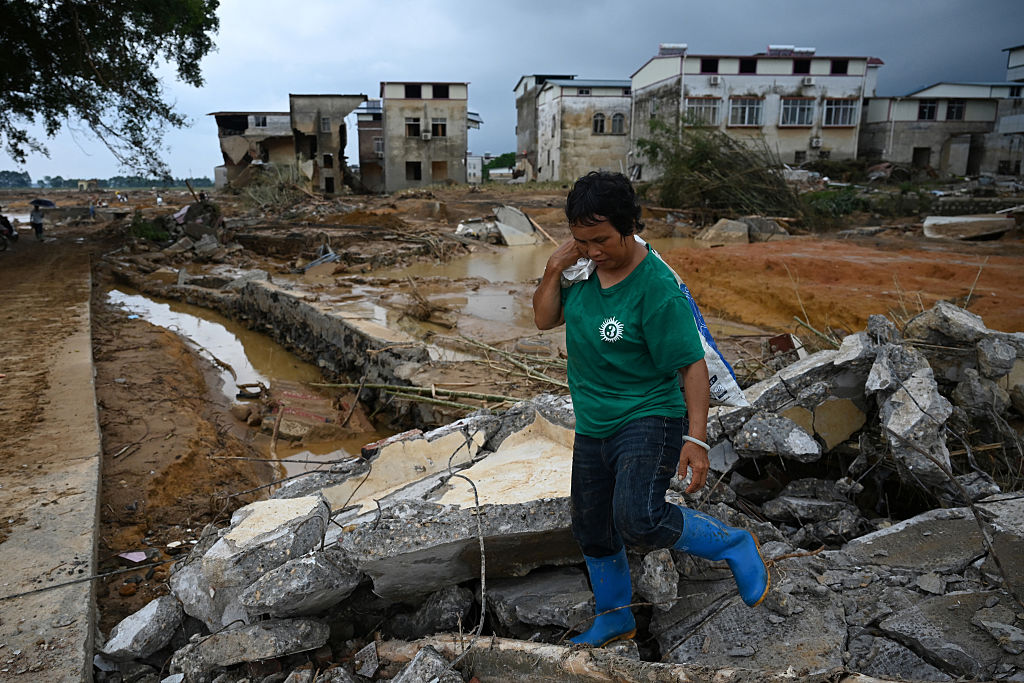
Recently, Guangxi has experienced rare flooding, causing heavy losses to the people. In addition to blocking information about the disaster, the progress of rescue work has also been heavily questioned. Civilian rescuers who have been deep in the disaster area for several days describe the scenes they have witnessed, depicting the area as a scene of devastation akin to “the end of the world.”
Volunteer Zhang Jian (alias), who drove an off-road vehicle to Yunbiao Town and Zhenlong Township to participate in civilian rescue efforts, spoke to Epoch Times on July 15 about what he has seen and heard during his consecutive days in the disaster area.
He stated that the extent of damage in the disaster area far exceeds what the outside world imagines, with scenes that are shocking. “I’ve been to many villages, scenes like the end of the world, scenes like the end of the earth.”
He mentioned that carcasses of livestock were seen everywhere along the way. “It’s spine-chilling to see, with big cows, pigs on the road, dead there.”
Zhang Jian visited many villages affected by the disaster, stating that many villages were submerged by floods up to three to five meters high. Some villages with higher terrain had slightly better conditions, but “80 to 90 percent are unbearable to witness, with only about two out of ten villages looking relatively okay.”
Zhenlong Township suffered from flash floods and severe landslides, which he believed to be the most difficult area for rescue. He said, “The flood in the mountain ditches is seven to eight meters high, rushing down continuously, roads washed out, everything washed away.” Nearly all roads were damaged, with riverbeds filled with fallen trees, making transportation of supplies extremely difficult.
He expressed that civilian rescue forces were not effectively integrated in a timely manner, in addition to issues with supply distribution and road management, reducing the efficiency of the rescue operation.
As a member of the off-road vehicle rescue team, Zhang Jian believed that the way roads were repaired directly impacted the efficiency of supply transportation. Off-road vehicles only require “a road width of two and a half to three meters” to pass, but many roads are closed for four hours each time they are repaired.
“Recommend offering ten-minute passage for every hour of repair, let other vehicles pass. Deliver supplies in the morning and start road repairs after 2 p.m. in the afternoon.” He suggested that currently, supply vehicles are often stuck on the road.
“The supplies are not unable to be delivered, but when stuck on the road for two kilometers, three kilometers, stuck for three hours, four hours, unable to get through.” He recommended maximizing the advantages of off-road vehicles, drones, motorcycles, and outdoor teams, to establish a segmented transportation mechanism.
Zhang Jian also mentioned that in this rescue operation, civilian outdoor teams played a crucial role. “This time, outdoor enthusiasts played a significant role. In many areas where vehicles could not go, they often carried a lot of supplies, climbed difficult mountains, and delivered goods.”
He believed that official rescue thinking was relatively narrow, not fully utilizing social resources. A long-term cooperation mechanism should be established with civilian outdoor teams.
“Many government officials do not know how to use off-road vehicles, motorcycles, or outdoor enthusiasts; they have their own perceptions and are very stubborn, so efficiency has not been maximized.” He repeatedly emphasized, “We need outdoor enthusiasts, motorcycle teams, off-road vehicle teams, drone teams to work together in coordination to deliver supplies to villagers quickly and safely.”
Zhang Jian believed that there is still room for improvement in the supply distribution mechanism. He suggested that after each batch of supplies is delivered to villages, a clear registration system should be established.
“After supplies are delivered, there should be a list, with someone signing off. You can’t favor one village over another because you’re familiar with them and send multiple trucks, while neglecting another village where you’re not as familiar, and they don’t receive supplies for five or six days.”
He admitted that he organized seventy to eighty off-road vehicles to continuously participate in transportation, but many vehicles remained in a waiting state for a long time. “The most difficult part is that supplies are not being delivered, the government is not distributing them. Many off-road vehicles are waiting there but do not receive supplies (to deliver).”
He mentioned that disaster victims who came to collect supplies were also asked to leave.
Zhang Jian also pointed out that many civilian volunteers bore a significant amount of expenses. Although the authorities had announced that some costs could be reduced, the actual implementation was not smooth.
“They say the toll roads are free, refueling is free, but many times you need organization proof, for individual volunteers without organization, it’s very difficult.” He said, “Volunteers pay for their own fuel, given a subsidy of twenty to thirty yuan a day, not many days.”
Many volunteers ended up going on fruitless trips. “They deliver the goods but can’t find anyone, phones are unreachable, some people wait where there is signal, waiting for a day and night, sleeping on the ground.”
He mentioned that many civilians just completed one round of supply delivery and left, with few insisting on long-term transportation. Therefore, he continued to coordinate resources, hoping that “not only do I have supplies to deliver, but also more off-road vehicles have supplies to deliver.”
Apart from food, Zhang Jian believed that the issue of drinking water was severely underestimated in this disaster relief operation. He said that the water supply systems in many villages were completely destroyed. “Ninety-five percent of the villages have no water. Water pipes, water towers, and power equipment are all broken.”
He mentioned that people were forced to use contaminated river water, “The river has had dead pigs, lots of bacteria; if you let villagers bathe and wash clothes with this water, isn’t that harming the people?”
He noticed that many villagers’ most important daily task was to line up far away to get water. “They sit in the mud, chat, recall painful memories, with no water. I found two or three places with water, they have long queues, bringing back water from a distant place, which becomes the most exhausting task for them every day.”