
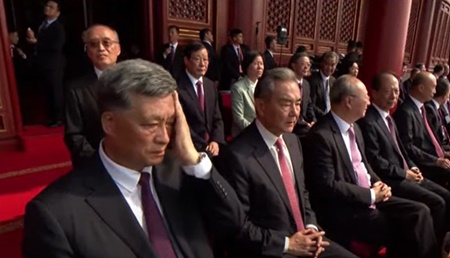
On July 14th, the member of the Central Political Bureau of the Chinese Communist Party (CCP), Ma Xingrui, was expelled from the party and dismissed from public office, and was sent for prosecution. The official report emphasized corruption without mentioning political charges such as “forming cliques” or “inflating political ambitions.” Analysts believe that the Ma Xingrui case has political factors involved. The current authorities are downplaying the issue due to its widespread implications, fearing that taking strong action could cause high-level political turmoil and collective panic.
In the official announcement on July 14th, Ma Xingrui was accused of four crimes, including engaging in power-for-sex transactions, widespread family corruption, illegal acceptance of significant amounts of money, with the statement condemning his actions as “extremely serious in nature, with extremely negative consequences.”
Observers noted that unlike other cases involving high-ranking officials, Ma Xingrui’s case did not include common charges such as “forming cliques,” “inflating political ambitions,” “disloyalty and dishonesty to the party,” or “undermining party unity.” The focus was on corruption, particularly family corruption.
Independent commentator Cai Shenkun told a publication that the official report largely avoided addressing political issues, despite numerous rumors surrounding them. He suggested that at this level, simple cases of family or staff corruption would not typically be investigated within the CCP, as nearly all officials in such positions tend to engage in corrupt practices.
“Ma Xingrui’s main problem is not about loyalty to Xi Jinping, but about his actions potentially raising alarms for Xi Jinping,” Cai Shenkun stated.
Cai Shenkun further explained that the underlying political connections of Ma Xingrui might have been through his wife, Rong Li, who allegedly provided high-value overseas insurance to several Central Committee members, including family members of Politburo Standing Committee members and political bureau members, establishing a political alliance that posed a direct threat to Xi Jinping.
Regarding Ma Xingrui’s “family corruption,” Hong Kong’s “Ming Pao” newspaper revealed in early April that his wife Rong Li and younger brother Ma Xingquan were primarily involved in such activities.
Ma Xingrui, who hails from a mining family in Shuangyashan, Heilongjiang, a small town near the Russian border, has had frequent interactions with Guangdong companies. Several Guangdong enterprises have donated millions and sought cooperation in Shuangyashan. Ma Xingquan, also known as “Lao Wu,” is a member of the standing committee of the Shuangyashan People’s Congress and chairman of Beijing Zhan Yingxingye Information Technology Co., Ltd.
Reports suggest that Ma Xingrui and his wife, Rong Li, met in the same class at the Fuxin Mining College and got married while he was pursuing his postgraduate studies. Their daughter had already obtained a Ph.D. from a prestigious university at that time.
There were speculations that the Ma Xingrui family helped launder money for the Xi family or facilitated illicit financial activities. Analysts indicated that the official report was careful to avoid linking Ma Xingrui directly to Xi Jinping or Peng Liyuan.
Apart from family members, several of Ma Xingrui’s secretaries also faced consequences. Gao Shiwen, who followed him in the China Aerospace Science and Technology Group, was dismissed from his position as Mayor of Nanchang City in Jiangxi. Additionally, Guo Yonghang, former Secretary of the Guangzhou Municipal Party Committee, fell from grace at the Guangdong Political Consultative Conference. Guo, who once served as Secretary-General of the Shenzhen Municipal Committee, was crucial in Ma Xingrui’s governance of Shenzhen.
Ma Xingrui’s charges include serious breaches of discipline and law and complicity in and overlooking malfeasance and crime involving his personal staff. Many believe this refers to his longtime secretary, Li Guanglu (or Lu). Reports indicate that Li Guanglu, a former public security officer in Guangdong and Xinjiang, had served as his “personal secretary” for an extended period and was known for his audacity. It was rumored that he was detained the day after Ma Xingrui was transferred from Xinjiang.
Born in October 1959 in Shandong, Ma Xingrui has a deep background in military industry and aerospace systems. He held various positions, including General Manager of the China Aerospace Science and Technology Corporation, Vice Minister of the Ministry of Industry and Information Technology, and Director of the China National Space Administration. In November 2013, Ma Xingrui moved to Guangdong and held positions such as Deputy Secretary of the Guangdong Provincial Party Committee, Secretary of the Political and Legal Affairs Committee, Secretary of the Shenzhen Municipal Party Committee, and Governor of Guangdong Province. In December 2021, he was appointed Party Secretary of Xinjiang and later promoted as a member of the Central Political Bureau at the Nineteenth National Congress of the CCP.
Ma Xingrui went missing at the end of November last year and was officially announced to have fallen from grace in April this year.
The latest official report did not explicitly link Ma Xingrui to his past involvement with the military industry complex or the aerospace group. Analysts suggest that the official report aims to portray the Ma Xingrui case as solely a family syndicate crime, although investigating such familial issues inevitably leads to geopolitical considerations.
Of note is that Ma Xingrui has held positions in various regions, and the Xinjiang Production and Construction Corps (XPCC) was the first to express support for the central authorities in handling the Ma Xingrui case. According to the CCP’s “XPCC Daily” announcement, the Standing Committee of the XPCC Party Committee held a meeting on July 14th, declaring resolute support for the central government’s decision regarding Ma Xingrui.
Analyst Shen Mingshi told a publication that if Ma Xingrui’s issues had occurred during his tenure in Xinjiang, they might be connected to the arrests of certain officials in Xinjiang.