
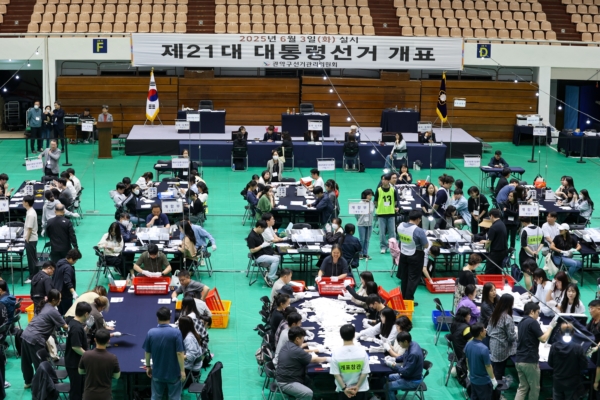
Local time on Wednesday, June 3, South Korea held local elections for mayors and regional administrative chiefs in various areas. Exit polls indicated that the ruling party in South Korea, the Democratic Party, is expected to achieve a decisive victory. The nationwide election is seen as an important test of President Lee Jae Myung’s one-year performance.
According to exit polls conducted by Korean Broadcasting System (KBS), Munhwa Broadcasting Corporation (MBC), and Seoul Broadcasting System (SBS), the Democratic Party is expected to win at least 11 out of 16 mayor and provincial governor positions in first-tier administrative regions. The opposition People Power Party is only clearly leading in one election, with fierce competition in other regions.
Exit polls released by the television network JTBC also indicate that the Democratic Party is maintaining a lead in major cities like Seoul, Busan, and Incheon. The main opposition party, the conservative People Power Party, is only dominating in North Gyeongsang Province.
Preliminary vote counts show that the Democratic Party is leading in 14 areas, while the People Power Party is ahead in 2 areas (North Gyeongsang Province Governor and South Gyeongsang Province Governor).
The Seoul mayoral election is considered one of the most anticipated focuses of this election. Exit polls and preliminary results indicate that the Democratic Party candidate Chong Won-o is leading over the incumbent mayor from the People Power Party, Oh Se-hoon.
Another highly watched district is Daegu. This city has long been seen as an important conservative stronghold in South Korea, but the Democratic Party candidate briefly led in the polls. Analysts point out that if the Democratic Party wins in Daegu, it will deal a significant blow to the People Power Party.
Late Wednesday night, some polling stations in Seoul experienced a shortage of ballots. The South Korean Election Commission stated that voting at 14 polling stations in Seoul was temporarily halted due to a shortage of ballots but later allowed queued voters to continue casting their votes after the deadline.
People Power Party leader Jang Dong-hyeok called for a suspension of vote counting and an investigation into the issue, but the Democratic Party refused the requests while expressing regret over the election management error.
Currently, the People Power Party is still deeply affected by the controversy involving former President Yoon Suk Yeol. Yoon sparked a huge controversy at the end of 2024 by briefly declaring martial law, leading to his impeachment, removal from office, and a life sentence, causing continued divisions and infighting within the conservative camp.
According to a report from Nikkei Chinese website, Jeong Han-Wool, director of the Korean People Research Institute, stated that the Yoon Suk Yeol incident severely weakened the conservative base, while the support for the liberal camp continues to expand. He pointed out that a victory for the Democratic Party in this local election would help solidify President Lee Jae Myung’s government.
Lee Jae Myung was elected in a presidential by-election in June 2025 and currently maintains a support rate of over 60%. The South Korean presidential office has recently been promoting the economic achievements of President Lee Jae Myung’s government, including the stock market’s rise, record-breaking exports, and economic recovery and growth.
However, the People Power Party criticizes President Lee Jae Myung’s government for pushing legislation that attempts to help the president and related individuals avoid legal responsibility regarding past scandals. Additionally, the People Power Party blames the recent labor disputes at major tech companies like Samsung Electronics and Kakao on President Lee Jae Myung’s labor policies.
Political commentator Kim Joon-il stated that the conservative camp’s “extremist tendencies” during Yoon Suk Yeol’s presidency have led to a growing disconnect with mainstream voters.
He mentioned that the biggest challenge facing the People Power Party now is not just the defeat in this local election but how they will reorganize and regain political influence in the future.