
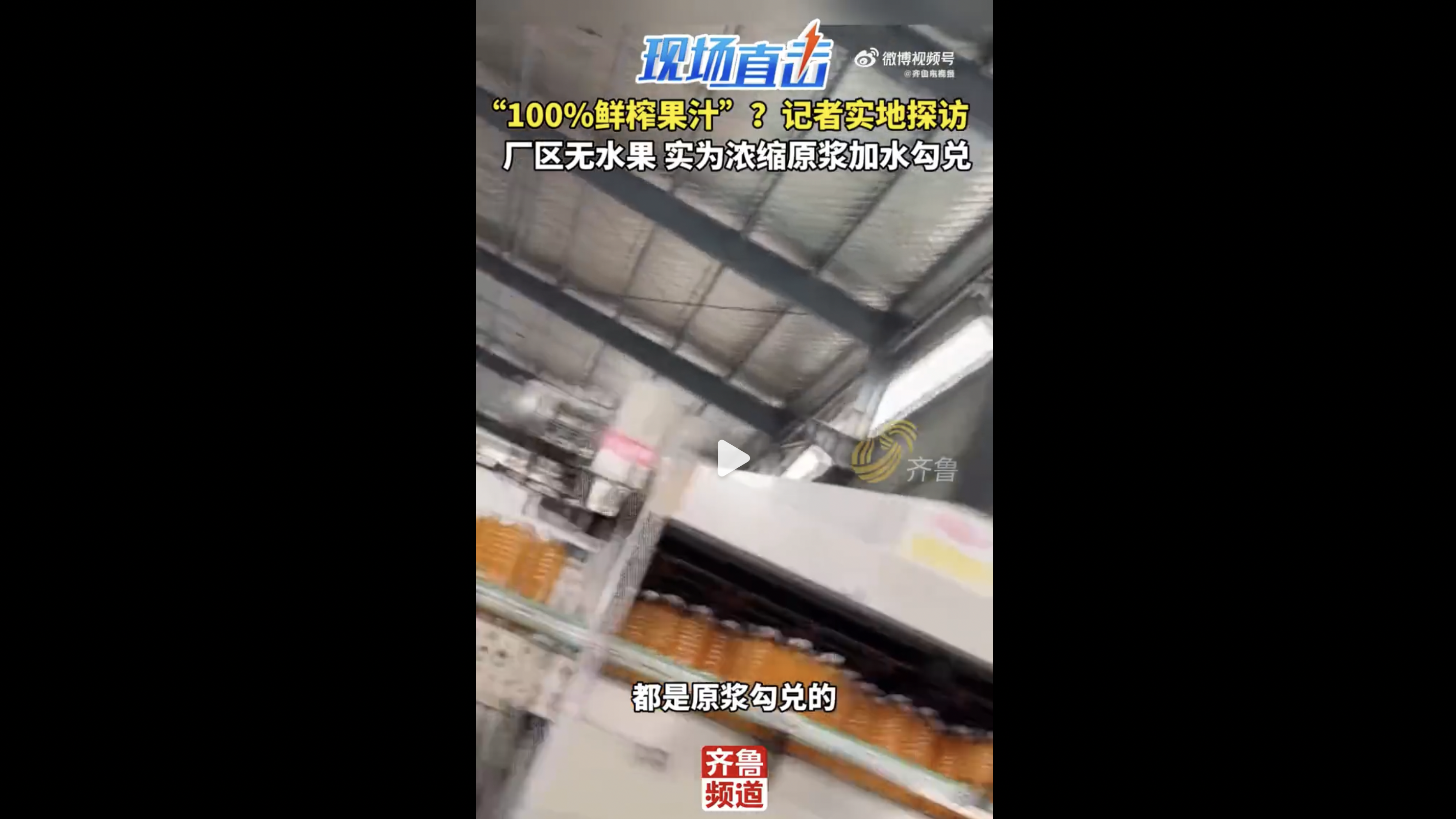
In recent years, NFC fruit juice has been favored by consumers in mainland China. However, recently, several NFC fruit juice processing factories in Henan have been exposed for not having actual fruit in the workshop and some manufacturers are misusing the “NFC” label.
NFC, which stands for Not From Concentrate, promotes freshly squeezed fruit juice that is not concentrated or reconstituted, hence it has been regarded as a higher quality fruit juice product.
Many products such as pineapple juice, watermelon juice, mangosteen juice, labeled with “freshly squeezed,” “100% fruit juice,” “NFC fruit juice” have seen high single-product sales on major e-commerce platforms in China, yet their prices are unbelievably low.
A report by Qilu TV revealed that during a recent undercover investigation of several NFC fruit juice processing factories in Henan (including some popular brands sold online), it was found that there were no actual fruits or fresh squeezing equipment in the workshop. The so-called “freshly squeezed fruit juice” was made entirely by mixing water and concentrated pulp.
The manufacturers claimed that “low prices are not possible for freshly squeezed fruit juice,” often resorting to swapping the order of labeling featuring “100%” and “NFC” on the packaging. Currently, related products are still being sold online, with some bottle labels not being updated.
The incident quickly became a hot topic on Weibo, sparking widespread public concern and discussion.
Many netizens expressed disbelief, questioning how fruit juice can be made without any actual fruits in the production workshop. Some remarked that the so-called NFC fruit juice is just a mixture of water and concentrated fruit juice.
There were also expressions of disappointment, with comments like, “So, all these years of consuming these beverages were just artificial sweeteners diluted in water!” and “Good fruits are not being juiced, good meat is not being filled.”
Some netizens pointed fingers at the Chinese government’s regulatory authorities, criticizing the lack of oversight. They commented, “Is the Chinese food regulatory bureau just a place for retirement?” “Regulation is virtually non-existent.” “It’s all about deceiving consumers with false and inferior products, which ultimately undermines consumer confidence.”
In fact, the chaos surrounding NFC fruit juice labeling has been exposed multiple times before.
Previously, several fruit juice products sold online and offline, claiming to be “100% NFC”, were found to have water and concentrated fruit juice as the top two ingredients on the ingredient list.
An opinion piece in the Xinjing News stated that false advertising and deceptive practices in the NFC fruit juice market are not isolated incidents but are becoming more common, indicating a systemic issue.
Not long ago, a well-known brand’s grape mixed fruit juice labeled with added NFC fruit juice was found to contain only 0.005% in the ingredient list, meaning that in a 125ml product, the NFC content might be less than a drop of water.
Additionally, many products are labeled with prominent signs like “NFC+”. Experts have explained that such a designation doesn’t exist in the fruit juice classification and is purely a marketing gimmick.
In January 2026, Guangzhou Huayang entrusted a Henan factory to produce multiple 100% fruit juice products mixed with water, failing to meet regulatory standards. The labeling included false information, leading to a fine of 133,800 yuan by the Fanyu District Market Supervision Administration in Guangzhou.
On November 23, 2021, Henan’s official website issued a notice regarding 38 batches of unqualified food products. One batch of Huiduozhi 100% NFC mango juice produced by Henan Huiduozhi Beverage Co., Ltd. was found to have detected values of 0.200g/kg for sorbic acid and its potassium salt (calculated as sorbic acid) and 0.042g/kg for acesulfame, which should not have been detected based on relevant regulations.
From several recent cases, it can be seen that in the pursuit of low cost by brand owners and catering to order demands by processing factories, some products touted as “100%,” “freshly squeezed,” “NFC” have ultimately become ordinary beverages packaged with conceptual marketing, making consumers the biggest victims of this deception.