
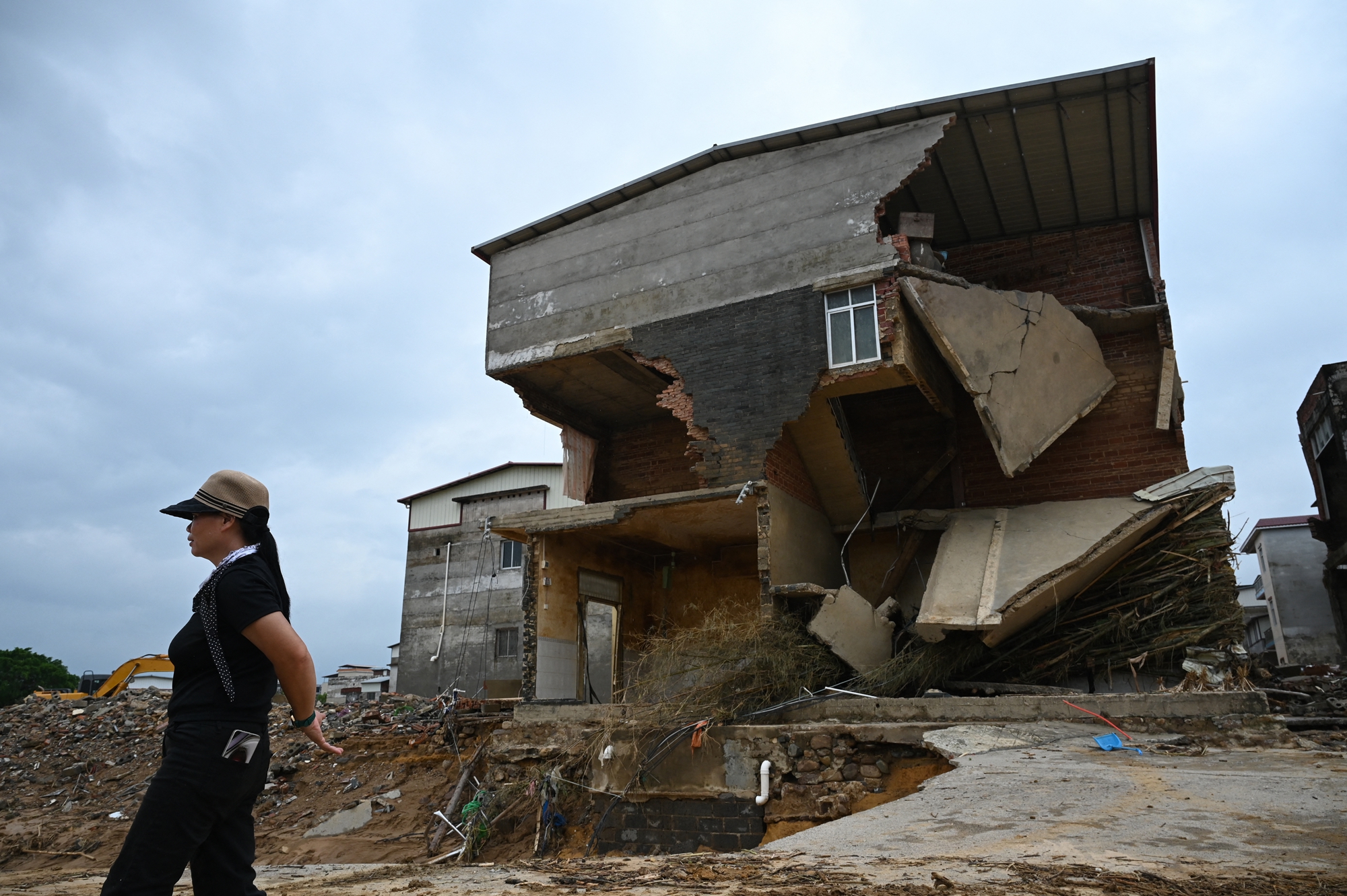
Typhoon “Maisak” caused severe damage in Guangxi, with multiple reservoirs collapsing in Hengzhou City resulting in significant casualties. Villagers revealed hidden details behind the reservoir breach, attributing the disaster to a delay in releasing floodwaters caused by a fish farm.
Affected by Typhoon “Maisak” from July 4th to 6th, Guangxi experienced continuous heavy rainfall, with several areas recording historically extreme rainfall, affecting 375,000 people. On July 6th, the collapse of the Liulan Reservoir in Hengzhou City led to flooding downstream, severely impacting villages such as Liulan and Yunbiao.
Regarding the reservoir breach, villager Yang Jiancheng (pseudonym) from Yunbiao Town told reporters on July 15th that it was not simply a natural disaster, stating “this is a man-made tragedy, I am not spreading rumors.”
According to Yang, on the evening of July 5th at 8 pm, the reservoir was instructed to open floodgates for water release, but due to the reservoir being contracted for fish farming, “the fish farmers insisted on pulling the nets before opening,” and operations did not start until 8 am on the 6th.
Recalling the events, Yang Jiancheng mentioned that the reservoir failed to release water in time, leading to the tragedy. “In the end, the gate was not opened, the net rope broke, and the breach occurred around 9 o’clock. The village committee notified us villagers, and within half an hour, the water reached the second floor of my house.”
Liulan Village resident Chen Jiawei (pseudonym) also shared his experience, highlighting that it was a man-made disaster. “The gate was pulled up and broke, then washed back down. If water had been released earlier on the 5th, maybe our reservoir wouldn’t have overflowed.”
Chen Jiawei further described the current situation of the dam: “The Liulan Reservoir is now dried up, and the gate is stuck, with a large breach beside it. Once the dam overflows, it will surely break.”
Attempts to contact the company responsible for fish farming at the reservoir were unsuccessful when Epoch Times reporters called for verification.
Recounting the flood’s impact, Chen Jiawei recalled the swift flooding on the morning of July 6th. “The dam had breached, and the water flowed down rapidly. Most of us ran uphill to seek shelter.”
Liulan Village lies less than a kilometer from the Liulan Reservoir. Chen mentioned that the flood caught them off guard while asleep. “The phone woke me, and I saw everyone had disappeared. I immediately woke my sister and ran uphill with her.”
At that moment, there was no time to gather belongings. “We just ran without taking anything; what could we take at that point? We ran uphill, and the flood followed us directly.”
“Over a thousand people ran to the hills. Some villagers below probably couldn’t make it in time,” he added.
Due to the higher terrain of Liulan Village, the flood receded quickly on that day, but low-lying areas suffered severe losses.
Upon returning to his village, Chen Jiawei was shocked by the chaos left behind by the flood. “Everything was a mess, windows and doors shattered, with debris swept in by the flood. The first floor was completely submerged, and almost all furniture was damaged beyond repair.”
“Some houses were completely washed away, some only had a toilet left, and others were reduced to foundations,” he explained.
“Now, many villagers are too scared to return home. With the foundations loosened, who would dare to live there?”
Currently, many affected residents have sought temporary shelter in schools, or with relatives. Chen Jiawei mentioned, “After the water receded that day, we went to my grandmother’s place as our home was no longer habitable.”
As per official reports until July 9th, Guangxi has recorded 39 deaths and 9 missing persons due to the floods (26 dead and 7 missing from the Liulan Reservoir collapse), with no updated figures. However, local villagers claimed that the death toll was at least in the four digits, with entire villages being wiped out.
Expressing concern over the lack of complete data, Chen Jiawei believes the actual situation is very grave. He highlighted that villages closest to the reservoir had almost no time to escape. “People below the embankment had no chance to run. The flood came down in an instant; how could the elderly run? The force of the water was immense, bending iron and uprooting fifteen-meter tall banyan trees.”
He disclosed, “Dutian Village downstream was essentially flattened.”
Furthermore, there are still areas upstream that remain cut off from communication. “Some villages are unreachable, with residents unable to leave,” he added.
For ordinary rural families, this flood signifies the loss of their hard-earned savings in an instant.
Chen Jiawei lamented, “We labored our whole lives just to build this house, and now there’s nothing left, only the foundation. It’s truly heartbreaking.”
“My father spent around two to three hundred thousand yuan building the house, and that’s excluding the interior decorations. It took three to four years to build,” he continued, reflecting on the family’s collective effort. “It’s not easy to build a house; some people even borrowed money to construct their homes.”
Facing the devastation of their homes, Chen hopes for donations from society to genuinely help the disaster victims. “We hope every contribution can help us rebuild our homes, rather than being embezzled by officials or not reaching us in the end.”