
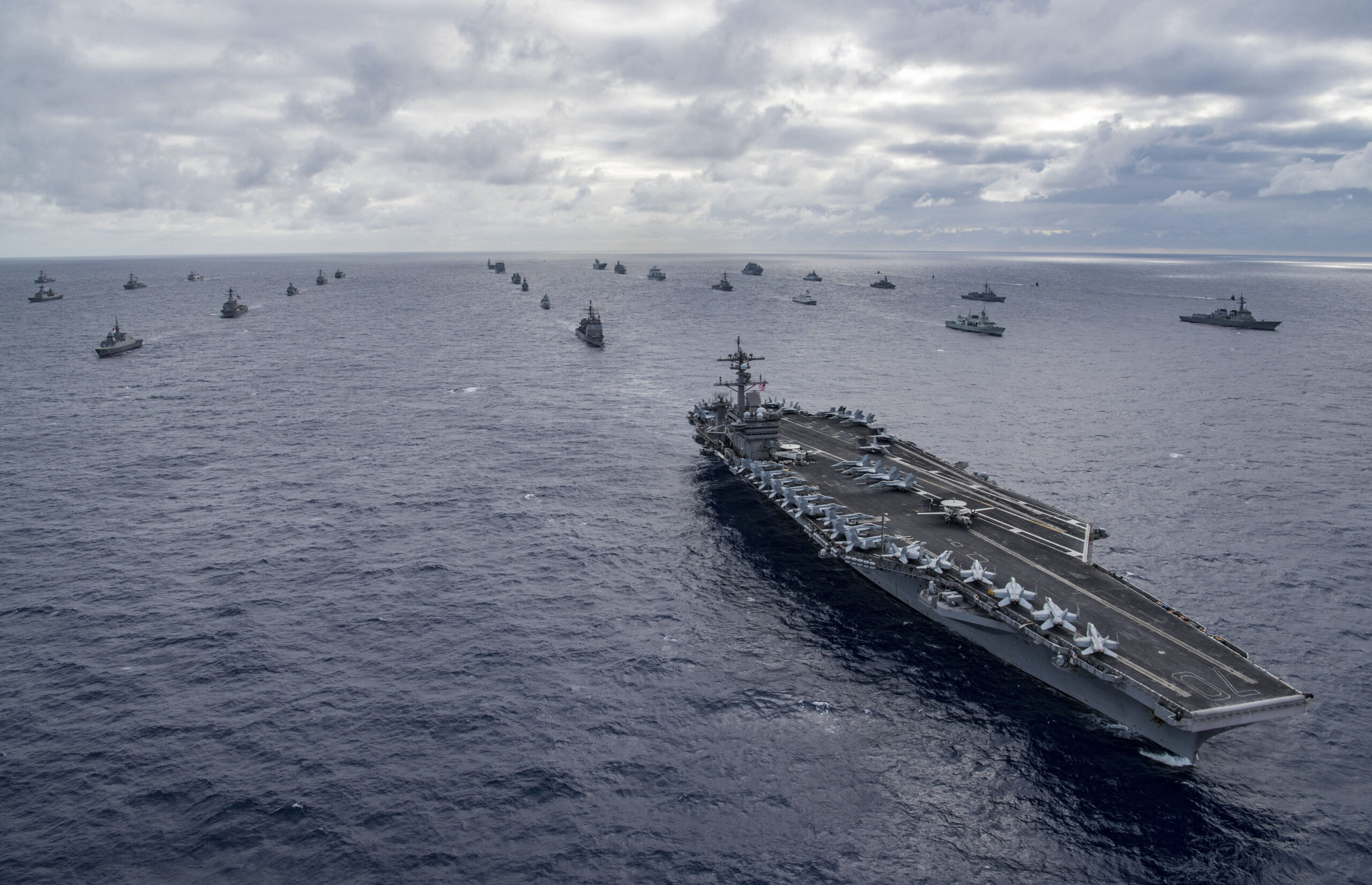
On July 15, 2026, the Brookings Institution, through the analysis of three senior security experts, pointed out that despite the progress made by the Chinese Communist Party (CCP) in certain military domains, the United States still maintains significant military superiority in various key areas, relying on crucial technology, global allies, and combat experience.
The experts generally believe that military superiority must be judged in combination with operational domains and specific contexts. Among them, Michael E. O’Hanlon, a senior researcher at the Brookings Institution, emphasized that the United States still leads in overall strategic competition.
“China is not ahead, not even close to being on equal footing,” O’Hanlon said.
He pointed out that the United States has invested billions of dollars annually in military procurement and modernization over decades and possesses the “strongest ally network in history” and the “longest-tested forces in combat around the globe.”
O’Hanlon believes that the multiple wars the American military has engaged in since the 21st century have accumulated considerable combat experience. He likened this experience advantage to the growth of the Kansas City Chiefs from their July training camp to their Super Bowl level in the following February.
In comparison, although the CCP military continues to modernize its weaponry, it lacks modern combat experience comparable to the U.S. military.
However, O’Hanlon also pointed out that even the United States does not have experience fighting an opponent of equivalent strength, so both sides would have to learn during a major power conflict; nevertheless, the U.S. holds a critical advantage in combat experience.
The report analyzed the strong operational capabilities demonstrated by the U.S. military in recent military operations, including:
1. Long-range strike and stealth capabilities:
The single-day battle launched against Iranian nuclear facilities on June 22, 2025, showcased the U.S. military’s long-range strike and stealth capabilities.
2. Special operations experience:
The U.S. military has participated in defeating terrorist organizations like al-Qaeda and ISIS, killing Osama bin Laden, and recent operations in capturing Venezuelan President Nicolás Maduro.
3. Significant lead in the underwater domain:
John Culver, a senior research fellow at the Brookings Institution, pointed out that the United States still enjoys a significant advantage in submarines and underwater warfare. This advantage allows the U.S. military to deploy cutting-edge long-range strike weapons to the theater and maintain survivability after launch while providing robust anti-ship capabilities, weakening the CCP’s Navy and amphibious operations.
The analysis also delved into the current status of the CCP’s military. While the CCP possesses a vast missile force, including ballistic missiles, cruise missiles, and hypersonic systems, and strong shipbuilding capabilities, internal turmoil and corruption within could affect its actual combat capabilities.
Culver noted that since 2024, CCP leader Xi Jinping had replaced at least 53% of three-star and four-star generals (major generals and lieutenant generals), causing disruptions in the military’s overall command chain.
Additionally, severe corruption within the CCP’s defense industry complex might have already impacted the performance of some critical weapons and ammunition, weakening the CCP leadership’s confidence in matching advanced opponents like the United States.
Bruce Jones, a senior researcher at the Brookings Institution, pointed out that the United States still maintains critical advantages in the underwater and space domains. These capabilities enable the U.S. military to weaken or restrict the CCP’s vast naval force, air defense systems, and anti-ship missile capabilities.
Jones quoted the late U.S. military analyst Owen Coté, saying, “Future battles for control of the seas and land by major powers will be decided by earlier battles for control of the underwater and space domains.”
“Although the CCP has made progress, the overall U.S. advantage in the underwater domain remains substantial,” Jones said, “unless Beijing narrows this gap further, the performance of the U.S. submarine force might materially impair any war options for Beijing.”
Culver emphasized the importance of Japan to the U.S. military. He believed that bases in northern Philippines and northern Australia are also crucial, as key anchors for U.S. operations in the Western Pacific, but to a lesser extent than Japan.
During wartime, if the U.S. military cannot fully use Japan’s air bases, naval ports, and other facilities, it could significantly increase the difficulty of defending Taiwan.
1. “Saturation” missile threat
The CCP possesses a vast missile force and an inventory of hypersonic weapons, with strike ranges covering areas such as Okinawa, Guam, northern Australia, and even U.S. military bases in Hawaii. These U.S. facilities have not yet been fortified against these new weapons, and the effectiveness of existing missile defense systems against such concentrated attacks remains uncertain.
2. Attrition warfare disadvantageous to the U.S.
The CCP’s massive defense industry excels in the mass production of ships, submarines, and advanced munitions, plus holds a dominant position in global commercial drone manufacture, having developed multiple long-range capable military drones. Meanwhile, the U.S. military faces logistical constraints due to the distant nature of operations in the Western Pacific. Experts believe that if the war evolves into an attrition conflict, it could be disadvantageous to the U.S. military.
3. Narrowing underwater gap, intensifying space and cyber competition
While underwater warfare remains a core advantage for the U.S. military, limitations such as the slow pace of U.S. submarine construction and the imminent retirement of Los Angeles-class nuclear attack submarines, coupled with substantial CCP investments in closing the gap, may gradually erode U.S. leading prowess.
The CCP possesses strong capabilities in space, anti-space, and cyber domains. Experts caution that Beijing might utilize tools such as artificial intelligence and kinetic strikes to disrupt U.S. space operations early in a conflict. However, Jones believes that the U.S. has the ability to withstand these attacks and likely secure victory.
4. Global U.S. deployments versus CCP concentration
Compared to the U.S. military’s global security responsibilities, CCP military focus primarily lies in the Western Pacific. Within the First Island Chain, the CCP’s surface warfare and air defense capabilities have become competitive. Therefore, the ability of the U.S. military to use bases in Japan, northern Philippines, and northern Australia, as well as the confidence of allies in Washington, could be critical factors in a conflict.
Overall, the U.S. maintains advantages in underwater warfare, combat experience, aircraft carrier operations, global ally networks, and long-range logistics. However, attention must also be paid to CCP developments in regional saturation strikes, defense industry capacity, missile, and drone technologies. These factors might weaken U.S. advantages in parts of the Western Pacific.
Jones cautioned that once a military conflict erupts between the U.S. and China, the economic repercussions globally would far surpass those experienced in the recent conflicts in Iran. O’Hanlon also suggested that to prevent a war, the U.S. and its allies should sustain necessary military investments, pursue a calm and resolute diplomatic approach, and reduce vulnerabilities in the economy and supply chains to dissuade Beijing from believing it can win in a conflict.