
The rise and fall of Los Angeles’ Panhai Plaza is not only one of the most absurd chapters in American commercial real estate history, but also a brutal epitome of Chinese capital’s “big go-global era.”
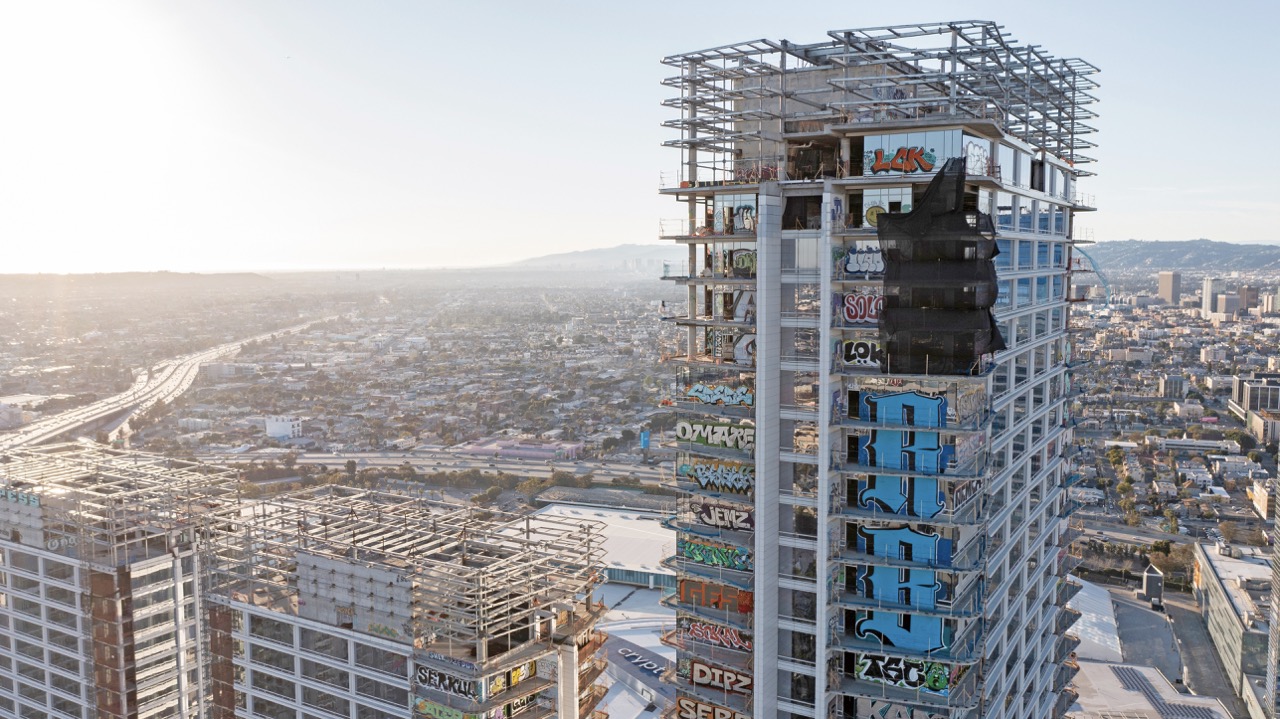
In early 2024, the three buildings of the “Oceanwide Plaza” stood abandoned in downtown Los Angeles, right next to the Crypto.com Arena, where the Lakers and Grammy Awards are usually held. It attracted dozens of graffiti artists who risked their lives to spray-paint giant graffiti on the windows of the unfinished high-rise buildings, some as high as 27 stories.
The contrast of the “$1.2 billion luxury development” becoming a “street graffiti artist’s canvas” immediately caught the attention of mainstream media worldwide. After the graffiti incident, the location quickly became a “must-visit destination” for subcultures across the United States.
Enthusiasts engaged in extreme sports base jumped from the top of the buildings, with their videos garnering millions of views on YouTube. In mid-2024, a well-known YouTuber even trespassed onto the construction site and set up a steel wire between the two buildings to perform a risky high-altitude tightrope walk.
This incident brought a significant blow to the city of Los Angeles. To prevent further escalation, the city had to spend over $1 million of taxpayer money to urgently erect tall wire fences around the site and increase police patrols.
As of mid-2026, the three Panhai buildings still remain as a massive concrete skeleton caught in a legal battle and bankruptcy proceedings, making negotiations between buyers and the Los Angeles city government tremendously challenging.
The origin of Panhai Plaza dates back approximately 12 years ago. In the mid-2010s, Chinese funds began flooding into the United States, investing in housing and commercial real estate projects. From 2010 to 2015, Chinese buyers accumulated around $93 billion in U.S. residential properties and approximately $17.1 billion in commercial real estate acquisitions.
During the peak period of 2014-2016, Chinese funds, including Anbang, HNA, Fosun, Greenland, Wanda, CIC, and China Life, heavily acquired hotels, office buildings, and development projects in the United States.
Panhai Holdings acquired the 4.6-acre land opposite the Staples Center (now Crypto.com Arena) in downtown Los Angeles in 2014, amidst the peak of Chinese investments in real estate projects in the U.S. This land was previously owned by the Moinian Group from New York, with plans to develop a complex including hotels, residential properties, and a shopping mall named “Fig Central.”
However, the “Fig Central” project also faced abandonment. The land was purchased for $200 million in 2006 but was stalled due to the financial crisis in 2008, leading it to be utilized as a large outdoor parking lot.
In late 2013, Panhai acquired this land for nearly $200 million, outbidding numerous local developers. They adopted the concept of a large-scale complex development and officially renamed the project to their brand “Oceanwide Plaza.” By the end of 2014 and early 2015, construction began with the demolition of the outdoor parking lot, marking Panhai’s first significant real estate investment in the U.S.
The Panhai Plaza project was envisioned to be a three-tower high-rise complex integrating a hotel, apartments, retail outlets, restaurants, and a large LED exterior wall. The project received a warm welcome from Los Angeles authorities, as Chinese investments were highly favored by American politicians at that time, causing great enthusiasm from local authorities.
Panhai had heavily invested in public relations and political contributions in Los Angeles, even getting involved in a corruption scandal with Councilman Jose Huizar. Many city officials highly praised the project, referring to it as the “crown jewel” of the downtown Los Angeles revitalization effort. Additionally, Panhai employed the globally renowned construction firm Lendlease for the project. With local government backing and top-tier contractors, the project’s “abandonment risk” seemed close to zero in the eyes of Chinese investors.
However, in January 2019, construction suddenly came to a halt when the project was close to completion. The cranes stopped operating, and hundreds of workers were laid off. The straightforward reason for the halt was Panhai running out of money. Five core reasons led to this situation:
As indicated in Panhai’s mid-2019 report, as of June 30th that year, the group only had HK$96.8 million in unrestricted cash and liquid assets, while loans and debts, including convertible notes, amounted to HK$6.19 billion, in addition to outstanding payments to subsidiaries of HK$5.57 billion. By the end of 2019, the situation worsened with decreasing assets but increasing liabilities.
Panhai clearly stated in its 2019 mid-year report that they would seek additional financing for ongoing development and construction costs. Management expected to fund the project construction through bank loans; if these loans were not obtained, they would resort to equity financing, support from the parent company, or other borrowing. In layman’s terms, they needed to continue borrowing money to complete the project halfway.
Between 2018 and 2019, the real danger lay in the fact that the project was already in deep and it was financially unstable. This was the most vulnerable stage of large-scale development projects. Essentially, it was a case of playing with too much leverage, or more precisely, its over-dependence on subsequent financing for large amounts of concurrent projects took a toll on the company.
The Chinese government’s 2018 list of “sensitive industries for overseas investment” identifies real estate, hotels, cinemas, entertainment, and sports clubs as industries where companies’ foreign investments should be restricted. Panhai Plaza precisely overlapped with real estate and a five-star hotel.
As a result, it became more challenging for Panhai to continue financing overseas real estate and hotel projects from within China or through Chinese financial systems, constraining the company’s financing and potentially pulling the plug on major unfinished assets.
Starting from 2015, Panhai began allocating assets in U.S. dollars, investing in real estate development in major North American cities, core properties in Shanghai, and other dollar-denominated assets.
In 2021, Panhai announced that real estate projects in Los Angeles and Indonesian energy projects had been suspended, with the funds only maintaining basic project expenses without being used for construction. Although this was a later disclosure, it reflected the same issue: Panhai faced liquidity problems not just with one particular project but across its entire overseas asset platform.
Between 2018 and 2019, this colossal luxury mixed-use development in the city center posed high risks for lenders: immense construction costs, the absence of stable cash flow before completion, and prolonged sales and leaseback recovery times. Banks or potential investors saw not a “nearly completed cash cow” but a high-risk asset that had received substantial funding and required even more with uncertain turnaround times.
Starting in 2017, Chinese investment in U.S. real estate began to decline, reducing from $16.2 billion in 2016 to $7.3 billion. Lenders worried: if there were fewer Chinese buyers, who would purchase these expensive apartments? If the Chinese parent company could no longer provide financial support, who would fill in the money needed to complete the project?
The project had already amassed over $1 billion in investment, with estimated completion around 60%. However, compounded by a series of factors leading to a debacle, the project was abruptly terminated in 2019. With years of abandonment, the development was ensnared in complex property and debt disputes, only to gain global spotlight once again with the graffiti incident in early 2024.
In February 2024, multiple creditors filed an involuntary bankruptcy petition against Oceanwide Plaza LLC; on March 11th of the same year, the bankruptcy court issued a relief order, placing the case under bankruptcy court supervision.
Business real estate services company Colliers submitted an evaluation to the bankruptcy case, estimating the value at around $434 million, while the completion of the project would require approximately $865 million more. Some market analysts believe that considering a full restart, leasing, repositioning, and risks, the total cost could be even higher.
As for those who invested through the EB-5 program, court documents and related reports indicate that the EB-5 funding pool raised around $138 to $150 million in total. Approximately over two hundred EB-5 investors participated in the project. Of course, the investments made by these individuals went down the drain, resulting in fierce legal battles among subsequent investors striving to protect their priority rights for reimbursement.
According to The Real Deal, Panhai owed creditors approximately $400 million, including roughly $180 million to EB-5 investors, about $175 million to contractors led by Lendlease, and around $18 million in county taxes.
Although in early 2026, a buyer group named KPC Square LLC proposed to take over for less than $500 million, the Los Angeles city government strongly opposed the deal in May. The reason being the new buyer did not present a clear plan for resuming construction, raising concerns that the building would remain abandoned. Currently, this monumental structure remains stuck in legal proceedings.
Today, the concrete steel skeleton standing in downtown Los Angeles reflects the greed and speculative nature of Chinese capital under the Communist regime. For local U.S. government entities, they have learned a solid lesson from the “Panhai Revelation.”