
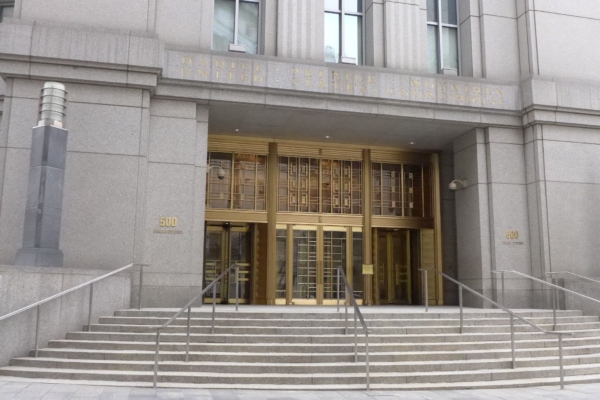
New York, US – Socialite Christina Jiang, who was once active in the New York Chinese social circle, has been sentenced to 25 months in prison on June 17 by the Federal Court in downtown New York for her involvement in a long-standing immigration fraud scheme. She will also be under post-release supervision for 3 years and has been ordered to pay a fine of $95,000.
Jiang had previously pleaded guilty to the charge of “conspiring to commit immigration fraud.” According to court documents, she has agreed to forfeit nearly $3.92 million to recover illegal gains.
Prosecutors revealed that from 2015 to 2022, Jiang, along with co-defendant Yu Cao (also known as Carolyn), worked together to profit millions of dollars by submitting fraudulent H-1B work visas, PERM labor certifications, and green card applications for Chinese clients through more than a dozen shell companies she established.
Court documents showed that one client, referred to as CC-1, paid $200,000 in hopes of obtaining a green card. When the application was delayed, Cao arranged for CC-1 to apply for an H-1B visa through her company, Sun American, stating that CC-1 would work as a “public relations officer,” despite never actually working there.
When the US Citizenship and Immigration Services (USCIS) requested additional evidence, Jiang and Cao submitted multiple false materials, including forged job duty descriptions, fabricated work histories, and posting nonexistent job advertisements on the company’s website to falsely show the need for hiring professional talents.
Moreover, Jiang even instructed CC-1 to borrow educational certificates from classmates to pose as a former employee of the company to increase the chances of visa approval. Eventually, CC-1 obtained an H-1B visa in 2018 but never actually worked for the sponsoring company.
Furthermore, to help CC-1 obtain a green card, Jiang instructed CC-1 to post false job recruitment information on the company’s website, then quickly remove it to avoid genuine job applicants, thus completing the PERM labor certification process. Jiang then continued to apply for the green card for CC-1 through her shell company, NYFG Entertainment Inc.
Apart from the CC-1 case, prosecutors stated that Jiang submitted dozens of fraudulent immigration applications between 2016 and 2021, often falsifying resumes, work experience, salary statements, W-2, and 1099 tax forms. She also hired an accounting firm to fabricate tax documents for the shell companies to create an illusion of normal business operations and employee hiring.
Prosecutors also revealed that Jiang used bank accounts of different shell companies to receive client payments interchangeably to conceal the flow of funds. She also impersonated clients to communicate with the US State Department, handling visa applications and appointments, to circumvent requirements for applicants to contact the government personally or through legal representatives.
The defense requested the court to sentence Jiang to 3 years of probation, 1 year of house arrest, and community service, citing her lack of criminal history, the need to care for her young children, and her agreement to pay part of the forfeited amount. The defense also mentioned that co-defendant Cao was sentenced to two years of probation and 6 months of house arrest in April 2025, hoping for a similar outcome for Jiang.
However, prosecutors argued that Jiang was the mastermind behind the operation, engaging in crime for seven years, establishing multiple companies and repeatedly making false statements to federal agencies. Her actions were not isolated mistakes but a systematic and ongoing fraudulent scheme. Despite her legal education and awareness of the illegal nature of her actions, she chose to continue lying to US government officials multiple times. As a result, the severity of her crime far outweighed that of co-defendant Cao, who only assisted individual cases. Hence, incarceration was deemed necessary.
Prosecutors emphasized that each H-1B quota obtained through fraudulent means meant another legitimate applicant lost the opportunity to work in the US, highlighting the need for legal deterrence through incarceration. Consequently, the court ultimately upheld the prosecution’s recommendation and sentenced Jiang to 25 months in prison.