
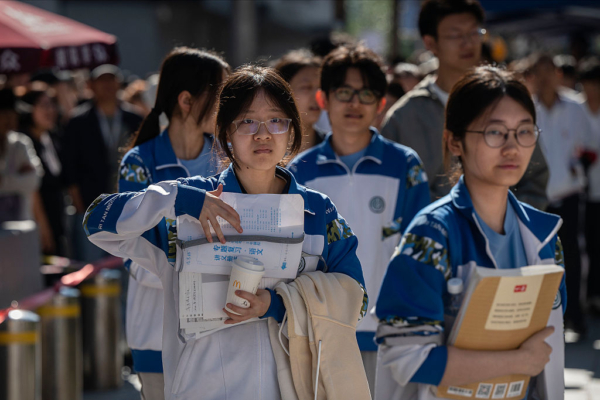
In 2026, the number of high school exam registrants in mainland China was 12.9 million, a decrease of 450,000 from the previous year, marking the second consecutive year of decline. Against the backdrop of a slowing economy, persistently high youth unemployment rates, and a record high number of university graduates, getting accepted into a university no longer guarantees stable employment. Some students and families are beginning to reassess the costs and benefits of higher education.
According to mainland Chinese media reports, the national college entrance exam took place on June 7th, with the main exams scheduled from June 7th to 8th nationwide. Due to variations in exam subjects in different provinces, some areas also had exams on June 9th and 10th.
Data from the Chinese Ministry of Education shows that this year, there were 12.9 million registrants for the national college entrance exam, a decrease of 450,000 from 2025, representing a 3.4% decline. This marks the second consecutive year of decreasing registration numbers. In 2024, there were 13.42 million registrants, which dropped to 13.35 million in 2025, and further declined to 12.9 million in 2026. Over the span of two years, there has been a cumulative decrease of 520,000 registrants.
On June 7th, Radio France reported that the college entrance exam in China has long been considered a significant test affecting academic and employment opportunities. However, the decline in registration numbers this year coincides with a worsening youth employment environment in mainland China. According to official Chinese data, the unemployment rate for young people aged 16 to 24, excluding students, has exceeded 16%, meaning roughly one in six young workers is unemployed.
A report by Reuters on June 5th pointed out that the decline in the number of eligible students, combined with the ongoing sluggish job market, is a key factor contributing to the drop in college entrance exam registrations in mainland China. It is projected that this summer, about 12.7 million university graduates will enter the job market, further intensifying job competition.
According to Ministry of Education data, the number of college graduates in China was 12.22 million in 2025, expected to reach 12.7 million in 2026, setting a new record. Data released by the National Bureau of Statistics of China in March 2026 indicated that the urban unemployment rate for the non-student population aged 16 to 24 was 16.9%, up 0.8 percentage points from the previous month.
Given the high youth unemployment rates and the continued increase in the number of university graduates, the employment returns on a university education are being questioned by more people. The job prospects for recent university graduates in mainland China are challenging, leading many to consider options such as “slow employment,” “flexible employment,” or furthering their education. Meanwhile, the official youth unemployment data released by the Chinese government does not account for students still in school, suggesting that the real employment pressure may be even greater.
As college entrance exam registrations decline, vocational education has become an alternative choice for some families. With mounting pressure in the job market, some students and parents no longer view traditional university degrees as the only way forward.
Reuters reported that in May this year, when a vocational school in Beijing opened its enrollment, hundreds of parents lined up to secure one of the 30 available spots for their children. In Shanghai, enrollment numbers for certain courses at vocational colleges have increased by 15% compared to three years ago.
The pressure in the job market is also reflected in other social phenomena. For example, after a farmer in Inner Mongolia announced a job opening for two shepherds, he received over 700 applications, including from white-collar workers, factory workers, and university graduates from major cities like Shanghai and Chongqing. This job ad garnered a lot of attention on social media platform Weibo.
In addition to employment pressure, the rising costs of university education and the uncertain returns on academic degrees are factors causing some students and families to reconsider pursuing higher education. Reports have shown that in recent years, universities in various parts of China have raised tuition fees, with some public universities increasing fees by 30-50%, while private universities, which already have higher costs, charge annual tuition fees ranging from 20,000 to 30,000 yuan for undergraduate programs.
A report by The Paper in September 2025 highlighted that tuition fees at private universities for the 2025 academic year were generally higher than in 2020, with over 80% of private universities increasing their fees. On average, tuition fees for undergraduate programs at private universities rose by 5734 yuan per year, and for college programs, it increased by 3146 yuan per year.
The rising tuition fees have coincided with growing skepticism about the returns on a university education. An article on Caixin’s website on June 3rd pointed out that the decrease in college entrance exam registrations can be attributed to several factors, including changes in registration statistics, the increase in the proportion of vocational school students opting for direct employment, and the devaluation of degrees following the widespread accessibility of higher education, indicating that a university degree does not necessarily guarantee an ideal job opportunity.
On social media platforms, some netizens have linked the decline in college entrance exam registrations to diminishing returns on education, noting that the costs of attending university are increasing while the job prospects post-graduation are far from guaranteed.