
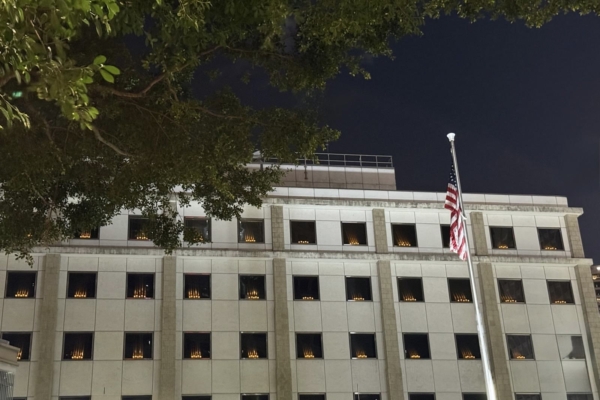
On Thursday, June 4, marked the 37th anniversary of the Tiananmen Square massacre. While numerous foreign consulates in Hong Kong took to social media to mourn the victims, the Chinese authorities refused to acknowledge the event and accused foreign interference.
The U.S. Consulate in Hong Kong and Macau once again placed commemorative candles on all windows, and other diplomatic institutions expressed condolences through social media posts.
Simultaneously, the U.S. Consulate’s Facebook cover photo was updated with candlelight and featured a statement from U.S. Secretary of State Marco Rubio, asserting that Beijing’s censorship cannot erase the memory of June 4. He emphasized that those who sacrificed their lives for defending the fundamental rights of free speech and peaceful assembly will one day be vindicated.
The U.S. Embassy in Beijing also shared Rubio’s remarks on the Tiananmen Square events.
The British Consulate in Hong Kong posted a video on its Facebook account showing a mobile phone held high with the flashlight on, followed by the numbers “VIIV,” symbolizing June 4.
Additionally, the British Embassy in China uploaded a short video commemorating June 4 on X, but their official Weibo account was blocked in mainland China due to the video’s release.
The Australian Consulate in Hong Kong shared a candlelight photo on its Facebook, stating their remembrance with people worldwide for those who lost their lives on June 4, 1989, at Tiananmen Square. Australia pledged to continue firmly upholding human rights, including freedom of association, speech, and political participation.
Meanwhile, the Canadian Consulate in Hong Kong and Macau posted on Facebook, expressing Canadians’ remembrance of those who died, were injured, or went missing on Tiananmen Square on June 4, 1989. Canada pledged to stand with survivors, families, and continue seeking accountability.
Thirty-seven years ago today, on June 4, 1989, the Chinese government deployed troops to violently disperse peaceful protesters gathered in Tiananmen Square in the heart of Beijing. This brutal event ended weeks-long protests by citizens calling for anti-corruption measures and political reforms within the Chinese Communist Party.
Numerous protesters lost their lives, and even after 37 years, this crackdown remains a taboo topic in China and even in Hong Kong.
In response to the foreign consulates’ humane commemorations of June 4, Chinese Foreign Ministry spokesperson Mao Ning, during Thursday’s routine press briefing, stated that Beijing “has long reached a clear conclusion on the political turmoil of the late 1980s.”
Mao Ning responded to Rubio’s statements on June 4, expressing China’s strong disapproval and firm opposition. This phrase is a typical response from the Chinese Foreign Ministry, often ridiculed and lamented by netizens.
The annual commemorations of June 4 are often criticized by Beijing, and the Chinese government even issued a 6,300-word “explanatory document,” listing it as so-called “evidence” of foreign interference.
Hong Kong was once one of the few places outside mainland China where annual candlelight vigils for June 4 were held, symbolizing a relative freedom compared to mainland China. However, the city has regressed to the same treatment as mainland cities.
In 2020, the Hong Kong police cited COVID-19 restrictions to ban the candlelight vigil at Victoria Park and implemented the same prohibition the following year.
This year, Victoria Park — historically the location for Hong Kong’s candlelight vigil — was occupied by a five-day “Patriotic Carnival” organized by pro-Beijing groups.
These vigils were once seen as a symbol of Hong Kong’s “relative freedom” compared to mainland China; however, today the anniversary is marked by heavy police presence and a rare absence of public commemoration events in the city.
Approximately a thousand uniformed police officers and dozens of plainclothes officers were deployed around Victoria Park, located in the core retail and tourist district of Hong Kong.
Hong Kong activist and former chair of the now-dissolved pro-democracy group “League of Social Democrats” (LSD) Sze Pui-yin, appeared near Victoria Park holding a yellow flower and was taken away by police.
“Today is June 4, a special day with a widely known significance. It’s absurd how just one person holding a flower attracts such high attention from journalists and authorities… It’s simply ridiculous,” Sze Pui-yin remarked before being detained by the police.
In the nearby Causeway Bay area, this has been the location for the annual peaceful vigil for decades. Despite the heavy police presence and tense atmosphere with officers stopping and searching passersby, brief moments of chaos erupted.
The police arrested a man holding a candle, accusing him of “disorderly conduct.”
(This article partly references reports from Reuters)