
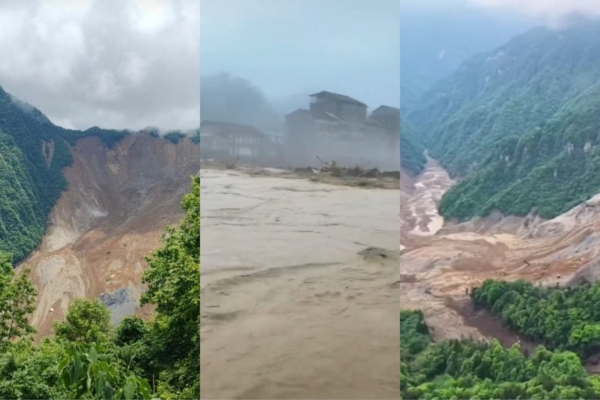
In mid-May, Shimenchang County in Hengyang, Hunan Province, was hit by historically extreme heavy rainfall. The village of Jinhe in the north and south towns was the hardest hit, with the entire village seemingly “disappearing”. Over 10 people were reported missing and presumed dead, while more than 100 villagers managed to escape by foot, walking for three to four hours to reach safety in the town’s relocation sites.
Reports from mainland media indicate that since 7 o’clock on May 17th, Shimenchang County has been experiencing heavy rainfall, resulting in flash floods, landslides, and road closures in various areas. Located in the mountainous regions of northwestern Hunan, the county’s valleys are densely woven, with complex terrain. The torrential rain led to rapid flash floods in a short period of time, severing communication with Jinhe Village in the town of Nanbei, turning it into a “solitary island”.
According to local villager Mr. Li, it wasn’t until May 20th that the severity of the disaster in Jinhe Village was discovered by relatives of the missing individuals, who ventured into the village. Mr. Li revealed that 12 people, including a 3-year-old child, remain missing to this day. Jinhe Village is composed of several smaller villages, including Jin Santai, Hongyao, Nancha, Baizhushan, Houjialing, and Zhasangping, all of which have been severely affected by the disaster.
Another resident of Jinhe Village, Zhang Wen (pseudonym), who was working in Zhejiang, recounted how he had spoken with his mother on the evening of May 17th, when the flooding began.
“The amount of rain for an entire year poured down in just one night. The flood came down within two seconds, there was no way out.”
He instructed his sister and her husband to take their mother and run for their lives. By around 2 am on the 18th, due to a power outage, Zhang and his family lost all contact.
On May 29th, due to his mother suffering from high blood pressure after seeking shelter in town, Zhang rushed back home from an out-of-town location for her emergency medical treatment.
He explained that after the 18th, there was no contact with his family, and they were completely cut off. He later learned how the villagers managed to escape that night, during which one of his 60-year-old relatives tragically lost their life in the mudslide disaster.
“My sister and brother-in-law called my mother, then went to wake up other villagers, and swiftly moved them to higher ground.”
With more than 100 villagers aiding each other during the relocation to higher ground, it took about two hours for them to reach the homes of villagers uphill, where they sought shelter and assistance from one another to temporarily evade the disaster.
Zhang Wen disclosed that family members of the missing individuals had recovered a body buried in the village using an excavator on May 29th. As of now, ten people remain missing, with an estimated four to five confirmed casualties. A three-year-old child, along with their grandparents, a family of three, are among the missing individuals, with a high likelihood of them being casualties.
Due to power and water outages, washed-out roads, and the inability for outside personnel to enter the village, it wasn’t until May 21st, three days after the disaster, that government helicopters were dispatched for rescue operations and for airdropping food supplies.
He mentioned that only airplanes could reach Jinhe Village for rescue operations. However, only two groups were evacuated, with the helicopters carrying only 3 people each, and the second batch of aircraft airdropping supplies could only rescue 15 people. Furthermore, they were all villagers with physical disabilities or injuries. “Later, when the mist set in and the night fell, over 100 people simply couldn’t be evacuated.”
On the 22nd, Zhang Wen said his brother-in-law led all the villagers to decide to escape the village on foot to the relocation site in town. “They walked all the way by themselves, from our village to the town, covering about 10 kilometers in three to four hours. The roads were all washed out, filled with mud. Where there was a path, they walked, where there wasn’t, they climbed hills. In muddy areas, they treaded carefully, self-rescuing along the way. As long as they were physically able, they were all self-rescued.”
Zhang also questioned why the local government couldn’t send airplanes to evacuate over 100 people simultaneously.
“This disaster had government-led rescue operations, but they were a bit too slow. Now, the search for missing individuals is primarily conducted by the families of the deceased.”
Currently, over a hundred displaced residents are being accommodated in nine hotels and guesthouses in Nanbei Town. Zhang Wen emphasized that the biggest challenge faced by the villagers is the post-disaster reconstruction.
“We need authorities to inspect the disaster-affected areas on-site to determine if they are safe for residents to return. Only when it’s safe, can we villagers go back. If it’s not safe, we’ll have to relocate. If some choose not to relocate, how will they be assisted? So far, the government has provided no solutions and we’ll have to wait and see how they plan to arrange things.”
It is reported that Hongyao Village has now become a trapped lake, rendering it uninhabitable. Zhang Wen has appealed for external support and attention towards the post-disaster reconstruction efforts in Jinhe Village.