
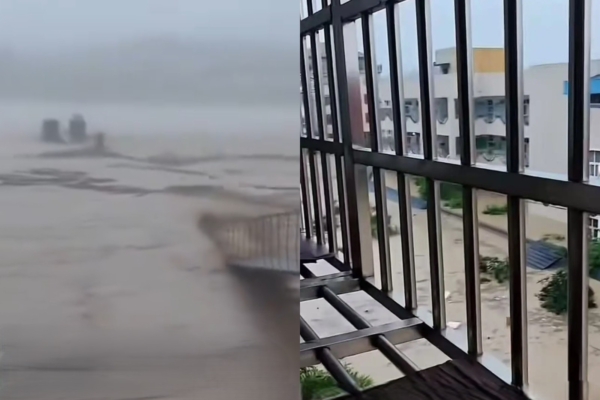
In recent days, southern provinces in China such as Hunan, Hubei, Guizhou, Guangxi, Guangdong, Jiangxi, Anhui, and others have been devastated by flooding, leading to casualties. During this time, the so-called “civilian organization,” the Blue Sky Rescue Team of Henan Province, reported that three of its teams had autonomously traveled to Hunan for rescue operations and self-published videos, demanding all members to withdraw. This incident has sparked controversy, with some netizens questioning: “Is self-aid equivalent to rebellion?”
Since May 17, Shimen County in Changde City, Hunan Province, has been hit by severe flooding. Local residents revealed to NTDTV that the county government did not notify villagers to evacuate in advance. Without warning, the floodgates were opened, triggering a serious flood that washed away three hydropower stations and downstream villages and houses. Currently, there is an “extreme shortage” of supplies in the disaster area.
As of May 23, the official Communist Party of China reported that the disaster had caused 7 deaths and 14 people missing. However, local residents stated that the situation on the ground was extremely dire, and the actual death toll could far exceed the official numbers, with some entire villages being wiped out.
On May 22, the Blue Sky Rescue Team’s Rescue Inspection Department of Henan Province issued a notification stating that the teams from Yichuan, Yiyang, and Songxian had unlawfully traveled to Changde City in Hunan to conduct cross-regional rescue operations without fulfilling approval procedures, and filmed and published related videos at the Shimen Toll Station. The notification claimed that this act “violated relevant national emergency management regulations and Blue Sky Rescue System’s cross-regional rescue scheduling, operational management, and other rules and regulations,” “sparked negative public opinion online, causing extremely adverse social effects,” and so on.
The notification stated that the relevant teams were ordered to immediately withdraw all members and receive a formal written warning within the entire team.
This incident has led mainland Chinese netizens to question: “Is self-aid considered rebellion?” “In the face of the disaster, do we have to seek approval before doing good deeds?” “If the equipment, vehicles, and personnel are all owned by themselves, and the team members bear all expenses, is there a mistake in going to rescue?” “Does shooting videos have any influence?” “Do we need approval even when helping others?” “Mainly afraid of leaking videos, right?” “So, just because you filmed the actual situation, people can’t see it now?”
Some mainland netizens said, “Anyone who doesn’t follow the rules and procedures is causing chaos. Unordered rescue operations are messing with those who abide by the rules.”
In the discussion on X platform, netizens also commented: “What a strange country this is: you need approval to do good deeds…” “Self-aid is considered treason, and self-rescue is also a serious crime.” “Our party is extremely afraid of organization; only they can mobilize the whole society.” “If you expose the truth of the disaster relief, one by one, based on the actual situation, how will the officials handle it in the end?”
One netizen mentioned, “A few years ago, when it rained heavily in Beijing, causing flooding in Zhuozhou, Hebei, several rescue teams went to provide assistance but were not allowed to pass the highway exit, saying they did not receive an invitation from the local government. As a result, many villages in Zhuozhou, Hebei, were flooded.”
There are defenders of the rescue approval process who say, “First, they criticize their own team. Second, hope you also encounter subordinates who do not follow orders. In such a unified command system, the most important thing is obedience. Without following orders, how can rescue operations be carried out?”
As of the publication by Da Ji Yuan, the article published by the Henan Blue Sky Rescue Team has been deleted. However, several mainland Chinese media outlets have reported on this incident.
The *Beijing Daily* reported on May 22 that the Blue Sky Rescue Team “is a purely public welfare emergency rescue organization in China that is private and independent,” established in 2007. Other information shows that on May 20, more than 20 core members from the Luoyang Regional Blue Sky Rescue Team coordinated and went to the disaster area in Shimen, Hunan, and were interviewed at a toll station in Henan.
Mainland blogger “Faraway Silhouette” posted an analysis hinting at the excessive power of this organization: “To understand this news, you first need to understand what kind of organization this nationwide Blue Sky Rescue Team is. What kind of nature it has! Currently, civilian rescue organizations bearing the banner of public welfare, emergency response, risk management, rescue, search and rescue, etc., are everywhere across the country. Relative to others, the Blue Sky Rescue Team is the largest in scale, with branches below the headquarters in provinces, cities, and counties, with a large network but relatively loose, somewhat like a national chain. To establish one, you must have their authorization, accept rules and regulations, and leadership!”
“In natural disasters, mine accidents, outdoor risks, and travel accidents, their presence often appears, but there are also various problems! If a civilian organization, following the model of headquarters-province-city-county, possesses such a huge and vertically led force nationwide, it always feels like something is wrong!”
Commentator Li Linyi said that under the rule of the Communist Party of China, there are no truly independent civilian organizations or pure public welfare organizations anymore. This kind of massive rescue organization certainly has Communist Party organizations, controlled by the Party, so the commands at the headquarters are primarily based on China’s political leadership situation and require regular self-examination.
Li Linyi said that among these organizations, the authorities are concerned about the “political loyalty” of some spontaneously participating civilians. For instance, if someone goes to a disaster area, shoots some real disaster videos that end up abroad, and the situation does not match the Party’s narrative, the Party is more worried about the mobilization capabilities of civilian organizations, which may transform into the basis for rights protection and other political demands in the future, thereby jeopardizing the security of the Communist regime.
Public information shows that the earliest Blue Sky Rescue Team was founded by Zhang Yong (online nickname Far Mountain) in Beijing, established in 2007, and registered in Beijing in 2010. Since then, various “Blue Sky Rescue Teams” have been established throughout mainland China, and some civilian rescue teams have also changed their names to “Blue Sky.” In 2014, the authorization model for the “Blue Sky Rescue” brand was established: the Beijing Blue Sky Rescue Team holds the brand and logo, responsible for authorizing, organizing, examining, etc., rescue teams in various regions, and establishing supervisory officials in each province. In recent years, there have been occasional reports of internal disputes within this rescue organization involving conflicts of interest.