
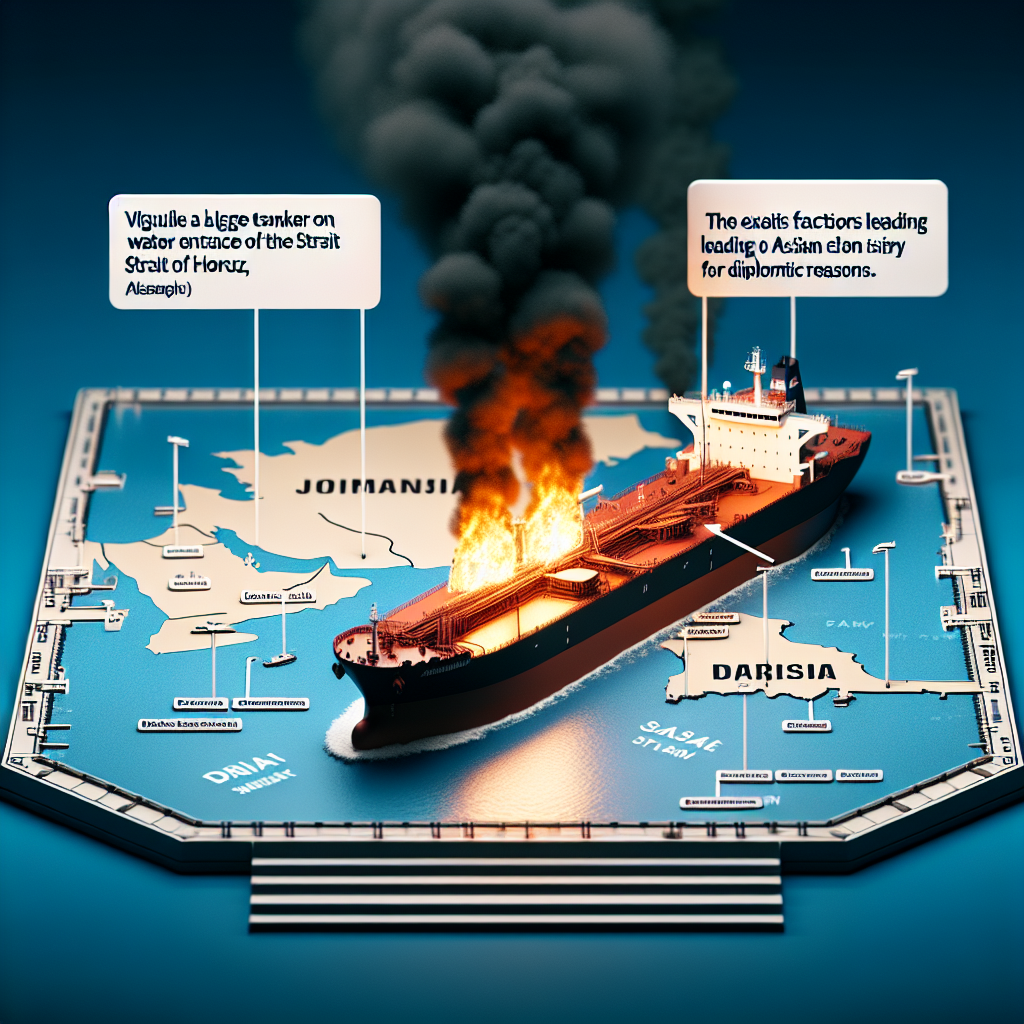
A large oil tanker owned by a Chinese shipowner was attacked this week in the waters near the entrance of the Strait of Hormuz, with the deck of the ship catching fire. Iran’s Foreign Minister, Araghchi, later visited Beijing. Experts believe that the attack on the Chinese ship may involve factors related to internal strife within the current regime in Iran.
According to the reports by mainland media outlet “Caixin” on May 7, a large oil tanker was attacked on May 4 in the waters off the Port of Al-Jeel in the entrance of the Strait of Hormuz, in the UAE. The ship was notably marked with “CHINA OWNER & CREW”.
Informed sources from the shipowner stated that this was the first time a Chinese oil tanker had been attacked, which was “psychologically hard to accept”.
Additionally, a medium-sized cargo ship operated by a South Korean shipping company also experienced an explosion and caught fire on Monday (May 4). The ship was anchored in the waters near the interior of the Strait of Hormuz, close to the UAE.
On May 4, the United States initiated an operation named “Project Freedom” to assist stranded merchant ships in leaving the Strait of Hormuz. President Trump halted this operation the day after, stating it was to observe whether the US and Iran could reach an agreement to end the conflict.
Prior to Trump’s upcoming visit to Beijing in mid-May, Iran’s Foreign Minister, Araghchi, arrived in Beijing on the morning of May 6 and had a meeting with Chinese Foreign Minister Wang Yi. Official information indicated that the two sides discussed the issue of the openness of the Strait of Hormuz. Araghchi concluded his visit to China on May 7.
Su Ziyun, Director of the Strategic and Resource Institute at the Institute for National Defense and Security Studies in Taiwan, told Epoch Times that the attack on the Chinese ship could be due to the radar not being able to detect the markings on the ship, but there might also be intentional elements and the potential for internal strife within Iran. There are three factions within Iran, one being the religious regime, the second being the elected government, and the third being the Revolutionary Guards warlords. Therefore, this situation does not exclude intent. The Iranian government is inclined towards diplomatic negotiations, but the warlords disrupt the peace process.
Mark, a senior political and military commentator, told Epoch Times that the reason the Chinese oil tanker was attacked is twofold. First, the Islamic Revolutionary Guard Corps (IRGC) in Iran is in a relatively decentralized state. Previously, in anticipation of possible US strikes in the future, Iran delegated some decision-making authority to lower-level units. When war breaks out, if the upper echelons are incapacitated, the grassroots units can decide to launch attacks independently, creating a sense of acting on one’s own.
Furthermore, there is a fundamental contradiction between the intellectual government of Iran and the Islamic Revolutionary Guard Corps. Mark stated that although the CCP is an important ally and financial backer of Iran, some lower-level IRGC commanders do not see the CCP as a true ally and even feel that the CCP has betrayed Iran.
However, Mark believes that although the attack on the Chinese oil tanker was somewhat embarrassing for the CCP, the most crucial thing for the CCP at the moment is to ensure the continuation of the divine power regime in Iran, which is the CCP’s greatest interest, so it will not affect the CCP’s support for Iran.
According to the latest reports from various media outlets, such as Israel’s Channel 12, on Thursday (May 7), US military forces deployed in the Strait of Hormuz were suddenly subjected to a fierce attack by Iranian armed forces, leading to a temporary retreat.
The US Central Command stated on Thursday that retaliatory strikes were launched by the US military against Iranian military facilities such as missile and drone launch sites. The US military said that in response to Iran’s unwarranted attacks on US warships passing through the Strait of Hormuz, this attack was a response to Iran’s aggression.
The US Central Command issued a statement on the social media platform X, stating that its three vessels were unharmed. Although the Central Command is not seeking an escalation of the situation, it remains in a deployed state, ready to protect US forces at any time.
Regarding the impact of this incident on the “peace memorandum” negotiations proposed by the Trump administration, Su Ziyun stated that this time the US military’s action was merely a tactical one, that is, tit for tat.
Mark stated that Trump does not want to continuously use military action against Iran and seeks to strike a balance. The retaliatory strikes by the US military against Iran were meant to teach Iran a lesson, and the US is unlikely to engage in large-scale military strikes against Iran again. Ultimately, Trump still aims to resolve matters through negotiations. Trump’s primary focus is to deal with the CCP, which has a hierarchy and priority, as the US needs to take care of global interests.
On the evening of May 7, US President Trump posted on the “Truth Social” platform, stating that Iran is led by a group of lunatics and is not a normal country, and the US would never allow Iran to possess nuclear weapons.