
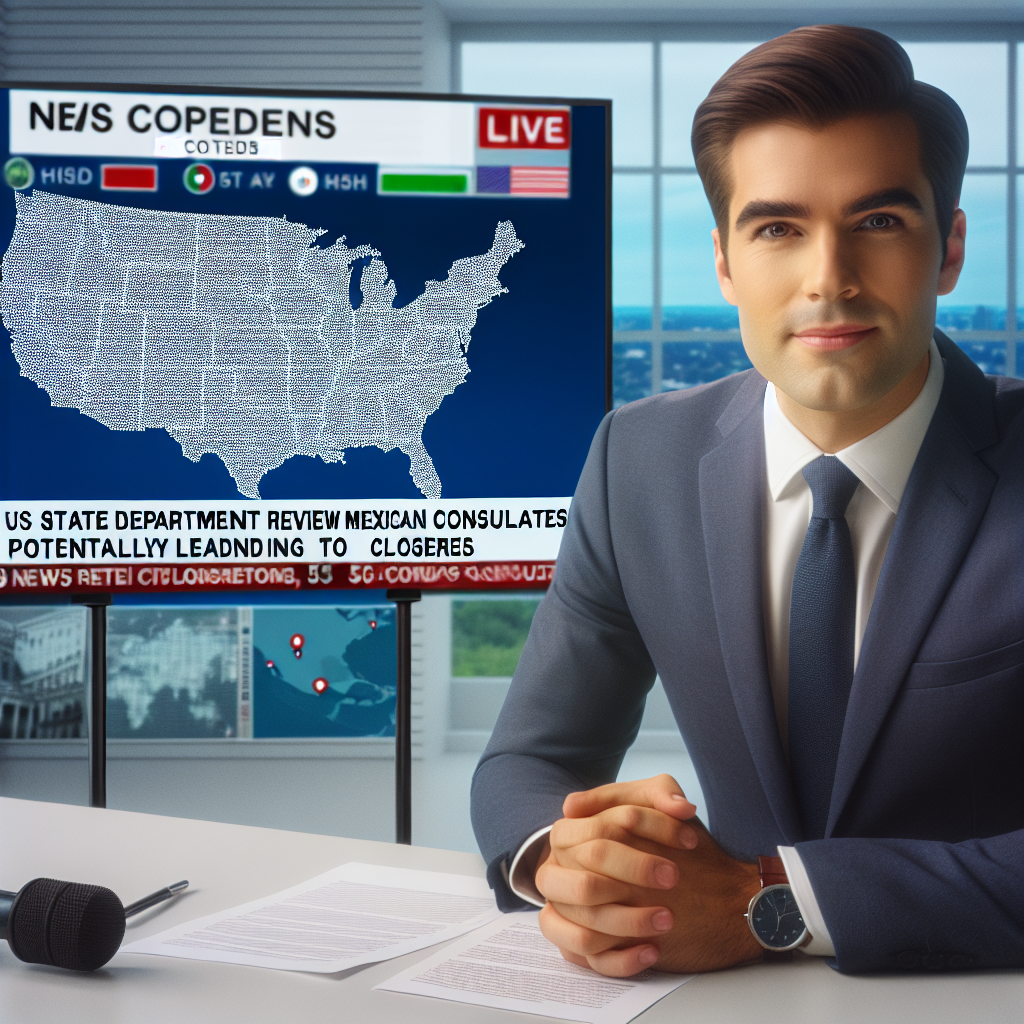
On Thursday, May 7, a US State Department official revealed to Colombia Broadcasting System (CBS) News that the State Department is conducting a review of all 53 Mexican consulates operating within the United States. This move could potentially lead to the closure of some diplomatic institutions.
The review comes at a time when the United States and Mexico have diverged on issues related to security cooperation and combating drug trafficking groups. This follows the tragic incident last month where two Central Intelligence Agency (CIA) operatives died in northern Mexico during a counter-narcotics operation.
Assistant Secretary of State for Global Public Affairs, Dylan Johnson, stated when asked about the matter, “The State Department is continuously reviewing diplomatic relationships across all levels of the United States to ensure they align with the President’s ‘America First’ foreign policy and advance US interests.” Currently, the Mexican Ministry of Foreign Affairs has not responded to this review.
According to data from the Pew Research Center on the American Community Survey (ACS), Mexican Americans form the largest immigrant group in the United States, with at least 37 million Mexican Americans living in the country in 2021.
As such, Mexico, being the country that shares the largest border with the US in the south, has the most extensive foreign consular network in the United States. These consulates are mostly concentrated in border states like California, Texas, Arizona, and cities with diverse immigrant populations, providing millions of expatriates with assistance related to identification documents, legal matters, and more.
The closure of a consulate by the host country may reflect tensions in diplomatic relations between the parties. In 2020, the US State Department ordered the closure of the Chinese consulate in Houston following allegations of Beijing engaging in espionage activities.
In 2017, in response to Moscow expelling American diplomats, the US ordered Russia to close its consulate in San Francisco as well as diplomatic facilities in Washington and New York.
The news of the review of Mexican consulates comes amidst growing tensions between the United States and Mexico regarding border drug trafficking, violence, and smuggling issues.
The spark that ignited the current escalation of tensions may be related to the deaths of two CIA officials during a narcotics operation in northern Mexico. In April, they, alongside two Mexican investigators, were killed in a car accident while combating a suspected drug lab in a remote mountainous area.
On April 19, US Ambassador to Mexico, Ronald Johnson, confirmed the deaths of the two American officials on X platform.
Mexican President Claudia Sheinbaum stated on April 21 that she was unaware in advance of the American officials participating in the field operation in her state. She has instructed a review to determine if this action violates Mexico’s National Security Law. Sheinbaum reiterated that Mexico welcomes intelligence sharing but “will not accept US troops carrying out operations on Mexican soil.”
The White House emphasized in its response that the US is committed to combating drug crimes, and Mexico should show more cooperation. Former President Trump had designated multiple Mexican drug cartels as foreign terrorist organizations last year and had warned of unilateral action if the Mexican government failed to eradicate them effectively.
Subsequently, Sheinbaum expressed condolences for the deceased and arranged for the Ambassador to meet with the Foreign Minister.
In early May, the US filed lawsuits against ten current and former Mexican officials, accusing them of conspiring with drug cartels to smuggle large quantities of drugs into the United States. At least three of these officials are members of Morena, the political party of President Sheinbaum, the National Regeneration Movement Party.
The US Department of Justice has accused Sinaloa Governor Rubén Rocha Moya and nine other current and former officials of the state of colluding with the Sinaloa drug cartel to distribute “substantial” amounts of drugs to the US and has requested extradition from Mexico.
Regarding the allegations, Rocha categorically denied the accusations and stated that he will temporarily suspend his duties to cooperate with the Mexican authorities’ investigation. Sheinbaum responded by saying that the Mexican Foreign Ministry has sent a diplomatic note to the US government requesting specific evidence, and if the evidence is conclusive, Mexican prosecutors will initiate an investigation.
The US Embassy in Mexico later stated that combating corruption and transnational organized crime remains a top priority for both governments. The embassy declined to comment on specific allegations but stated that any corrupt behavior that facilitates organized crime “will be investigated and prosecuted within the jurisdiction of the United States.”