
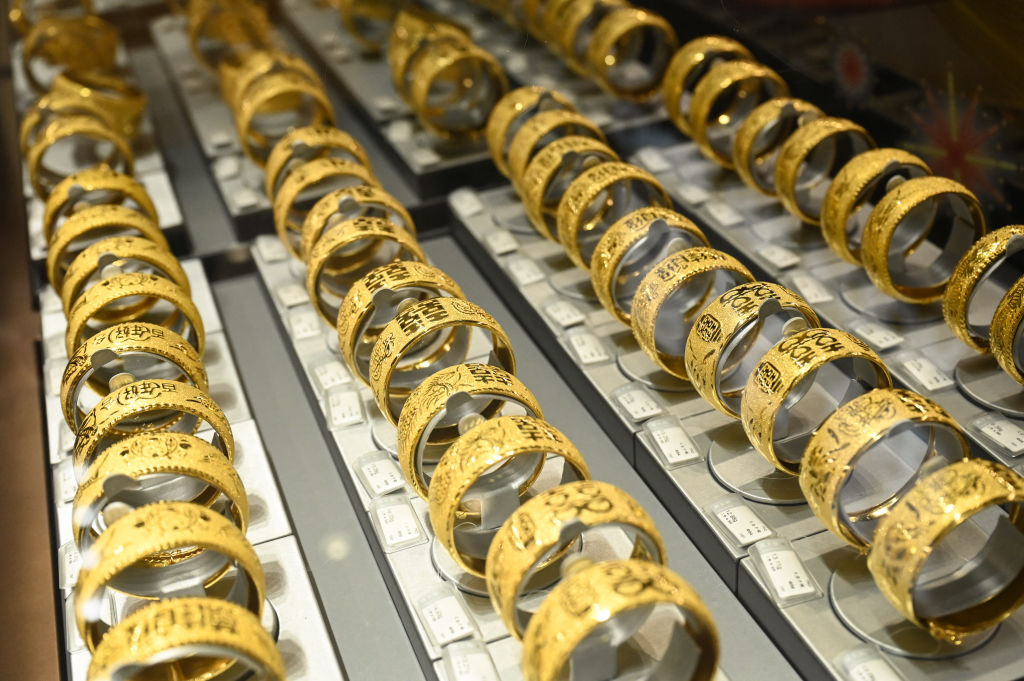
On July 14th, several mainland Chinese gold and jewelry brands collectively lowered the listed prices of gold jewelry, with a daily decrease of over 20 yuan, marking the largest drop in nearly two months. Compared to the high point earlier this year, the price per gram has dropped by nearly 485 yuan; based on the listed prices, the price difference for a set of 50 grams of wedding “three gold” jewelry exceeds 20,000 yuan.
According to mainland Chinese media reports on July 14th, mainstream brands such as Chow Tai Fook and Lao Feng Xiang have reduced their reported prices for 24k gold jewelry to around 1215 yuan per gram. Some brands had listed prices as high as 1700 yuan per gram earlier in the year, which means they have now fallen by about 28.5% from that peak.
The spot price of gold in mainland China has also significantly declined. Data from the Shanghai Gold Exchange shows that on July 14th, the price for AU9999 gold, meaning gold with a purity of no less than 99.99%, closed at 879.9 yuan per gram for the spot contract. This type of gold had reached as high as 1256 yuan per gram in January this year, representing a decrease of 376.1 yuan from that peak, a drop of nearly 30%.
The drop in gold prices has also reduced the cost of purchasing gold for weddings in mainland China. The “three gold” typically refers to three pieces of gold jewelry purchased for weddings, commonly including rings, necklaces, earrings, or bracelets.
Calculations based on the prices of the Shanghai Gold Exchange show that the material value of 50 grams of gold has decreased by about 18,800 yuan from the high point in January. When calculated based on the decrease of 485 yuan per gram in the listed prices of branded gold jewelry, the difference in the price of 50 grams of gold jewelry is about 24,300 yuan. However, actual consumer expenses may also be influenced by processing fees, style, discounts, and brand premiums.
While the prices of gold jewelry in mainland China have been adjusted downwards, there has also been a noticeable decline in the international gold market. On July 13th, the price of spot gold dropped by nearly 3%, closing at around $4000.8 per ounce. According to Reuters, the situation in the Middle East has driven up international oil prices, leading to market concerns that rising energy costs will exacerbate inflation and prompt the Federal Reserve to maintain high interest rates for a longer period. Since gold itself does not generate interest, the opportunity cost of holding gold increases when interest rate expectations rise.
On July 14th, the price of spot gold fell to around $3983 per ounce during the trading day, breaking the $4000 mark and reaching its lowest point since early July.
The U.S. released lower-than-expected consumer price index for June on that day, prompting traders to reduce bets on a near-term rate hike by the Federal Reserve. This caused international gold prices to rebound, with an intraday increase of over 2%.
However, based on the price rebound on July 14th, spot gold is still about 27% lower compared to the historical high of nearly $5600 per ounce in January this year.