
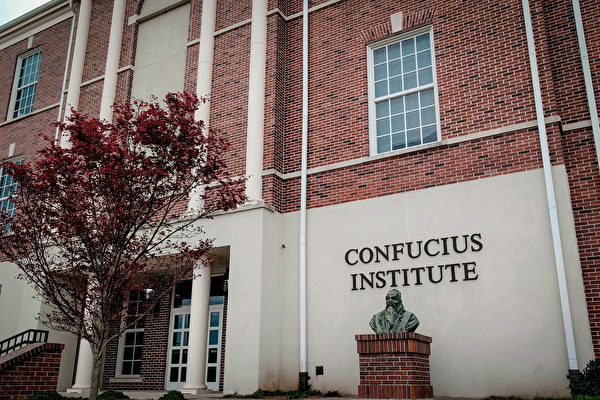
The influence of the Chinese Communist Party (CCP) on American campuses is continuing to spread through a disguised approach, shifting focus from the previous Confucius Institutes to more covert non-profit organizations under the guise of cultural exchange, continuing to influence American children. The curriculum used for American public school students learning Chinese may likely be shaped by the CCP.
In 2004, the CCP began establishing Confucius Institutes on American university campuses, which then collaborated with American primary and secondary schools to set up approximately 500 Confucius classrooms across the United States. After strong opposition from the U.S. Congress, almost all Confucius Institutes were shut down, seemingly resolving the issue.
However, Jennifer Richmond, Deputy Director of Education and National Security at the Foundation for Defense of Democracies, and an expert on China issues, pointed out in a recent article in the Congressional Hill Report that a report by the National Association of Scholars (NAS) in 2022 revealed that many Confucius Institutes have resorted to changing names or operating through third-party organizations to continue propagating CCP ideology to American students.
One such organization is the Center for Bridging Cultures, a non-profit educational institution in Virginia. Public school documents show that the center brings Chinese teachers into American classrooms, organizes student and staff exchanges to China, and continues cooperation with CCP authorities and universities as a partner of the Confucius Classroom at Alfred University.
While the Center for Bridging Cultures in Virginia has not been explicitly identified as a transformed Confucius Institute, public evidence shows the ongoing relationship between the two.
Firstly, there are clear personnel connections between the two entities. The Center for Bridging Cultures was established in 2021, coinciding with the widespread closure of Confucius Institutes on American college campuses. Its executive director is Gao Qing, who has long served as the director of the Confucius Institute Headquarters in the United States. The U.S. State Department has recognized the Confucius Institute Headquarters as effectively the headquarters of the Confucius Institutes. In August 2020, the U.S. State Department designated the Confucius Institute Headquarters as an overseas mission of the CCP, aiming to promote CCP propaganda and malign influence activities in global campuses and primary/secondary school classrooms.
Currently, whether there is a financial relationship between the two entities remains unclear. As a tax-exempt non-profit organization, the Center for Bridging Cultures is not required to disclose donor information publicly but must provide this information to the IRS through annual 990 forms. While the CCP acknowledges funding Confucius Institutes, the Center for Bridging Cultures has not disclosed the identity of its donors.
However, the website of Beijing Language and Culture University, which is under CCP control, lists the Center for Bridging Cultures as a global institution. This category on the global institution list had previously included many Confucius Institutes at U.S. universities, and the website explicitly states that the Center for Bridging Cultures is taking on the role previously played by Confucius Institutes.
Over the past twenty years, Beijing Language and Culture University has been a major sponsor of Confucius Institutes globally, establishing cooperation with 29 Confucius Institutes worldwide and earning the title of “Annual Outstanding Chinese Partner Confucius Institute” multiple times.
The Beijing Language and Culture University website also highlights that the Center for Bridging Cultures covers a national service range and plays a crucial role in continuing and expanding the Chinese language courses previously offered to primary and secondary school students and communities by Confucius Institutes and Confucius Classrooms.
Beijing Language and Culture University operates directly under the CCP Ministry of Education, with its Confucius Institute operating in coordination with the CCP United Front Work Department. The university’s organizational structure chart indicates that the CCP United Front Work Department is included in its official administrative units. The U.S. State Department has pointed out that the CCP United Front Work Department’s mission is to conduct external influence and infiltration activities to eliminate any potential opposing forces. A former head of the CCP United Front Work Department had previously served as the Chairman of the Confucius Institute headquarters in Beijing.
To understand the internal operations of the Center for Bridging Cultures, it is best to review the three annual 990 forms submitted to the IRS for 2022, 2023, and 2024. While these forms do not disclose donor identities, they indicate receiving over $2.5 million in donations, which were allocated to multiple public school districts, private schools, a community college, a private university, an online Chinese language learning platform, and a Mandarin immersion charter school in Washington, among other institutions.
The Center for Bridging Cultures website actively promotes a 12-day China education and exchange trip to American principals and education officials and has launched the U.S.-China Friendly Schools Program, pairing American schools with Chinese schools for friendship exchanges.
The author notes that state and local education departments generally reject such collaborations with the CCP, but due to lack of transparency, American parents and legislators are unaware of the hidden agendas behind organizations like the Center for Bridging Cultures. While the TRACE Act requires federally funded primary and secondary schools to disclose information on foreign influences like the CCP to parents, it does not mandate schools to disclose information about nominally independent non-profit organizations like the Center for Bridging Cultures unless amended.
The author suggests that the IRS conduct a more thorough review of organizations applying for tax-exempt status to check for any associations with entities on the U.S. Department of Defense CCP military enterprise blacklist or the Department of Commerce Entity List for export controls.
In conclusion, all these changes require significant efforts, and the United States cannot afford to stand idly by while allowing the CCP to poison the worldviews and values of American children.