
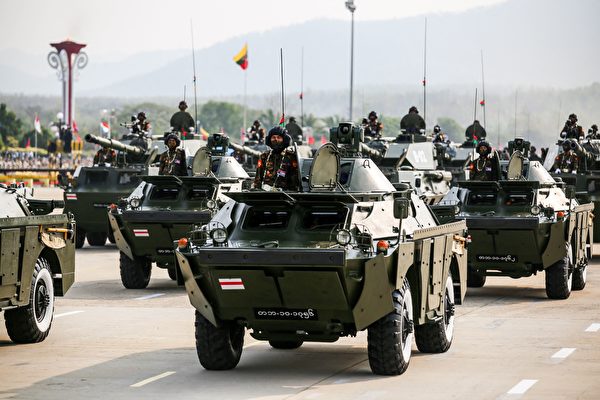
【Epoch Times News, May 31, 2026】Burma’s new president, Min Aung Hlaing, embarked on his first official visit to India on May 30th (Saturday). During this time, the Burmese military has launched a new offensive against rebel groups in border areas to regain control of rare earth mineral areas and border trade ports.
Min Aung Hlaing, the former leader of the Burmese military government, transitioned to the role of civilian president in April. His five-day visit to India marks his first official visit as president, signaling his efforts to seek regional legitimacy and restore connections with neighboring countries.
While China has long-standing investments and influence in Burma, India was chosen as the first destination for Min Aung Hlaing’s visit. Analysts believe that his decision reflects a move to counter Chinese influence, with India providing an opportunity to weaken China’s significant presence in Burma while ensuring access to key rare earth mineral deposits and enhancing security along the India-Myanmar border.
Min Aung Hlaing is scheduled to hold talks with Indian Prime Minister Modi. The Indian Ministry of External Affairs spokesperson, Randhir Jaiswal, stated on Friday, “All issues related to Myanmar-India relations will be discussed during the meeting.”
According to Reuters, Gautam Mukhopadhaya, the former Indian Ambassador to Burma, remarked that Min Aung Hlaing is likely seeking India’s assistance in countering the Arakan Army (AA) and Chin armed groups along the Myanmar-India border. These ethnic armed forces are engaged in combat with the Burmese military in Chin State and neighboring Rakhine State.
Since assuming office in April, the new Burmese military commander, Ye Win Oo, has launched aggressive offensives in northern Kachin State, western Chin State, and southeastern Karen State.
Kachin State, near the Chinese border, holds globally coveted rare earth resources, particularly heavy rare earth elements like dysprosium (Dy) and terbium (Tb), which the Burmese military aims to control. The military’s operations in Chin State are geared towards securing the India-Myanmar border routes, while in Karen State, their aim is to seize trade ports along the Thailand border.
Burma’s prolonged internal conflict is often referred to as “one of the world’s most complex civil wars,” with numerous ethnic armed groups, rugged terrain, foreign interventions (from China, India, Thailand, etc.), and a chaotic mix of drugs, minerals, and geopolitics.
Since Burma’s independence in 1948, various major ethnic armed groups have emerged, fighting against the central government dominated by the Burmese ethnic majority to secure greater autonomy for minority ethnic groups such as the Karen, Kachin, Chin, Shan, Mon, Rakhine, and others. Other militia groups are local paramilitaries with unclear command structures, formed either to resist the military government or simply maintain control in the ongoing chaos.
For instance, the Chin National Front (CNF), founded by the Chin people residing in Chin State, aims for Chin autonomy, federalism, and opposing the military government. CNF operates its armed wing, the Chin National Army (CNA). CNF had a ceasefire agreement with the Burmese government in 2012 but resumed large-scale conflict after Min Aung Hlaing’s coup in 2021 replaced the elected government. In recent years, CNF has gained control of many mountainous regions, border ports, and routes towards India in Chin State.
Neighboring Rakhine State is home to the Arakan Army, one of the most powerful ethnic armed groups in Myanmar, while Karen State hosts the Karen National Union (KNU) and its armed wing, the Karen National Liberation Army (KNLA), and Kachin State is home to the Kachin Independence Army (KIA).
In February 2021, a military coup in Burma ousted the elected government of Aung San Suu Kyi. From March to May, the military government violently suppressed protests, leading to numerous killings and arrests of young people. Many anti-government youths sought refuge near the borders to join ethnic armed groups for training, while some stayed back to form local guerrilla movements. Subsequently, the National Unity Government (NUG) was formed in May 2021 to combat the military government and restore democracy. The People’s Defense Force, established post-coup, operates under the exile NUG, collaborating with local defense forces and ethnic armed groups against the military regime.
By the end of 2023, the resistance forces officially or unofficially aligned in Burma had control over more than half of the country’s territory, prompting speculation among international observers about the imminent collapse of the military government. However, Min Aung Hlaing’s regime managed to retain control over major urban areas in central Burma in 2024 and 2025, partly due to Chinese manipulation and intervention.
In 2025, the Burmese military initiated a controlled election campaign, suppressing major opposition forces and banning them from running for office. On December 27, 2025, The Guardian reported analysis by Jason Tower, a senior expert with the Global Initiative against Transnational Organized Crime, focusing on Burma-related issues.
Tower remarked, “In reality, it is the Chinese Communist Party driving the situation towards favoring the military government. The new drone technology introduced by China to the Burmese military and the pressure applied on ethnic armed groups have helped diminish resistance faced by the military in northern regions.”
Utilizing border closures, China exerted pressure on strong ethnic armed groups in northern Burma, compelling them to agree to ceasefires, return some territories to the military, while increasing diplomatic support and supplying weapons to the Burmese military. Although the internal conflict in Burma persists, and the military struggles to control vast territories, Chinese support has aided in reclaiming some lost areas.
Tower also noted that Beijing facilitated Burma’s military participation in platforms like the Shanghai Cooperation Organization, elevating its international standing.
China adjusts its policies towards Burma as needed. Following the coup, China initially maintained a low-key response, but subsequent conflicts and economic disruptions in Burma affected its investments. China planned a corridor through Burma, connecting its southwestern regions directly to the Indian Ocean, a plan impeded by the internal chaos in Burma.
In late 2023, China tacitly allowed northern ethnic armed groups in Burma to launch offensives against the military government, relying on arms supplies from the Chinese border. Their involvement in post-coup conflicts caught the military off-guard, resulting in the loss of significant territories.
Morgan Michaels, a Southeast Asia security and defense researcher at the International Strategic Research Institute, highlighted that it was during this time that China “adjusted its strategies,” using border closures to force these ethnic armed groups to back down. “Did Beijing really intend for these groups to become strong enough to overthrow the Burmese state machinery? I don’t think so—because once that possibility arose, it intervened,” Michaels said.
China did not support the military coup in Burma because it brought instability; however, it feared that if the military government collapsed, it could lead to even greater chaos. China then fully supported the Burmese military and its electoral plans, a move condemned by UN experts as a sham.
Regarding the rare earth resources in northern Burma, India has long sought an opportunity to intervene to reduce its dependency on China’s supply chains. Reuters previously reported that India, with assistance from a powerful anti-military government organization, obtained mineral samples.
Currently, about two-thirds of the global heavy rare earth sources are linked to Burma. These heavy rare earth minerals are mostly sent to China for processing, as China controls over 90% of the global rare earth separation capacity, positioning Burma as a low-cost raw material supplier.
In a report from the German Green Party’s Heinrich Böll Foundation, it was mentioned, “According to Chinese trade data, in 2023, China imported around 41,700 tons of these critical raw materials (heavy rare earths) from Burma, more than twice its domestic quota. Other countries like the US, Australia, and Brazil only mine small amounts of these heavy rare earths. Therefore, China and Burma are indispensable in the supply chain, as dysprosium and terbium are crucial components in permanent magnets.” Over 95% of pure electric vehicles utilize permanent magnets, while wind turbines and various equipment like industrial robots, generators, heat pumps, and household appliances also rely on them.
The Heinrich Böll Foundation engages in international research, policy reports, and forums. In a report released on May 29th, the foundation emphasized, “The world’s fourth-largest rare earth producer, Burma supplies most of its products to China’s processing facilities.”
Regarding Min Aung Hlaing’s visit to India, Mukhopadhaya remarked, “India’s ultimate goal is to acquire raw materials, rare earths, and explore commercial cooperation opportunities. This aligns with the desires of the Burmese military, as they seek to strengthen their military capability.”