
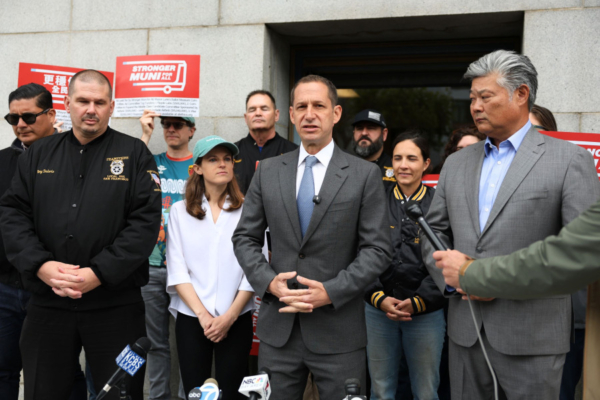
San Francisco Mayor Daniel Lurie announced on May 28 outside the San Francisco Department of Elections that the “Stronger Muni for All” proposal, aimed at providing stable funding for the Muni (San Francisco public transportation system), has collected 18,469 voter signatures, exceeding the required 10,600 statutory threshold to be placed on the ballot on November 3.
Mayor Lurie and supporters of the proposal delivered 9 boxes of signature documents to the Department of Elections for verification. If the qualification review is successfully completed, “Stronger Muni for All” will be officially included on the San Francisco ballot on November 3 for voters to decide.
If the proposal is passed, it will levy a parcel tax on residential and commercial properties, expected to provide Muni with approximately $160 million in stable annual revenue.
95% of single-family homeowners would pay an estimated additional $129 in taxes annually; while large landowners and major corporations would be required to pay higher amounts. Tenants within rent-controlled units would have a tax cap of $65 per year.
Mayor Lurie said at a press conference, “I am very excited to announce that we are about to submit 18,000 signatures to the Department of Elections – a number that far exceeds the required 10,000.”
Mayor Lurie expressed gratitude to the signature-gathering volunteers present and stated that if the proposal is passed by voters, “we will invest in and strengthen this vital public resource (public transportation), and we will continue to lead the nation in creating a world-class public transportation system.”
Lurie stated that the Muni team works diligently every day to improve service quality, increase passenger capacity, maintain cleanliness and safety on all routes, “They deserve our support, gratitude, and appreciation. We will fulfill this support and gratitude in November by strengthening the Muni system, increasing investment in each route, and thus ensuring continued economic recovery in our city.”
One of the initiators of the “Stronger Muni for All” proposal, Kat Siegal, stated at the scene that since the launch in March, 300 volunteers have been involved in street signature collection.
In less than two months, the volunteer team collected nearly 9,000 signatures. She believes this fully demonstrates how important this issue is to the public and underscores the solid support base of San Francisco residents for public transportation.
“They simply cannot imagine what San Francisco would be like without a reduced Muni service.”
The campaign team’s press release stated that with the temporary state and federal subsidies during the pandemic expiring, coupled with the uneven economic recovery post-pandemic, without additional funding, the San Francisco Municipal Transportation Agency (SFMTA) faces a roughly $307 million fiscal gap for the 2026-2027 fiscal year.
The balanced budget passed by the San Francisco Municipal Transportation Agency last month is based on the funding from the passing of this proposal. If the proposal does not pass in November, it could lead to cuts in public transportation services, including cutting some routes, increasing wait times, further affecting commuting for the working class and commercial activities.
Tony Delorio, Principal Officer of Teamsters Local Union No. 665, stated that a high-quality, reliable transportation system is crucial for working-class families in San Francisco.
Delorio said that even Mayor Lurie was one of the 300 volunteers, participating in signature collection efforts.
“If Muni cannot operate smoothly, then the vision of ‘Revitalizing San Francisco’ that the mayor is working hard to achieve will not be realized,” Delorio added.
Rodney Fong, President and CEO of the San Francisco Chamber of Commerce, stated, “The public transportation system is the lifeline of this city; and a great city inevitably has a great public transportation system.”
He noted that the boxes of signature documents displayed clearly demonstrate the urgent needs of the San Francisco community.
Mayor Lurie mentioned that in the next five to six months, the city government and supporting groups will work tirelessly to promote and continue to garner more support. “Muni is currently facing serious challenges. People must realize that we need to invest in Muni, solidify and enhance it.”
He emphasized accountability, ensuring that every penny from the “Stronger Muni for All” proposal will be traceable and directly used for operations and route construction, so everyone knows the money is for Muni and not for other aspects of the community.
Lurie said that the daily passenger volume for the San Francisco Municipal Transportation Agency has recovered to nearly 80% of pre-pandemic levels on weekdays, and close to 95% on weekends.
The decrease in ticket revenue for the San Francisco Municipal Transportation Agency is considered one of the reasons for the tight budget, with fare evasion possibly being a contributing factor. Agency data shows that in the past 12 months, the number of fare checks has increased by 39% compared to the same period last year, but fare evasion remains prevalent, with nearly half of public transit riders having no payment record, approximately one-quarter of which are evading fares.