
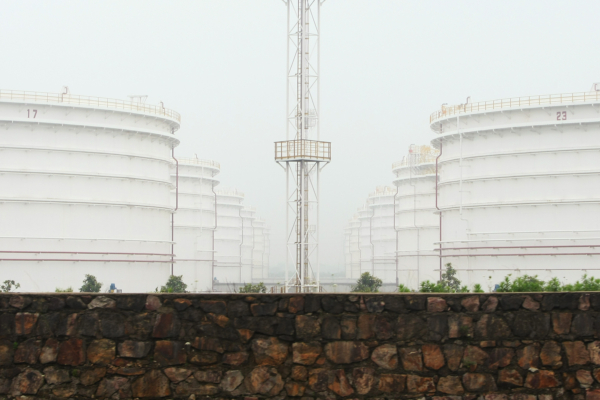
On May 25-27, Chinese Premier Li Keqiang conducted a research trip to Zhoushan and Ningbo in Zhejiang province, inspecting oil and agricultural product reserve bases and instructing to expand reserve capacity and enhance strategic security. Analysts pointed out that this move reflects Beijing’s deep-seated anxiety over being “choked” in terms of energy and food resources, with the Chinese Communist Party reshaping its economic security system with a “wartime thinking” approach.
Li Keqiang’s research itinerary was intensive, including visits to the Zhoushan National Oil Reserve Base, bulk agricultural product storage and transportation bases, and the commercial oil reserve project in Ningbo.
The research also extended to the transportation and logistics field, with Li Keqiang visiting the Ningbo section of the Yuyao-Zhoushan Railway Jin Tang submarine tunnel and the Meishan Port area in Ningbo-Zhoushan Port, examining the construction planning of Zhejiang’s transportation and logistics system, reflecting Beijing’s high concern for the overall layout of the supply chain.
Traveling US current affairs commentator Tang Jingyuan told Dajiyuan that Li Keqiang’s choice of Zhejiang for this research trip was not accidental. The Zhejiang bulk commodity trading center is one of the key nodes in the “three bases and two centers” plan that the Chinese Communist Party has particularly focused on establishing as a strategic template project.
“This is one of the most valued strategic model projects by the Chinese Communist Party,” he believes, noting that Zhejiang’s mature economic system and complete commercial infrastructure make it easier to link with the international market, thus becoming an important base for the Party to drive its strategy on bulk commodities.
Chinese affairs expert Wang He told Dajiyuan that Li Keqiang’s choice to research in Zhejiang is closely related to the escalating situation in the Middle East, potential risks in the Hormuz Strait, and the Chinese Communist Party’s close involvement in the national security layout for the “15th Five-Year Plan”. It also reflects Beijing’s long-term anxiety regarding energy and food security issues.
He believes that the current tense situation in the Middle East, if any trouble arises in the Hormuz Strait, will directly impact China’s energy imports. About 40% of China’s oil is transported through the Hormuz Strait.
The Chinese State Council openly solicited opinions on the “China Reserve Security Law” in January this year. Wang He believes this indicates that relevant institutional construction is accelerating. In his view, these actions reflect China’s long-standing vulnerability in the fields of energy and food.
The latest military conflicts between the United States and Iran have directly manifested in the drastic fluctuations of the international energy market.
With the outbreak of new military clashes between the U.S. and Iran, international oil prices soared by over 3% in a single day, with Brent crude oil hitting $97.8 per barrel at one point; U.S. West Texas Intermediate (WTI) rose by 3.73% to $91.99.
Citi Group has warned that the surge in energy prices may trigger “second-round inflation”, with central banks worldwide maintaining a high level of vigilance and possibly leaning towards a more hawkish stance.
Aside from energy, food security is also a persistent strategic concern in Beijing. During his research in Zhejiang, Li Keqiang emphasized the significance of having reserves in the face of challenges brought about by external environment changes, stating that “having food in hand means no worries,” highlighting the importance of bulk commodity reserves for the stable operation of the economy and society.
Tang Jingyuan points out that the official research theme this time emphasizes “coordinated development and security”, with the most core element being “security,” which essentially means energy and food security. The continuous turmoil in the Middle East has made Beijing more worried about energy and food security.
“China currently has a very strong sense of crisis,” he said, “because it cannot be certain whether drastic changes in the future international order and geopolitics will fundamentally alter the global energy supply pattern.”
“Once external circumstances change, or even if a certain ‘choking’ situation arises, the consequences for the Chinese Communist Party would be very serious.” Therefore, Tang Jingyuan believes that Beijing is currently re-evaluating economic and supply chain issues with a proactive “wartime thinking” approach.
China is the world’s largest importer of agricultural products, and food crisis has long been considered a deep-seated weakness of the Chinese Communist Party. Under Xi Jinping’s leadership, food security issues have been emphasized multiple times.
China not only has a high external dependence on food but also heavily relies on a few countries.
According to statistics, China primarily depends on Brazil and the U.S. for soybean imports, while the top three countries for wheat imports are Australia, Canada, and the U.S., all of which are geopolitical rivals with China. The top three countries for corn imports are Brazil, the U.S., and Ukraine.
The Chinese Communist Party also harbors a concern about the possibility of maritime trade being cut off. The shipping route from Brazil to China passes through the Atlantic Ocean, the Indian Ocean, and then through the Malacca Strait before reaching China. The Malacca Strait is easily blockaded, currently jointly administered by Singapore, Malaysia, and Indonesia, all of which have close defense relations with the U.S.
At the Zhejiang International Bulk Commodity Trading Center, Li Keqiang emphasized the need to focus on building an integrated service platform for bulk commodities, effectively connecting domestic and international markets, establishing a comprehensive multi-category full-chain trading service system, actively exploring the integration of futures and spot operations, and enhancing the international influence of bulk commodity pricing mechanisms.
Analyzing this, Tang Jingyuan believes that China’s vigorous promotion of the construction of the Zhejiang International Bulk Commodity Trading Center serves a deeper purpose of competing for the global pricing hegemony of bulk commodities.
He states that while China is the world’s largest buyer of bulk commodities, the pricing power of commodities such as crude oil, iron ore, and soybeans has traditionally been held by Western financial markets in New York, London, Chicago, and others.
“The Chinese Communist Party hopes to translate its advantage as the world’s largest buyer into a strategic leverage,” he says. However, Tang Jingyuan points out that behind this strategic ambition lies inevitable institutional bottlenecks.
He explains, “A truly mature commodity market needs high transparency, legalisation, and market trust. Yet, the CPC system is highly interventionist and politically strong, which naturally conflicts with these requirements.”
Wang He, on the other hand, expresses that Beijing is attempting to endow the reserve system with triple functions—strategic safeguards, macroeconomic control, and emergency supply, hoping to combine them with market mechanisms, which all require strong integration with market mechanisms.
He believes that in a certain sense, Beijing is drawing inspiration from the way the U.S. operates with bulk commodities and strategic reserves, aiming to establish a market mechanism, although the practical obstacles remain substantial.
The Chinese national reserve system has long been a “problem area” of corruption. From exaggerated reports of food production to fraudulent practices in warehouses, systemic failures in grassroots supervision have repeatedly occurred, turning national granaries into breeding grounds for some officials to seek personal gains.
In recent years, high-ranking officials in the Chinese agricultural system have been falling one after another, including Tang Renjian, Party Secretary and Minister of Agriculture and Rural Affairs of the Chinese Communist Party, and several officials in the China Agricultural Bank system.
Wang He points out the long-standing corruption issues in China’s food reserve system. Since the planned economic era, relevant institutions have undergone multiple rounds of reform. In the past few decades, there have been few notable achievements.
“Especially against the backdrop of the current international situation and economic fluctuations, Beijing is more concerned that the reserve system may not be able to fulfill its stability function,” he says.
Tang Jingyuan analyzes that Beijing is currently caught in a deep-seated strategic contradiction. “On the one hand, it’s becoming increasingly distrustful of the external environment; on the other hand, this continuous emphasis on security and autonomy will further weaken China’s integration with the global market.”
He believes that this cycle is propelling the long-term and structuralization of the U.S.-China strategic competition. “This is not just an economic issue, but a trend towards increasingly apparent strategic and geopolitical orientations.”