
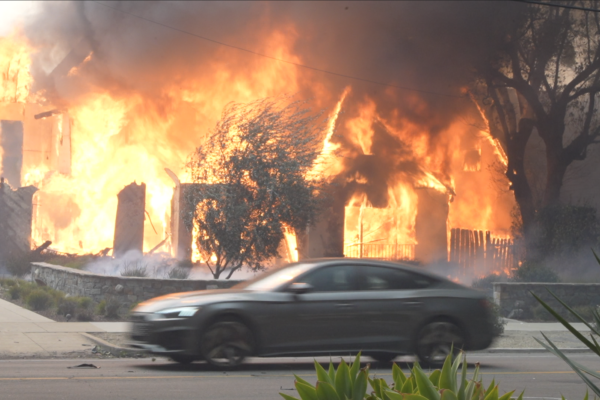
In recent years, wildfires have been frequent in California, threatening the Chinese community. In addition to traditional firefighting methods such as water or chemical agents, a new “sound wave firefighting” technology is expected to become a new solution for the public, promptly extinguishing fires before they escalate into large-scale infernos.
According to the American magazine “Scientific American,” this technology has already been put into practical use in the suburbs of Los Angeles. In a wildfire, the courtyard of a main residence was engulfed by flames, but the house remained unscathed as any small flames appearing on the walls or roof were quickly extinguished due to the suppression of fire by sound waves. No water was seen at the scene.
This firefighting technology based on acoustic principles may play a significant role in combating wildfires in the future.
Geoff Bruder, the CEO of Sonic Fire Tech, who was formerly a NASA aerospace engineer specializing in thermal energy conversion research, explained, “The basic principle of this technology is to make the vibration speed of oxygen faster than the combustion speed of the fuel, thus disrupting the chemical reaction.” The firefighting equipment he developed can extinguish fires from a distance of 25 feet (about 7.6 meters).
The key elements of a fire include heat, fuel, and oxygen; by removing any one of these elements, the flame can be extinguished. Sound waves can displace oxygen molecules from around the fuel, thereby suppressing the fire.
Bruder mentioned that residential fires often start because of sparks landing on nearby vegetation or entering the attic through vents. Therefore, he has installed sound wave firefighting systems on metal pipes under the roofs and eaves of buildings. When the sensors detect flames, electric motors drive pistons to generate sound waves, creating a subsonic force field to extinguish the flames and prevent re-ignition.
Bruder also plans to equip new residential buildings with heat sensors and sound wave emitters so that every room can be protected. In California, a house destroyed in the Altadena wildfire is being rebuilt and testing this system. Currently, this device is not meant to replace sprinkler systems but to act as a supplement, preventing the spread of fire before the sprinkler system is activated and avoiding the common water damage issues in small fires.
Bruder believes that insurance companies may be interested in this technology.
In fact, sound wave firefighting is not a new concept.
The Defense Advanced Research Projects Agency (DARPA) of the Pentagon studied sound wave firefighting technology from 2008 to 2011. Following this, the academic community has also engaged in related research within the past decade. For instance, George Mason University developed a firefighting device similar to a low-frequency loudspeaker in 2015.
Albert Simeoni, the head of the Fire Protection Engineering Department at Worcester Polytechnic Institute in Massachusetts, believes the real challenge lies in how to make sound waves practically usable on a large scale without being noisy or causing damage.
“Scientific American” pointed out that previous studies mainly used sound waves in the 30 to 60 hertz range, which can be generated by simpler equipment. Sonic Fire Tech keeps the frequency at 20 hertz or below, utilizing “infrasound” to address the issue. These sound waves, inaudible to the human ear, can propagate further.
Although Sonic’s firefighting equipment is currently only suitable for small fires, many residents facing wildfire threats are still willing to try this technology. The company is collaborating with two utility companies in California to demonstrate the technology, with residents signing up for the service. The company aims to complete 50 trial installations by early 2026.
The company also showcased a backpack-style sound wave extinguisher for firefighters to use on smoldering embers at wildfire scenes. Bruder said, “The backpack extinguisher currently used by firefighters can hold 5 gallons of water, which is quickly depleted, requiring a water truck to follow for continuous refilling. Our system can achieve the same effect, running for several hours on battery power alone.”
Derrick Berumen, a fire inspector in Concord, was one of the first testers of this technology. Just a few days ago, he had not even heard of this technology.
“This is completely new to me. We only learned about this system about a week ago and watched a short video, which we found quite impressive,” he said. “Seeing this backpack system in operation was very interesting, and I am looking forward to its future development.”
This article referenced reports from the American magazine “Scientific American” and CBS.