
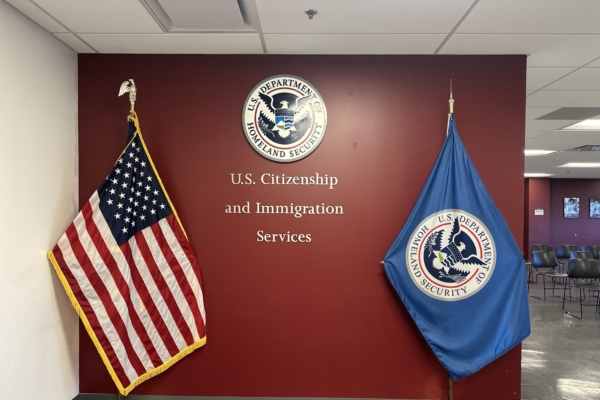
The U.S. Citizenship and Immigration Services (USCIS) released a new policy memorandum on Friday reaffirming immigration policies: requiring applicants to adjust their green card status from outside the country, causing concerns among many immigrants currently residing in the U.S. How will this memorandum be implemented? Who will be affected? Immigration lawyer Chen Chuangchuang provided some professional analysis.
Chen Chuangchuang stated that as it stands now, the new announcement will affect many individuals who were originally waiting to adjust their status within the U.S. If strictly enforced, tens of thousands of people will be impacted to varying degrees, “this indeed has a significant impact.”
The immigration agency reiterated in the new policy memorandum that, based on long-standing immigration laws and immigration court rulings, foreign nationals seeking “adjustment of status” must go through the U.S. Department of State for processing outside the country.
In its statement, the immigration agency mentioned that nonimmigrant foreign nationals (including students, temporary workers, or visa holders for tourism purposes) typically come to the U.S. for short-term stays, and these individuals should depart after their authorized stay period. These short-term visits should not be considered as the “first step” in the green card application process.
Chen Chuangchuang explained, “The current announcement requires these individuals to leave the U.S. and not adjust their status within the country. However, there were already provisions in the immigration law exempting certain individuals from this restriction.” These exceptions usually include: victims of domestic violence (under the VAWA Act), U visa holders, and special immigrant juveniles.
Furthermore, adjustment of status for refugees and asylees is not subject to the new announcement. Chen Chuangchuang noted, “Asylum applicants are not allowed to return to their home country anyway, so they are not affected by the new regulations. However, applicants in family-based or employment-based categories appear to be impacted.”
When will the new regulation come into effect? Chen Chuangchuang analyzed that since the immigration agency has issued the new memorandum, if there are no external constraints such as a judge’s order, strictly speaking, the new rules can take effect immediately.
“Green card applications approved yesterday will not be revoked by the immigration agency; however, for those applying for green cards next Monday, the immigration agency can apply the new memorandum policy,” he pointed out that the new rules also apply to those who have submitted applications but have not been approved yet.
Chen Chuangchuang emphasized that individuals who legally entered the U.S. and subsequently fell out of status would face trouble if they married a U.S. citizen before. “If the individual overstayed for more than a year, they generally cannot return within ten years; if it’s over 180 days (within a year), they cannot return within three years.” He stated that according to the new rules, those leaving the U.S. to apply at a consulate would also need to apply for an additional waiver to address their “unlawful presence” issue, significantly increasing the difficulty.
According to Chen Chuangchuang’s observations, the immigration agency has been tightening its policies for approving green cards for some time already.
While the immigration agency’s announcement is fresh as of Friday, the upcoming developments could still be subject to changes. He cautioned the public not to panic excessively, as many policies are not applied universally.
He illustrated, “If you can prove, for example, that leaving (the country) would be a cruel act – especially concerning family members, demonstrating the difficulties and adverse effects it would cause to family members of the applicant by being away for a few months from the U.S., that could be a reasonable justification for applying to stay in the U.S. while waiting to adjust status.”
Furthermore, applicants need to actively showcase positive factors such as contributions to the community and the U.S.
He added, “It’s not just about filling out a (green card application) form, meeting the basic requirements, and expecting the immigration agency to approve it, it’s not that simple.”
Chen Chuangchuang learned that immigration lawyers believe the new memorandum is an administrative interpretation of immigration law that greatly exceeds the original intent of the legislation passed by Congress, and the industry is expected to challenge the law next week.
Once litigation arises, federal judges will determine whether to continue enforcing the new rules, and currently, the outcome is difficult to predict.
This article is for general information reference only. Dajiyuan does not provide investment, tax, legal, financial planning, real estate planning, or other personal financial advice. Federal policies may change at any time, so please stay updated with real-time updates.