
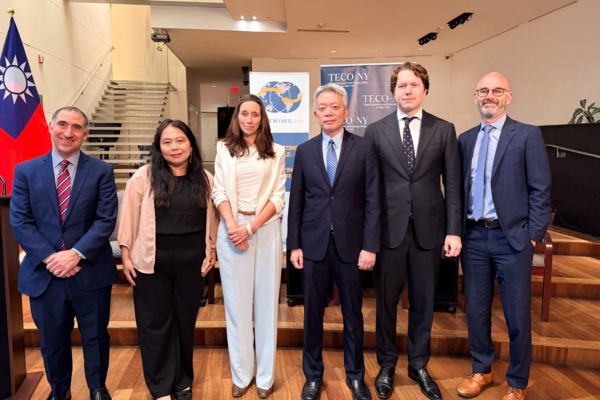
The Taipei Economic and Cultural Office in New York recently held a symposium titled “Taiwan’s Role in the US High-Tech Supply Chain: Opportunities and Challenges.” During the event, participants raised concerns about the potential weakening of Taiwan’s “silicon shield” as TSMC expands its investment in the United States. However, experts and scholars at the event believe that such concerns are exaggerated, as Taiwan’s advantages in the global semiconductor market are solid amidst its continuous expansion.
The New York think tank “Network 20/20” and the Taipei Economic and Cultural Office in New York organized the symposium on April 6, focusing on analyzing Taiwan’s role in the global high-tech supply chain, artificial intelligence competition, and the semiconductor industry ecosystem. Over 80 attendees, including officials from Taiwan’s diplomatic missions in New York and partner countries, think tank representatives, academia, business leaders, and journalists from both domestic and foreign media outlets, participated.
David Sacks, Asia Studies Fellow at the Council on Foreign Relations (CFR), emphasized that the narrative of the “silicon shield being hollowed out” is not reflective of the industry’s reality. He mentioned that even with TSMC’s successful investments in Arizona, Taiwan’s share in the most advanced manufacturing processes may still remain stable due to the rapid growth in global chip demand.
Sacks stressed that the US commitment to Taiwan goes beyond semiconductors, citing the Taiwan Relations Act passed in 1979, which was before semiconductors became a core industry, highlighting the strategic importance of Taiwan to the United States.
Regarding the highly specialized nature of the global supply chain, Adam Segal, Director of the Digital and Cyberspace Policy Program at the CFR, bluntly stated that any country aiming to completely detach from the global semiconductor supply chain is engaging in an unrealistic pipe dream. He emphasized Taiwan’s critical role in global chip manufacturing and testing, with around 90% of AI servers being produced in Taiwan. Segal also mentioned that by 2030, the US would find it nearly impossible to replicate the mature systems already established by TSMC in Taiwan.
Segal further expressed that even if US policies successfully drive domestic manufacturing, the scale would not pose a structural threat to Taiwan. Given talent cultivation and industry ecosystem constraints, supply chain specialization would naturally balance out in a market that continues to expand.
Stephen Ezell, Vice President of Global Innovation Policy at the Information Technology and Innovation Foundation (ITIF), provided data to support the discussion, indicating that US semiconductor manufacturing has declined from 37% in 1990 to 12% in 2020, with policy goals aiming for a moderate increase to 17-20% under the CHIPS Act.
Ezell highlighted the rapid growth of the global semiconductor supply chain manufacturing market, projecting a value of approximately $480 billion in 2024 and anticipating a $1 trillion market by 2030. He emphasized that the market expansion is not about zero-sum competition, but rather a continuously expanding market where the US increasing its share does not mean Taiwan will diminish in importance.
In terms of industrial structure, scholars underlined the high level of mutual dependence in Taiwan-US relations. Roselyn Hsueh, Political Science Professor at Temple University, pointed out that the complex interdependence in globalization persists, evidenced by Taiwan’s investments in the US and the establishment of research and development centers by 17 American companies in Taiwan.
Hsueh suggested that amidst the escalating US-China tech rivalry, deeper cooperation between the US and Taiwan is essential to maximize the benefits of this mutual interdependence.
Addressing the argument that industrial relocation could hollow out Taiwan, Hsueh dismissed this notion as overstated. She indicated that Taiwan’s investments in the US would not lead to a core shift in the value chain but rather foster a diffusion effect, promoting further multinational collaboration and industrial linkages. Hsueh emphasized that Taiwan’s technology and capital would generate a ripple effect between the US and Taiwan, further enhancing the industrial networks of both sides.
Hsueh highlighted another key advantage of Taiwan’s semiconductor industry – “trust,” encompassing technical capabilities, supply chain integration, and long-term cooperative relationships. Citing Jensen Huang, she noted that one of the key reasons companies choose to collaborate with TSMC is based on this foundation of trust.
When discussing how Taiwan and the US can cooperate to address the impact of supply chain disruptions caused by conflicts and potential collaboration methods, Ezell suggested that Taiwan and the US could collaborate on investing in high-tech industry innovation, while Segal pointed out that drone manufacturing is a potential area for cooperation between the two countries. Hsueh believed that Taiwan and the US should cooperate on trade infrastructure, business exchanges, and standard establishment.
During his address at the symposium, Director Lee Chi-Chiang of the Taipei Economic and Cultural Office in New York emphasized that Taiwan produces over 90% of advanced semiconductors, playing a critical role as a partner in the global advanced semiconductor industry. He highlighted the mutual complementarity between Taiwan and the US in the high-tech supply chain ecosystem, with Taiwan excelling in semiconductor manufacturing while the US holds advantages in branding and innovation.
Director Lee underscored that 2026 not only marks the 250th anniversary of the founding of the United States but also the 30th anniversary of Taiwan’s implementation of direct presidential elections. He expressed gratitude for the decades of cooperation between Taiwan and the US and the bipartisan support for Taiwan from the United States. In the future, Taiwan will continue to closely collaborate with the US and like-minded countries to maintain regional peace, stability, and shared prosperity, ensuring the resilience of the global supply chain.