
Recently, there has been a heated controversy surrounding the first prize-winning work of a photography competition in Fujian Province, which was allegedly generated using AI.
On December 18, the Fujian Tourism Development Group WeChat public account released the list of winners of the “Fresh Fujian, Encountering Travel Photography Competition,” revealing a total of 188 award-winning works. Among them were five first prize winners, ten second prize winners, twenty third prize winners, and 153 finalists. The first prize-winning work titled “Lake Autumn Mist” was credited to a certain Mr. Zhou, who received a prize of 1000 yuan and a “Fresh Fujian” cultural tourism benefit card worth 199 yuan.
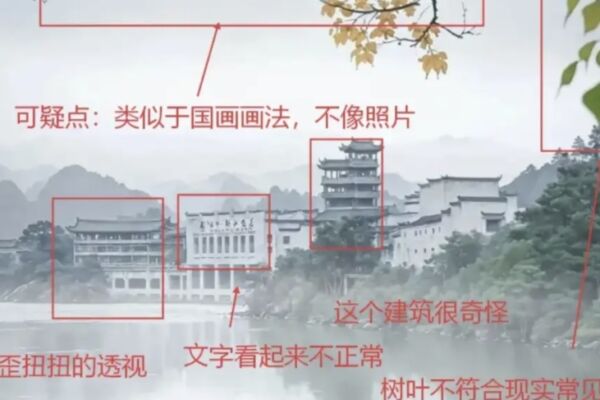
However, some netizens subsequently doubted the authenticity of “Lake Autumn Mist,” suggesting that it was generated by AI. They pointed out flaws in the artwork, such as irregularities in the foreground leaves, oversized and unidentifiable text on a building in the image, and distorted window outlines.
According to a report from the Elephant News in mainland China, a professional photographer from the Fujian Photographers Association carefully examined “Lake Autumn Mist” and found distortions in the building’s edges when zoomed in, as well as tilted and deformed contours of several windows. Despite six clear characters on the building, they were unidentifiable, leading to the conclusion that the work was likely generated by AI.
An AI graphics specialist analyzed that the texture and color of the leaves in the image appeared overly uniform, lacking the subtle differences typical in real photography due to factors like lighting and angles, resulting in an overall “excessively smooth” quality. These characteristics further indicate that the image was likely generated by AI.
The organizers responded to the allegations of “Lake Autumn Mist” being an AI-generated work, stating that they are currently conducting a comprehensive assessment and discussion. The competition rules explicitly exclude AI-generated works from participating, and they will strictly adhere to the terms of the announcement.
However, when questioned about the composition of the judging panel for the competition, the organizers’ staff stated that they were “unable to disclose” that information.
It is reported that this competition aimed to collect photography works featuring attractions, hotels, educational training centers under the Fujian Tourism Development Group, and benefiting resources of the “Fresh Fujian” cultural tourism card. The organizers clearly stated that submissions must be original images, prohibiting compositions, manipulated images, and AI-generated works. Participants were required to provide the accurate names of the shooting locations and guarantee the authenticity and originality of their works.
Netizens raised concerns, questioning the purpose of the judges and criticizing the awarding of a first prize to an AI-generated work. Some voiced frustration at the lack of transparency in the judging process and the prevalence of dishonest practices. They emphasized the importance of maintaining originality and the natural beauty of photography in competitions.
Photography enthusiasts commented that while AI technology has brought convenience to artistic creation, it is essential to remain vigilant and ensure that technological interventions do not undermine the uniqueness of artistic works. They stressed that the progress of AI technology should not be the sole criterion for judging art, and photography competitions should prioritize originality and the beauty of nature.