
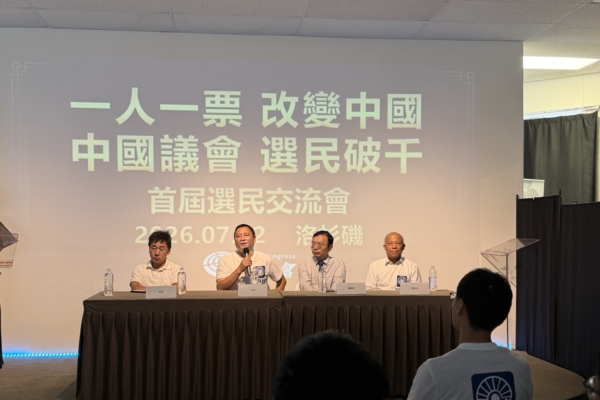
In January, the China (Interim) Parliament Preparatory Committee launched in Los Angeles has successfully attracted initial voters over the past six months, with the number of registered voters exceeding a thousand by early July. On the 12th (Sunday), at the Inaugural Voter Exchange Meeting held at the “June 4 Memorial Hall” in Los Angeles, attendees encouraged each other to “keep up the good work” to attract more Chinese to participate in the first council elections at the end of the year.
The enthusiasm of Chinese people at home and abroad for registering as initial voters for the China Parliament has pleasantly surprised many organizers, who expressed their gratitude during their speeches at the event. Wang Dan, the convener of the China Parliament, thanked the council staff and volunteers for their support and efforts. He believes that forming a party is a necessary step in the development of overseas democracy movements, and the establishment of the China Parliament marks a new historical stage.
“Our ultimate goal is to replace the Communist Party and establish a new political system in China. There may be an exile government in the future, but before that crucial step, we need a China Parliament,” Wang Dan said, emphasizing the critical nature of this step in the democratic movement.
The establishment of the China (Interim) Parliament Preparatory Committee announced its purpose: to provide a platform for Chinese people who are unable to express their will or whose political participation channels have been systematically blocked by the Communist system, in order to accumulate experience and consensus for the peaceful transformation of future Chinese society. The committee called on Chinese people at home and abroad to actively participate, register as voters, run for office, and work together to make Chinese people the true masters of their country.
Wang Dan encouraged attendees to redouble their efforts to attract more Chinese to participate in the parliamentary elections before the end of the year. He also expressed his anticipation for collaboration with like-minded individuals in Washington D.C. to elevate the China Parliament (Interim) onto the international stage.
Former Chinese human rights lawyer You Feizhe, in his speech, expressed, “It is an honor to be one of the inaugural voters. In China, just wanting to possess a ballot, just by taking such action, you will be accused of a crime of inciting subversion of state power or creating disturbances.”
“You are nothing without a ballot,” he said, emphasizing that not only do ordinary people lack the right to vote in China, but even provincial governors and party secretaries are similarly devoid of such rights. He remarked that China’s election system does not elect so-called people’s representatives, but rather selects obedient servants from among slaves.
He believed that the operation of the overseas China Parliament is a beneficial exploration because the authoritarian rule of the CCP is bound to be replaced in the near future. By intervening early and establishing power structures in a democratic manner, it helps Chinese society shorten the period of future power vacuum and instability.
According to members of the preparatory committee, some of the initial voters include secretly registered mainland Chinese voters. Due to the information blockade by the CCP, the vast majority of Chinese people are still unaware of the call to register as voters; even those who are aware may temporarily be unable to register due to the “Great Firewall” of the internet.
Representing the China Social Democratic Party, Liu Yinquan congratulated the breaking of the thousand-voter mark, saying, “At present, it seems relatively small, just a thousand people, but let me say this now: one day, it will surpass ten million.” He believed that the current “seeds,” given time, will blossom and bear fruit, sowing more “seeds.”
Liu Yinquan stated that the China Parliament is beneficial for integrating various forces, viewpoints, and people with different beliefs from both domestic and international sources. He noted that this platform can help everyone reach the “greatest common denominator,” making it well-suited for the development of the domestic and international situation in China.
The first batch of voters for the China Parliament also includes experienced Chinese political figures. Shi Qing, a former city councilor in Cremona, Alberta, Canada, was appointed as the convener for the China Parliament in Canada. He was sentenced to seven years in prison for participating in the 1989 democracy movement and settled in Canada after exile, where he was elected as a councilor three times.
Shi Qing stated, “Joining the China Parliament platform is the most meaningful thing I have done in my decades of activism.” He believed that this platform will provide talents and operational experience for China’s future formal parliament, allow voices of compatriots who cannot speak freely domestically to be heard, convey true public opinion to the international community, and unite various forces and opinions from overseas.
He mentioned that historical opportunities are present; the CCP has led China into a dead end. Now is the time to adopt the practices of Western parliaments, from electoral procedures to parliamentary rules, setting up a framework step by step that will swiftly establish a parliament that truly belongs to the people when China undergoes change.
Last year, exiled Hong Kong residents established their inaugural parliament, electing ten members; exiled Tibetans also founded a parliamentary organization decades ago. These experiences provide guidance and insight for the establishment of the current China Parliament (Interim).
Regarding the CCP’s frequent attacks on the parliamentary systems of Western countries, American lawyer Chen Chuangchuang pointed out that the vast majority of people in mainland China have never seen a ballot and do not know who is on it; the People’s Congress of the CCP lacks true representation of public opinion, ruling without the people’s mandate and lacking legitimacy.
Chen Chuangchuang concluded that establishing the China Parliament aims to overthrow the CCP’s authoritarian rule and engage in more robust political resistance.
The exchange meeting that day was chaired by members of the China Democratic Party, Yang Xiao and Yuan Jue, with seventy to eighty inaugural voters in attendance. Speakers included Jin Yan, executive director of the “June 4 Memorial Hall,” Wen Zuotuan, a former human rights lawyer and UK district convener, Geng Guanjun, Secretary-General of the China Parliament (Interim), and volunteer representatives.