
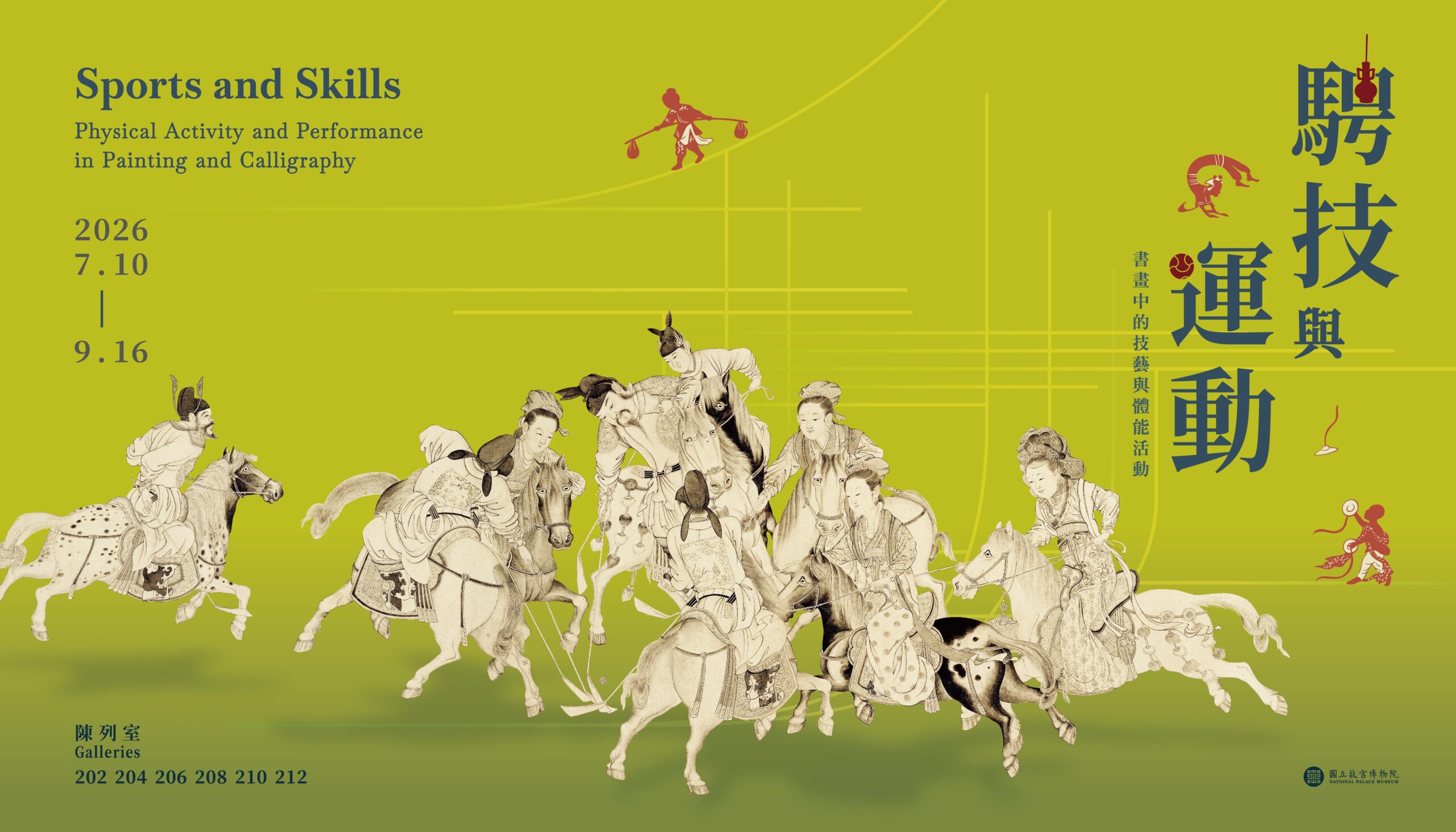
The National Palace Museum’s northern branch in Taiwan has launched a special exhibition titled “Skills and Sports – Techniques and Physical Activities in Painting and Calligraphy,” which offers a broad view of “sports” today to introduce audiences to the rich diversity of ancient skills, competitions, performances, and physical activities depicted in paintings and calligraphy.
During the summer season, with domestic and international sports events in full swing, the National Palace Museum in Taiwan welcomes visitors to explore the exhibition to witness depictions of activities such as kicking a ball, horseback riding, ice skating, and mountain climbing in paintings and calligraphy, showcasing the agility and vitality across time and space.
Curator assistant researcher Pu Li’an from the Painting and Calligraphy Documentation Department of the National Palace Museum in Taiwan mentioned that the term “sports” today encompasses various forms of individual training, group competitions, hiking, and more. Although ancient times lacked a unified terminology, words like “archery,” “art,” “skills,” “games,” and “recreation” were used to differentiate different physical activities and skill demonstrations.
The exhibition is divided into four sections: “Martial Arts and Rituals,” “Ball Games and Competitions,” “Impressive Feats,” and “Mountain Summit Views,” juxtaposing the concepts of “skills” and “sports” across time and space. It showcases the sense of speed and vitality depicted in paintings, from ball games, ice racing, performance displays, to admiring distant mountain views.
Interactive experiences have been set up within the exhibition for visitors to physically participate in the body skills depicted in the paintings and calligraphy. These include challenges like pottery tossing in a multimedia interactive area, close examination of artworks through a large interactive screen, and an augmented reality experience of “Along the River During the Qingming Festival,” comparing different versions of the painting for a more immersive journey into the world of painting and calligraphy.
The motif of ball games in the artwork resonates most with the audience’s familiarity with sports competitions. The National Palace Museum’s collection showcases activities similar to today’s soccer in ancient paintings, such as cuju, as well as polo sports with riders hitting balls, portraying individuals exhibiting their skills in attack and defense, speed, and coordination. Song dynasty artist Su Hanchen’s “Juchang Congxi” portrays a group surrounding a ball, with similarities in appearance to the figure kicking a ball in the museum’s “Portrait of Emperor Taizu of Song,” echoing the Emperor’s reputation for cuju expertise.
In the Qing dynasty painting “Emperor Minghuang Playing Polo” by Ding Guanpeng, the competition is depicted on horseback, with goalposts and goalkeepers on either side, while Emperor Xuanzong and his concubines, officials, and attendants gallop among them. Mainly done in fine lines with a blend of Western painting techniques, the artwork creates a sense of light and shadow and three-dimensionality, vividly showcasing the speed and momentum of equestrian sports in ancient times.
Apart from field competitions, various skill demonstrations are also captured in the paintings and calligraphy at the museum. The Qing dynasty’s Shen Yuan’s “Ode to Skating in the Imperial Court” brings the focus to winter ice activities, with skaters gliding on the Taiye Pool, forming winding queues, showcasing a blend of training and entertainment in the Qing court’s ice activities.
The Han dynasty’s “Rubbing of Illustrated Sculpture of Various Acrobats” features skilled performers tossing and catching round balls, balancing on plates while drumming, and performing handstands on layered stands, reflecting the bustling atmosphere of the hundred-act performances during the Han dynasty. Shen Yuan’s “Along the River During the Qingming Festival” depicts street performances such as outdoor stage plays, tightrope walking, and martial arts in the market streets, vividly presenting the lively scenes of ancient street performances.
Although seemingly static, calligraphy actually embodies rhythmic body movements. Zhang Xu’s “Self-Portrait in Cursive Script” mentions drawing inspiration from a dance posture of an elderly lady named Gong Sun, translating the rhythm of dance into writing movements. While undertaken as a later imitation, the work still exhibits strong visual tension of wild cursive script, showcasing the speed and dynamics of calligraphy strokes.
Regarding today’s familiar activity of mountain climbing, the National Palace Museum in Taiwan notes that in ancient times, it was often associated with cultural meanings such as religious rituals, processions, sightseeing, and self-cultivation. The Song dynasty’s Xue Shaopeng in the “Miscellaneous Writings” records the experience of mountain climbing in the poem “Poem of Yunding Mountain,” describing the steep and challenging mountain terrain and the joy of overlooking mountains and distant peaks after enduring hardship.
In the Qing dynasty painting “Autumn Scenery of Huashan” by Wang Yuanqi, the artist depicted his journey to Huashan, describing the mountain-climbing experience and expressing regret for not reaching the peaks. Through the repeated climbs, writings, and depictions by literati and artists from various dynasties, the beauty of famous mountains continues to be passed down in poetry, literature, paintings, leading the audience into the ancient travelers’ mountain journeys.
The National Palace Museum in Taiwan welcomes the public this summer to step into the museum and appreciate the ancient sporting events portrayed in paintings and calligraphy. Through the special exhibition “Skills and Sports – Techniques and Physical Activities in Painting and Calligraphy,” visitors can witness the dynamic images of racing, competing, showcasing skills, and embarking on journeys depicted in the museum’s paintings and calligraphy, feeling the passionate allure of skills and sports.