
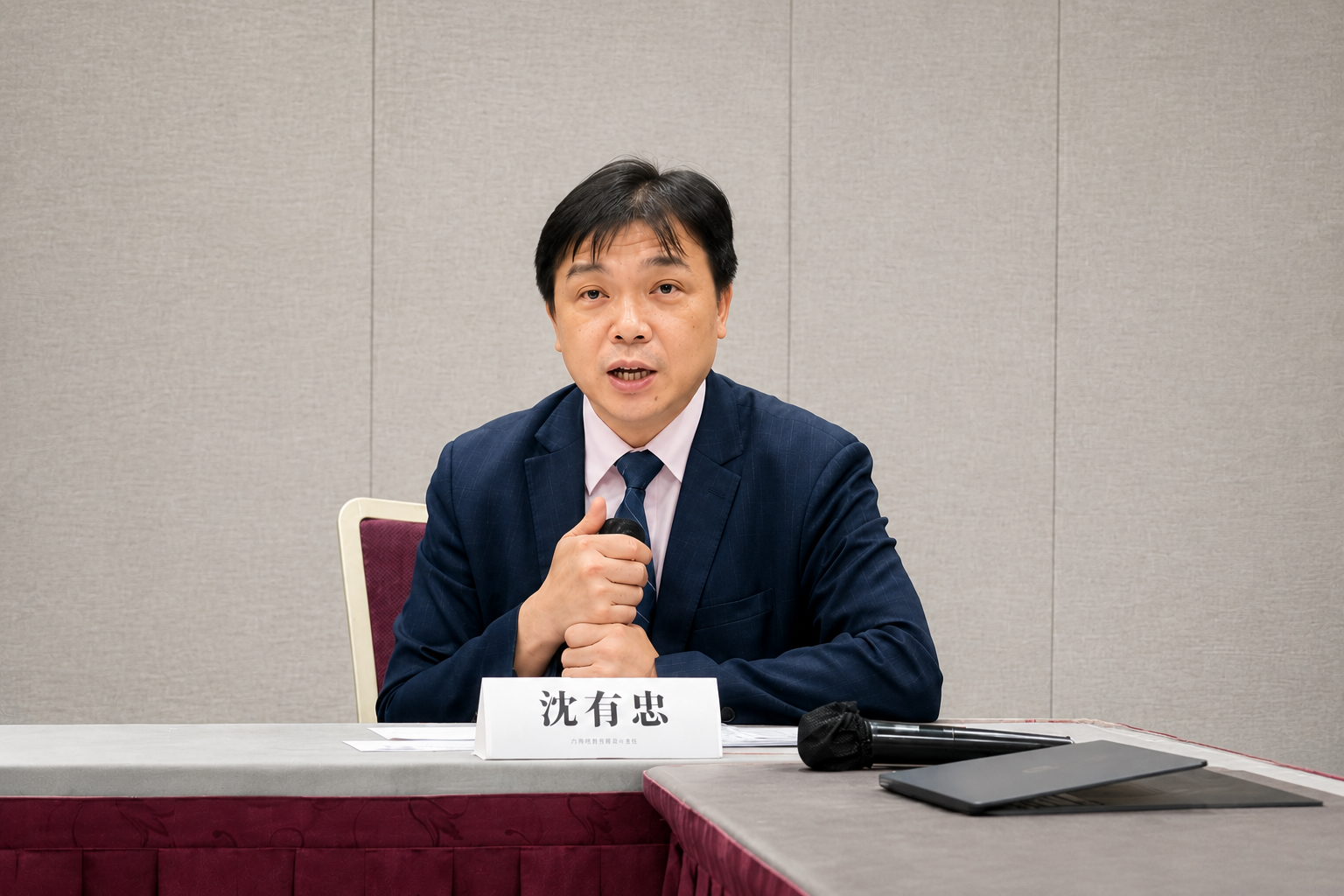
The Vice Chairman of the Mainland Affairs Council of the Republic of China, Shen Youzhong, attended a seminar on “The Impact of the National Unity and Progress Promotion Law on Cross-Strait Exchanges” on the 14th. He warned that the Chinese Communist Party’s actions add uncertainty and risks to cross-strait exchanges.
Since the official implementation of the “National Unity and Progress Promotion Law” by the Chinese Communist Party on July 1, Shen Youzhong pointed out that this law represents a drastic change in the CCP’s legal tactics towards Taiwan, continuing to undermine the current state of cross-strait relations.
According to Shen Youzhong, this law should not be seen as an internal administrative norm of the CCP, but rather as part of their recent efforts to legalize, institutionalize, and normalize extraterritorial jurisdiction and cross-border repression towards Taiwan, presenting unprecedented challenges to the national security and social stability of the Republic of China.
Shen Youzhong mentioned that the vague provisions with extraterritorial effects in the “National Unity and Progress Promotion Law” extend political jurisdiction and ideological control globally, imposing cross-border repression on democracy and freedom advocates, causing high levels of concern from international communities such as Japan, the United States, Canada, and the European Parliament.
Regarding the attack on journalist Yabe Akio on July 6, Shen Youzhong highlighted it as the first case of cross-border repression following the implementation of the “National Unity and Progress Promotion Law.” Through coordinated efforts across departments, the police swiftly arrested the suspect, demonstrating the effectiveness of the government’s countermeasures.
Shen Youzhong noted the strong condemnation from bipartisan lawmakers in Japan after the attack on Yabe Akio, as well as the critical editorial by the Japanese newspaper “Sankei Shimbun” condemning the law for undermining freedom of speech and enabling cross-border repression. Thirty-seven human rights organizations in Taiwan also called for international resistance, indicating global concern over the law and the case. The Mainland Affairs Council has continuously issued warnings about the risks of this law, contrary to some portrayals in certain media outlets.
Addressing the possibility of involvement of overseas forces, such as Hong Kong triads, in the attack on Yabe Akio, the spokesperson for the Office of the President of the Republic of China, Guo Yahui, emphasized the government’s commitment to investigating and combating any transnational repression aimed at suppressing diverse voices globally, in collaboration with like-minded countries.
Guo Yahui stressed that Taiwan is a democratic rule-of-law country that will not tolerate any external authoritarian forces using gangs, violence, or intimidation to oppress or attack advocates of freedom and democracy. To protect national security and citizens from harm, any involvement in unlawful activities, whether directly or through providing information or aiding the perpetrators, will be rigorously investigated and prosecuted.
Furthermore, Shen Youzhong pointed out that the “National Unity and Progress Promotion Law” of the CCP explicitly requires armed forces, social organizations, and business entities to obey the leadership of the Chinese Communist Party under the guise of national unity, serving as a legal foundation for Xi Jinping’s potential fourth term at the 21st Party Congress. It aims to solidify the CCP’s authoritarian leadership, Xi Jinping’s single leadership, and lifetime rule under the banner of national unity.
Shen Youzhong clarified that the government, following President Lai Ching-te’s directives, will actively engage in prevention, protection, and countermeasures, while continuing to collaborate with democratic allies to resist cross-border repression and uphold the universal values of freedom, democracy, and human rights.
In conclusion, Shen Youzhong once again urged the public to carefully assess the risks of traveling to the mainland and emphasized the government’s commitment to mitigating the negative impacts of the CCP’s “National Unity and Progress Promotion Law” on cross-strait exchanges. Through various means, the government aims to enhance public awareness of mainland China, unite the people in defending Taiwan’s democracy and freedom.
Shen Youzhong emphasized that the government strongly opposes the CCP’s use of violence and legal intimidation to silence Taiwanese society, and will continue to reinforce efforts to maintain the peaceful and stable status quo across the strait, while collaborating with the international community to monitor and address CCP’s actions of cross-border repression.