
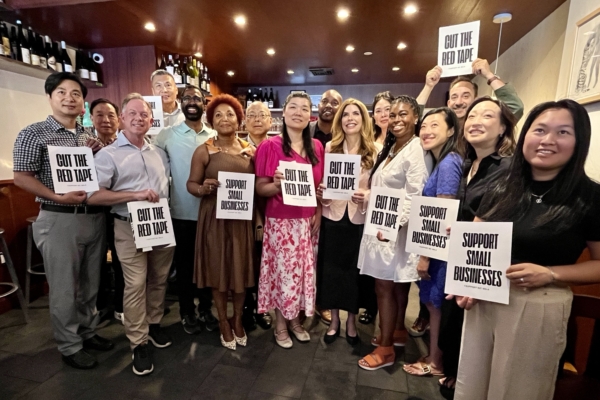
New York City Council Speaker Manning, along with Councilwoman Zhuang Wenyi and several other council members, the NYC Hospitality Alliance, and small business owners, held a press conference at the “Lei” restaurant in Manhattan’s Chinatown on the 13th, announcing two pieces of legislation to support small businesses. The aim is to reduce bureaucratic procedures, lower fines and fees, and simplify the city government’s approval and inspection processes.
Manning stated that small businesses are the backbone of New York City’s economy, but the current system is filled with red tape. Businesses have to deal with multiple departments like the Buildings Department, Fire Department, Health Department, and Environmental Protection Department, leading to lengthy approval processes and increased operating costs in various fines.
Last year, nearly 5,000 small businesses closed in New York City, surpassing the number of new businesses opening, a shocking and unacceptable phenomenon. Manning stated that the City Council will propose a bill to establish a “Quadrennial Regulatory Review Committee” to review business regulations, fines, and licensing systems every four years and make reform recommendations to establish a long-term monitoring mechanism.
Zhuang Wenyi introduced her “Red Tape Relief Act” (Intro. 955-A), which calls for the mayor to establish a cross-departmental coordination mechanism, integrating city departments such as the Buildings Department, Fire Department, and Health Department. She proposed modeling it after the New Business Acceleration Team (NBAT) during Mayor Bloomberg’s term to prioritize assisting restaurants and daycare centers in speeding up their opening process.
She mentioned that a restaurant in her district had been unable to open for four and a half years, resulting in a loss of up to $2.5 million. Another daycare center has been waiting for months without obtaining a Certificate of Occupancy (CO), reflecting how the current system has significantly hindered the development of small businesses. She emphasized that the government should be a partner to small businesses rather than just an enforcer who issues fines.
Chairwoman Shanel Thomas-Henry of the City Council’s Small Business Committee expressed that many entrepreneurs invest their life savings in renting stores, renovation, and hiring employees. However, due to a lack of coordination among departments, they are unable to open for business in the long term. She emphasized that true support for small businesses starts from the first application process, not just on ribbon-cutting day.
Andrew Rigie, Executive Director of the NYC Hospitality Alliance, pointed out that restaurants need to deal with multiple city departments like the Buildings Department, Fire Department, and Health Department simultaneously. However, lacking coordination among these departments, different inspectors sometimes have different requirements, leading to delays in inspections and subsequent processes. He stressed that these delays must stop and urged for the swift passage and enactment of the bills.
The owner of the “Lei” restaurant, Ms. Shi Hui, operates four Manhattan restaurants. She entered the food industry hoping to bring happiness to customers through food and wine, not to deal with bureaucratic regulations every day. She mentioned that most businesses are willing to abide by the law but are unsure of what the government truly requires, especially with regulations constantly changing. Small businesses lack the resources to hire representatives or professional consultants, unable to afford the rent and payroll costs incurred by delays in opening, hoping for clearer and more consistent guidance from the government.
Mr. Chen, a major investor in a restaurant in Coney Island, shared his own experience of heavy losses caused by administrative delays. He stated that he operates restaurants in Long Island, Flushing, and Manhattan, with 11 restaurants currently running, except for a new restaurant in Coney Island that cannot open due to the Fire Department delaying the approval of the kitchen’s automatic fire suppression system for over four and a half years.
“We submitted all the documents over two years ago, the restaurant’s construction is completed, but the Fire Department hasn’t come for inspection even once and hasn’t told us what doesn’t comply with regulations,” he said. All projects were constructed by large professional American companies according to regulations. He believed that what truly impedes businesses is administrative efficiency, rather than the businesses themselves.
Chen Zuozhou, Executive Director of the Chinatown Business Improvement District, mentioned that many historical buildings in Chinatown face difficulties in opening businesses due to current regulations like the Americans with Disabilities Act (ADA). He revealed that an Indian business owner invested over $500,000 and eventually gave up on opening a store due to incomplete procedures.
Even just to add two outdoor tables, multiple administrative procedures and coordination were required. “We really need to cut off those ‘red tapes’ that hinder small businesses,” he said, calling on the city government to continue pushing for regulatory reforms for more small businesses to smoothly establish themselves in New York.