
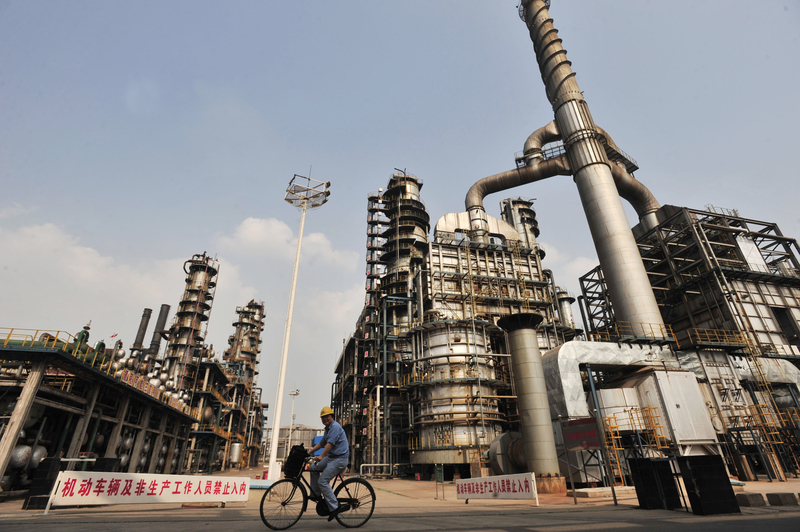
The escalating conflict between the US and Iran once again puts the Middle East in the spotlight of the global financial markets. Reports reveal that the Chinese government has ordered major domestic oil refineries to maintain high production levels. However, analysts believe that with high gasoline and diesel inventories, this move could exacerbate economic imbalances.
On July 12th local time, the Iranian Islamic Revolutionary Guard Corps announced the closure of the Strait of Hormuz, prohibiting any vessel from passing through. Subsequently, the US military announced it was launching a new round of attacks against Iran. On July 14th, the US declared its intention to take control of the Strait of Hormuz.
Citing data from maritime monitoring agencies, Bloomberg reported that on July 12th, there was “virtually no visible navigation” in the Strait of Hormuz, with only two oil tankers approaching the strait. Data from the international market services firm Kepler showed a continuous decrease in ship traffic through the Strait of Hormuz in recent days, dropping from tens of ships per day in early July to single digits, reaching the lowest levels in weeks, significantly below the pre-war average of over 100 ships per day.
The International Energy Agency warned that if shipping in the strait remains stagnant, the outlook for crude oil supply will significantly deteriorate. The IEA Director, Fatih Birol, stated that the daily oil supply in the Gulf region is currently only 16 million barrels, a substantial decrease from the pre-Middle East conflict level of 24 million barrels.
China is the world’s largest importer of crude oil. Public data shows that over 90% of Iran’s oil had been flowing to China’s refineries, with most of the oil revenues going to the Islamic Revolutionary Guard Corps (IRGC).
According to an exclusive report by Bloomberg on July 11th, the Chinese National Development and Reform Commission has instructed several large oil refineries to maintain a high level of fuel production. Insider sources revealed that despite the current high gasoline and diesel inventories in the mainland and the structural slowdown in domestic fuel demand, at least two major oil refineries have been instructed to maintain or even increase their refining processing rates.
The report suggests that this directive from the Chinese authorities may have a broader impact on the regional fuel market, as the higher operating rates of Chinese refineries are expected to further compress already weak refining profit margins.
It was reported that China’s transportation network is becoming electrified, especially with the proliferation of new energy vehicles and electric trucks, leading to a decrease in fuel demand. Institutions like PetroChina predict that domestic refined oil consumption will accelerate its decline by over 6% in 2026. Forcing high operating rates amid a structurally declining end-consumer market will result in a rapid accumulation of domestic gasoline and diesel inventories, forcing refineries to face skyrocketing storage costs and product devaluation risks. This will directly lead to severe overcapacity in downstream traditional plastics, chemical fibers, and other common materials.
Political observer Xia Yan believes that state-owned large refineries like Sinopec and PetroChina, by producing for political reasons in times of sluggish consumption and low demand in China, directly harm the operational performance of listed central enterprises, ultimately requiring policy subsidies or extensions of credit from state-owned banks to cover losses. In an environment of extremely compressed profits, government resources and import quotas typically lean towards state-owned large factories. Private oil refineries in regions like Shandong, due to their small scale and poor risk resistance, will be impacted in the high-output, low-profit “zero-sum game.” The shutdowns and production cuts of small and medium-sized local refineries will directly translate into fiscal revenue losses for local governments, triggering unemployment risks in certain chemical industry chains, and further exacerbating economic imbalances.