
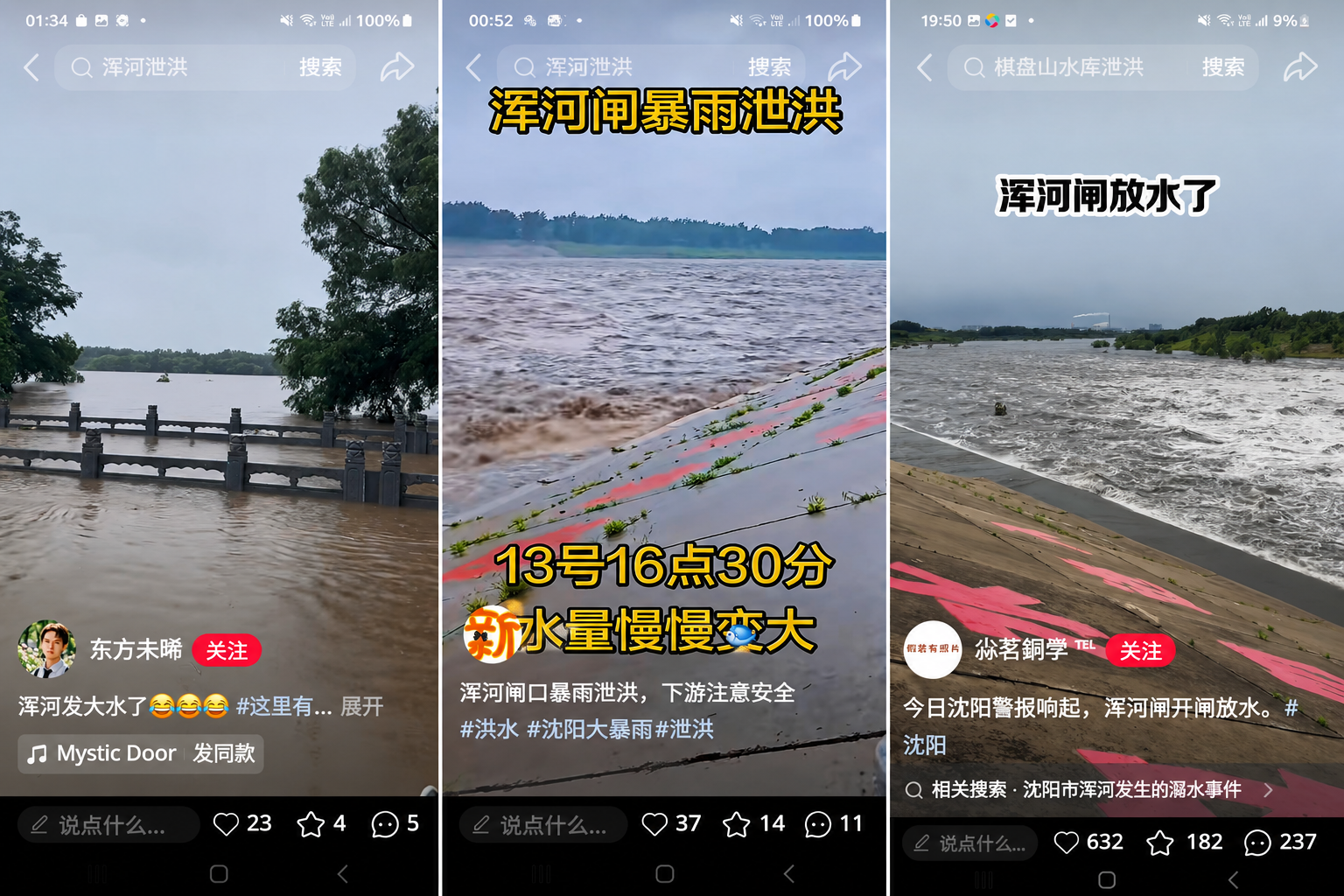
On July 13th, due to the influence of the residual circulation of a typhoon, continuous heavy rainfall, and the impact of flood discharge from the Huan River, Shenyang turned into a rare “sea-viewing mode” in recent years. In some sections where the water was deep, floodwaters submerged car roofs, city traffic was disrupted, and authorities announced the suspension of classes, work, and market activities, putting the entire city in a state of standstill.
According to live broadcasts from local media on mainland social media platforms, Shenyang’s main roads have turned into vast seas, with some bridge piers completely submerged. The accumulated water has covered the entire bridge tunnel, with a very strong water flow. Even the roads on the bridges have been submerged, reaching up to pedestrians’ knees.
The water depth on the main roads is at least 1.8 meters, and the anchor vividly described, “Those who don’t know might mistake this live broadcast for a river in front of them, but it’s actually a city’s main road.”
He emphasized, “Whether pedestrians, non-motorized vehicles, or motor vehicles, no one can pass through this flooded section, as it’s completely blocked.” Notices have been issued to suspend classes, work in factories, and business activities.
According to the anchor, the heaviest rainfall in Shenyang was from early morning to 8 am on the 13th. Compared to other cities, this “city sea-viewing” situation in Shenyang is relatively rare. Many people didn’t anticipate the rainfall being so heavy and didn’t move their cars in advance, resulting in many vehicles being soaked.
Videos online on July 12th and 13th showed floodgates of the Huan River being opened during heavy rainfall. Local residents who visited the site and filmed videos said, “Shenyang is experiencing continued heavy rainfall, causing the water level of the Huan River to rise dramatically.”
The anchor further mentioned that this round of heavy rainfall has significantly raised the water level of the Huan River in Shenyang. The river appeared yellow and turbulent, with the riverside walkways and waterfront platforms submerged, and some trees near the water’s edge were partially submerged at their roots. The river width has expanded considerably from usual. Currently, the Huan River has activated flood discharge scheduling to address the changes in water levels brought by the rainfall.
In videos by local residents, the volume of water released at 4:30 pm was gradually increasing.
Another blogger uploaded a video showing the flooding of the Huan River. Initially, some railings were visible, but half an hour later, the entire railing had been submerged, vividly illustrating how quickly the water level rose due to the flood.
Public records show that the Huan River is Shenyang’s mother river, flowing through the urban area and serving as the city’s primary flood control and water supply. Once the watershed experiences heavy rainfall, the changes in river water levels directly impact the city’s flood control safety.
A week prior on July 4th, the Huan River had also released water. Liaoning Province had encountered severe convective weather with localized heavy rainfall, leading to two fatalities in Fushun due to the heavy rain. At that time, the urban flooding in Shenyang was not as severe as the current situation.
Many local residents expressed dissatisfaction in the comments section of the videos showing the Huan River’s floodgate operations. Some said, “The lessons from 1995 should have taught us to open the floodgates earlier and gradually ease the flow ahead of time. Why wait until the water levels become critical before releasing water? What were they thinking?” Others mentioned, “With weather forecasts available, water should have been released earlier instead of waiting until it becomes a necessity.”
Many believed that the flooding in the Huan River was due to the discharge from the Da Huaifang Reservoir upstream, causing the Huan River to be overwhelmed.
Public records indicate that the Da Huaifang Reservoir, located upstream of the Huan River, is a crucial large reservoir for controlling the river’s floods. All floodwaters flowing toward Shenyang pass through the Da Huaifang Reservoir for regulation. During prolonged upstream heavy rainfall, the reservoir typically needs to balance flood control and water storage, leading to close monitoring by authorities of its water levels and discharge volume.
However, Liaoning Province’s public records rarely mention the daily discharge volumes of the Da Huaifang Reservoir, Guanyin Pavilion Reservoir, or the various control gates of the Huan River. The focus is primarily on storm warnings, flood alerts, flood prevention notices, and urban drainage.
Based on the urban river water system information released by Shenyang authorities, the water level of the Huan River has reached close to the alert height.
By 2 pm on July 13th, the water level at the Shenyang Water Hydrological Station of the Huan River reached 37.99 meters. Officials announced the formation of the “First Flood of the Huan River in 2026,” requiring areas along the river and relevant departments to enhance their flood prevention measures.