
Recently, Beijing announced the successful recovery of a reusable rocket for the first time, which was heavily promoted by state media. Experts pointed out that there is a huge technological gap between China and the United States, especially in terms of the number of times rocket boosters can be reused and operational costs, with the fundamental difference being a systemic issue.
According to CCTV, the Long March 10-B carrier rocket launched from the Hainan Space Launch Center on July 10 successfully separated its rocket booster from the upper stage, which then descended vertically and was captured by a recovery net on a sea platform about 6 minutes later. This mission also successfully placed a satellite into the intended orbit.
The global demand for satellite constellations is rapidly increasing. Reusable rocket boosters can significantly reduce the cost of space missions, making large-scale satellite constellation deployment, deep space exploration, and manned lunar missions economically feasible. Chinese state media hailed this test as a “milestone” breakthrough, declaring China to be the “second country mastering the technology of large liquid rocket recovery.” Chinese netizens were exuberant about this achievement.
However, from an external perspective, there is still a significant gap between China and the United States in reusable rocket technology.
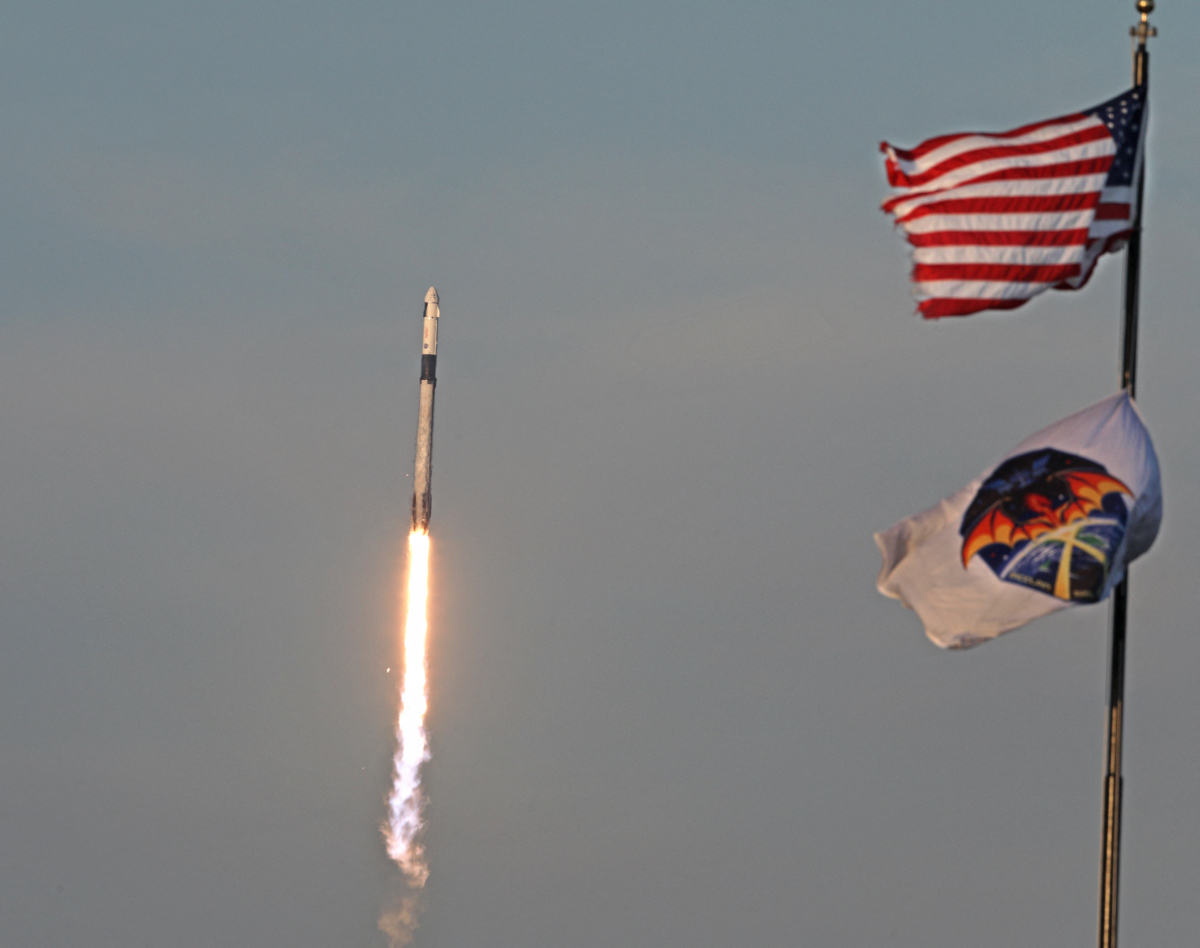
As early as December 2015, the American space exploration company SpaceX successfully carried out the first recovery of the Falcon 9 rocket booster. SpaceX has industrialized this technology: Falcon 9 rockets are now launched about 150 times annually, averaging about three launches per week, with each booster being reusable dozens of times. In contrast, China’s Long March 10-B has only completed one recovery. China plans for only one reuse this year, while SpaceX boosters are usually ready for the next launch within about three weeks.
Su Ziyun, Director of the Institute of National Defense Strategy and Resources at the Taiwan Institute for Defense and Security Studies, told Epoch Times that SpaceX has mature and efficient recovery technology, which can significantly reduce costs. China is currently just trying to catch up rapidly. The second issue is the hardware difference in electronic technology.
He explained that SpaceX uses the most advanced chip processes, enabling its microsatellites and low-orbit satellites to be compact, lightweight, and have excellent communication capabilities. China’s current chips cannot go below 7 nanometers in process, requiring relatively large chip arrays to achieve the same computing performance. This adds to the weight of the rocket launch, with larger power consumption for low-orbit satellites.
Su Ziyun said that TSMC’s advanced process chips are at the forefront. Whether it is fighter jets, missiles, or low-orbit satellites, China cannot utilize advanced processes, leading to an outdated, bulky design.
Regarding the technological gap between China and the US in aerospace, senior military commentator Mark told the Epoch Times that it fundamentally stems from a systemic issue: SpaceX, led by Musk, is a commercial company pursuing maximum commercial benefits. Everything they do aims to increase usage as much as possible, keeping operations continuous and streamlined like a production line. Falcon 9 launches continuously throughout the year, reducing costs significantly and simplifying logistics and maintenance.
Another aspect to consider is the refurbishment speed, also known as the interval for reusing first-stage rockets. SpaceX once achieved a record of approximately 9 days. The standard turnaround interval is roughly three weeks. The Falcon 9 has reached a maximum reuse of 36 times for a single rocket, highlighting its durability.
Mark noted that in contrast, China’s approach follows a whole-nation system, primarily focusing on state-owned companies for rocket launches. Beijing’s China Academy of Launch Vehicle Technology and Shanghai Academy of Spaceflight Technology each designed numerous models, such as the Long March series rockets. The array of rocket types limits the number of launches for each type annually, hindering economies of scale and preventing a reduction in launch costs.
“The Chinese rocket development is still of the old Soviet-era mindset, creating a plethora of models, with the two space institutes competing against each other for business. In reality, the launch frequency for each model is quite poor, lacking economies of scale, and the launch costs fail to decrease,” Mark said.
In recent years, China has seen some private aerospace companies entering into space launch fields through private funding, but their scale is small, and they can only launch small satellites. With China’s worsening economic conditions, private funding is finding it increasingly difficult to penetrate the aerospace sector.
Mark stated that aside from SpaceX, other successful companies in reusable rocket recovery in the US include Blue Origin and Rocket Lab. “The vast gap between China and the US is essentially a systemic one. Without systemic changes, China cannot achieve the same level of efficiency and innovation as the US.”
In this mission, China did not adopt Elon Musk’s SpaceX pioneered method but utilized a sea-based cable system, known as “net recovery.”
SpaceX’s Falcon 9 relies on deployable landing legs to autonomously land on ground landing pads or on recovery ships at sea. In contrast, China’s system uses four “landing hooks” to grasp a large recovery net suspended above the sea platform.
Chinese state media lauded it as a “globally pioneering success in sea-based net recovery” and claimed China had even surpassed its Western counterparts. Chen Muye, a technical expert in Chinese carrier rocket technology at China Aerospace Science and Technology Corporation, told Xinhua that this net recovery method simplifies the rocket structure, reduces body weight, improves launch payload capacity, and enhances adaptability to deviation in landing points.
However, Su Ziyun told Epoch Times that China’s method of using nets for recovery cannot be compared to the techniques employed by American companies like SpaceX and Blue Origin.
“SpaceX and Blue Origin land precisely at a point, enabling the use of landing legs or fixtures to secure the rocket. Their error margin may need to be controlled within tens of centimeters. China’s use of nets signifies that its terminal control technology is not yet precise, thus requiring a larger area to net the rocket.”
From the perspective of missile technology or control technology, the US can achieve a 10-centimeter error margin, while China may have a 10-meter level of error, indicating a considerable difference, Su Ziyun explained.
Mark added that China’s use of a mesh device for recovery, though a global first, was a method initially considered by SpaceX, which eventually found it to be unsuitable and continued with the landing leg approach.
He believes that a mesh device for recovery faces a major issue where the rocket’s weight upon landing cannot be too heavy due to cable loading restrictions. Additionally, after landing, it may sway with the waves, making quick stabilization difficult.
Currently, the commonly used method remains landing legs for descent. As for which technique is superior, it remains to be seen. Mark anticipates that after the first successful recovery, China will encounter numerous challenges that need resolution. Only once they find it feasible will they continue to progress.
Mark also mentioned that China’s Long March 10-A rocket is a direct competitor to the Falcon 9. The successfully recovered Long March 10-B in this mission is designed in size to match the Falcon 9, slightly larger and likely heavier. Falcon 9’s entire system is designed to be more lightweight, with greater thrust and higher orbital capability.
Mark stated that China has been following the most advanced American advancements, now having methane and liquid oxygen rocket technology and recovery technology, transitioning from nothing to achievement, resulting in domestic propaganda.
However, Mark pointed out that SpaceX’s Falcon 9 is transitioning to the Starship stage, where launch costs will be exceptionally low, and full recovery is possible. “The US is moving towards the era of Starship. China can only continuously steal and learn, playing catch-up from behind.”