
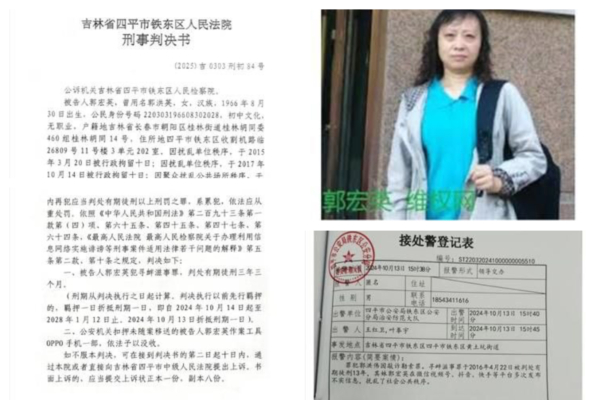
Jilin rights activist Guo Hongying, who has been seeking truth for her brother Guo Hongwei’s death in prison, was taken away by the police for requesting a second forensic examination. After nearly 20 court hearings, on May 22, 2026, she was sentenced to 3 years and 3 months in prison for “provoking trouble”.
This is Guo Hongying’s second imprisonment seeking justice for her brother.
In 2003, Guo Hongwei, the retired head of the Fushun Songjiang River Power Plant in Jilin Province, was sentenced to 5 years in prison for “extortion” after refusing to help retiree Chen Guogui write off over 23,000 yuan of false hospitalization receipts.
After being released in 2008, Guo Hongwei, along with his parents and sister Guo Hongying, fought for justice for the wrongful imprisonment of the 5 years. In May 2014, Guo Hongwei was arrested in Beijing and subsequently framed by the local government, sentenced to 13 years for “extortion” and “provoking trouble”. The following year, his mother Xiao Yunling was also sentenced to 6 years on the same charges, released on medical parole in 2020.
After her brother and mother were imprisoned, Guo Hongying continued to seek justice for her family. In 2018, she was sentenced to 5 and a half years for “obstructing official duties” and “provoking trouble”.
On April 9, 2021, Guo Hongwei, serving a sentence at the Princess Ridge Prison, died of a sudden cerebral hemorrhage. The family doubted the cause of death, questioning, “Did he suffer inhumane treatment before his death? Why have medical records not been released? Why was the application for medical treatment ignored?”
On February 1, 2023, Guo Hongying was released from prison. After her release, she continued to seek the truth about her brother’s death, demanding a second forensic examination, leading to her being taken away by the police in Beijing. She was criminally detained on October 14, 2024, arrested on October 20, 2024, and indicted on April 17, 2025. Guo Hongying’s case has undergone nearly 20 court hearings, with the prosecutor recommending a sentence of 2 years and 7 months, yet the court handed down a heavier sentence of 3 years and 3 months.
Guo Hongying’s father stated, “Although the trial has been ongoing for so long, the procedures have been consistently illegal.”
The prosecuting authority accused Guo Hongying of continuously creating and spreading false information since April 9, 2023, to stir up public opinion and create pressure, leading to a large number of netizens clicking, browsing, reposting, and commenting on various online platforms.
The prosecuting authority also claimed that, especially after Guo Hongying’s criminal detention, the previously disseminated false information continued to ferment, attracting significant attention, reposting, and speculation from domestic and foreign netizens, maliciously attacking the government of the People’s Republic of China, causing a negative social impact.
Guo Hongying’s first trial defense counsel, Man Zongli and Wang Wei, who are not lawyers, argued that the first-instance court had systematically and fundamentally violated procedures, deprived the defense rights and the right to cross-examine, failed to clarify key doubts, leading to the lack of substantive trial of the case, serious procedural unfairness, and a purely formal trial. The court unreasonably rejected all legitimate requests from the defense, blocking the channels for obtaining evidence and presenting evidence. Unlawfully limiting non-lawyer defense representation caused “defense without access to case file”.
Wang Wei said, “The violations of procedure mentioned above have resulted in the case not undergoing a legally valid substantive trial. According to Article 238 of the Criminal Procedure Law, the original verdict should be revoked and sent for retrial.”
Fujian rights activist Wang Xiuying, upon receiving the verdict of Guo Hongying’s first trial from the Tiedong District People’s Court of Siping City sent by Guo Hongying’s father, wrote an article titled “Guo Hongying Case: The Dilemma of Familial Appeals and Judicial Determination”.
The article stated, “Guo Hongying’s case, like a prism, reflects the complex tension between familial appeals, petitioning, and judicial determination in contemporary grassroots legal practice in China. This sister, who fought for justice for her brother who died in prison, is now behind bars! The Tiedong District Court of Siping sentenced her to 3 years and 3 months in prison for ‘provoking trouble’.”
On April 9, 2021, Guo Hongwei, serving a sentence at the Princess Ridge Prison, died of a sudden cerebral hemorrhage. The family doubted the cause of death: Did he suffer inhumane treatment before his death? Why have medical records not been made public? Why was the application for medical treatment ignored? “These questions are like thorns, piercing into Guo Hongying’s life. She refused to cremate the body, continued to appeal, and even when she went to Beijing in October 2024 to arrange for a second autopsy, she was taken away by the police.
“The court’s judgment determined that Guo Hongying had already crossed the line: she fabricated false information such as ‘Guo Hongwei was murdered’ and ‘judicial injustice’ on Weibo, TikTok, and in 46 petition WeChat groups (covering over 12,000 people), inciting domestic and international public opinion, leading to increased prison expenses and public disorder.”
The article also mentioned, “The court’s determination on this point is not one that I can agree with. Couldn’t the official disclosure of Guo Hongwei’s cause of death and the public acknowledgment of the questions raised by Guo Hongying prove that Guo Hongwei was not murdered and that the judicial department did not commit any injustice? Why should Guo Hongying be held responsible for the non-disclosure of official data?”
Wang Xiuying also mentioned that legal Ph.D. Zhou Shifeng wrote a complaint letter after the court hearing of Guo Hongying’s case, pointing out abnormal sources of the case – the anonymous report phone number coinciding with the number of the leading case approval supervisor; deprivation of defense rights – non-lawyer defense representatives were denied access to case files, and during the trial, suddenly presented with 11 volumes of case files; even questioning whether the motive for handling the case was to “suppress petitions”.
“These two narratives fundamentally represent the cognitive rift between ‘legitimate petitioning’ and ‘disturbing order’. From the family’s perspective and the judicial perspective, the key difference lies in whether Guo Hongying’s doubts about her brother’s cause of death are reasonable suspicions or malicious fabrications. What is even more thought-provoking is the procedural controversy.” She added, “If Zhou Shifeng’s assertions of ‘false anonymous reporting’ and ‘denial of access to case files’ are true, then they directly touch upon the bottom line of criminal proceedings. The credibility of the judiciary does not only come from substantive justice but also relies on the transparency and fairness of the process. When the source of the case is doubtful and defense rights are restricted, even if the judgment result complies with legal texts, it still fails to dispel public doubts about ‘selective law enforcement’.”
She concluded by stating, “The tragedy of the Guo Hongying case lies in the fact that it pits familial bonds against the rule of law. If the family’s channels for complaint were unimpeded, if the investigation into the cause of death was transparent and timely, perhaps the situation wouldn’t have escalated to its current state. Only by returning the investigation into the cause of death to professionalism and subjecting procedural disputes to supervision can the rift between familial ties and the judiciary be mended.”
Exiled rights activist Xing Jian in Australia expressed to a reporter from the Epoch Times, “The experiences of the Guo Hongying family represent the enormous pain suffered by countless powerless and disadvantaged groups at the grassroots level in China, which is extremely similar to our family’s experience. We have all endured immense suffering from CCP persecution causing disabilities and deaths to our loved ones during the rights protection process, as well as enduring long-term suppression and political persecution under the guise of ‘provoking trouble’.”
“Guo Hongying steadfastly seeks justice and truth, advocating for her family and fighting for justice. Every person with a conscience should support and pay attention to Guo Hongying, especially those of us who have suffered CCP persecution and fled overseas.”