
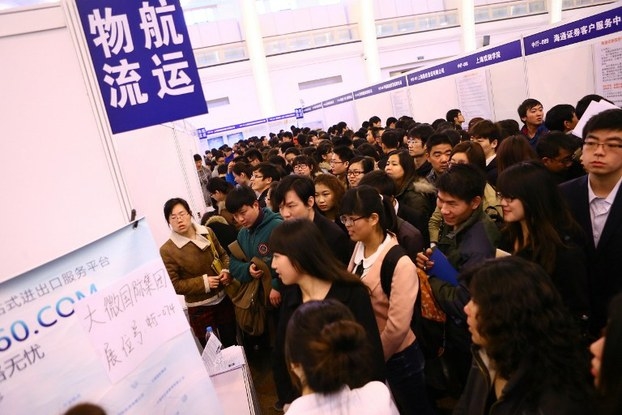
The Chinese Ministry of Human Resources and Social Security released its “15th Five-Year Plan” on July 9, abandoning the specific numerical targets for urban job creation for the first time since the 1990s. Instead, it vaguely stated it will “maintain a considerable scale.” Experts believe that this move signifies the Chinese government’s uncertainty about future variables and reflects the deep-seated challenges in labor structure imbalance under the impact of artificial intelligence (AI), real estate crisis, and external geopolitical challenges.
Looking back, setting targets for millions of new urban jobs has been a consistent part of China’s economic planning. The official “14th Five-Year Plan” in 2021 explicitly called for creating over 55 million new jobs, while the “13th Five-Year Plan” set a target of more than 50 million new jobs.
However, the latest “15th Five-Year Plan” only vaguely mentions that annual targets will be “proposed as appropriate,” attributing this shift to technological revolution, changes in population structure, and external pressures.
Chinese expert Wang He pointed out that the government’s reluctance to provide specific numbers indicates a lack of clarity on future variables, making precise judgments difficult. He analyzed that this uncertainty stems from two major impacts: concealing massive population death data during the pandemic leading to distorted fundamental population indicators, and the unpredictable impact of AI technology on the job market.
American economist David Huang criticized this move, stating that it is not policy optimization but a deliberate “laying flat” strategy by the authorities knowing that data is on the verge of collapse, playing word games.
He emphasized that the policy requirement to maintain urban job creation at a “considerable scale” is essentially a way to legitimize and normalize rising unemployment rates, signifying that if job creation is not feasible, it’s acceptable to give up on it.
Behind the disappearance of job creation targets lies a severe test facing the Chinese labor market. Official data shows that by the end of 2025, the number of urban employed individuals reached 475 million, with an annual increase of only about 2 million, indicating a significant slowdown in growth. The addition of new employment positions does not account for lost job opportunities, nor does it incorporate the unemployed population, creating a different picture of net employment changes.
The crisis in the real estate sector, coupled with pressures from tariffs and overcapacity, has led to massive job losses in the construction industry. Manufacturers are resorting to automation to cut down on staff, forcing millions of workers to turn to the gig economy.
According to a study by the New Employment Forms Research Center under the Chinese Ministry of Human Resources and Social Security, the number of individuals in “flexible employment” without regular full-time contracts is projected to increase from 280 million in 2025 to 320 million this year. Even those working just one hour a week are considered “employed.”
With a total employment of 725 million people in China by the end of 2025, flexible employment accounts for 44% of the total workforce, nearly equivalent to the total population of the United States.
This oversaturation of non-standard employment has raised concerns among local governments. Since April this year, at least four cities including tech hub Shenzhen have issued warnings of a “saturated” ride-hailing market.
Scholar Yang Zhan from the Hong Kong Polytechnic University told Reuters that this trend is no longer confined to migrant workers but has “extremely high” proportions among the middle class and college graduates. Increasingly educated young people and white-collar workers are reluctantly joining this trend due to weak domestic demand and the impact of AI applications.
Furthermore, according to another indicator from the National Bureau of Statistics of China, around 49 million out of the 180 million rural laborers migrating to cities in 2025 returned to their hometowns as they couldn’t find jobs in urban areas.
Research institution Gavekal Dragonomics pointed out that this is the second rise in the proportion of agricultural labor force in decades, indicating a significant blow to the urban labor market.
The “15th Five-Year Plan” particularly stresses the comprehensive response to the impact of “external environmental changes” on employment. Wang He interpreted this as a reflection of China’s deteriorating international situation. Being a country with over 30% of GDP dependent on imports and exports, China’s massive $1.2 trillion trade surplus last year has sparked discontent from many countries. If the external environment continues to worsen, leading to a sharp decline in imports and exports, millions of workers directly or indirectly dependent on foreign trade will face job crises.
David Huang further analyzed the contradictions in industrial policies. He noted that while Beijing desires to develop advanced technology and attract foreign investment, it’s also maintaining a tense relationship with Western countries. By using the term “external environmental changes,” the authorities are attempting to conceal the fatal impact of geopolitical conflicts leading to orders and industries shifting away from China.
Additionally, Huang criticized Beijing for abandoning the “old three items” (garments, household appliances, furniture) capable of absorbing a significant number of job seekers in favor of directing resources towards the “new three items” like electric vehicles, photovoltaics, and lithium batteries, which he views as absurd. He emphasized that the new three items face severe anti-dumping pressures in Europe and the United States.
In China, employment is not just an economic issue but a core pillar in maintaining social stability for the Chinese Communist Party (CCP). Since the outbreak of the US-China trade war in 2018, authorities have included “stabilizing employment” in the “six stability” policies, indicating that the issue has already reached the top levels of decision-making.
However, recent economic indicators have shown unprecedented weakness not seen since the COVID pandemic. Retail sales in May declined for the first time since 2022, and fixed-asset investment in the first five months of this year dropped by 4.1% year on year.
With the youth unemployment rate rising to 21% in 2023, the CCP stopped disclosing related data and later re-released it using new statistical methods. The May data under new criteria (excluding students aged 16-24) showed a rate of 15.6%, along with an estimated additional 12.7 million college graduates this year, and the existing 320 million flexible employment group, the pressure on stable employment and the economic downturn is increasingly significant.
Wang He concluded that the persistently high unemployment rate has become a factor of social instability in the eyes of the CCP, urgently needing to control the situation. However, the reality is that while they say one thing, they have no solution to implement—a harsh economic reality that has heavily hit official policies.