
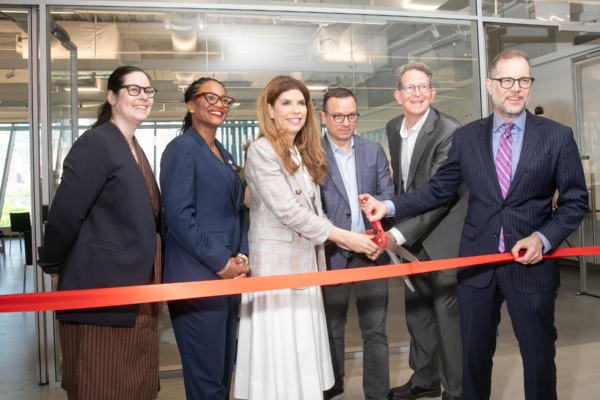
Cornell Tech, the technology campus of Cornell University, recently held an opening ceremony on Roosevelt Island in New York City to inaugurate a new teaching and research space located within the Tata Innovation Center. This marks the completion of a year-long renovation project covering a total area of nearly 60,000 square feet, further strengthening its position as a hub for artificial intelligence (AI) education, research, and innovation in New York.
The newly opened facilities include teaching spaces, research labs, a MakerLAB, coworking spaces, and a health technology research center. The Gensler Family AAP NYC Center, a key hub in the fields of architecture and urban planning within Cornell University’s College of Architecture, Art, and Planning, has also officially relocated to this space, becoming Cornell University’s new base in New York.
The new space also serves as a key hub for Cornell University’s Design Tech master’s program. This interdisciplinary program integrates resources from fields such as architecture, engineering, computer science, design, and human ecology to cultivate a new generation of talent with integrated technological and design capabilities to meet the demands for innovative talent in the AI era.
The Cornell Design Tech master’s program, a two-year interdisciplinary program jointly offered by five colleges of Cornell University, involves students taking courses on the Ithaca campus in their first year and choosing to study at the Cornell Tech campus in New York for their second year, collaborating with teachers in design, engineering, computer science, and human ecology for research. This year will also see the first batch of graduates who have completed training at both campuses.
Greg Morrisett, Dean and Vice Provost of Cornell Tech, stated that since its establishment in 2012, Cornell Tech has been continuously expanding innovative initiatives at the intersection of design, architecture, and technology. The opening of this new space will further promote collaboration between architects, AI researchers, industry leaders, and government agencies, embodying Cornell Tech’s mission as the “New York AI Campus”.
Robert Balder, Executive Director of the AAP New York Center at Cornell University, emphasized that the greatest value of the new hub lies in creating more opportunities for interdisciplinary collaboration among students and in closely linking architecture, design, and planning education to the city of New York. He stated that the AAP New York Center has always emphasized using New York as a classroom, allowing students to directly address urban development issues and collaborate with scholars, designers, and practitioners who are shaping the city’s future, continuing to expand innovative thinking in the new campus environment.
Several officials from New York City also attended the event, including City Council Speaker Julie Menin, City Comptroller Mark Levine, Senior Vice President of the New York City Economic Development Corporation (NYCEDC) Daria Siegel, Deputy Borough President of Queens Ebony Young, and Audrey Tannen, District Office Manager for State Senator Liz Krueger. The officials in attendance expressed that Cornell Tech has become an important pillar of New York’s technology innovation ecosystem, with significant implications for nurturing tech talent, promoting entrepreneurial development, and enhancing urban competitiveness.
For Roosevelt Island, Cornell Tech’s continued expansion in recent years symbolizes a shift in the island’s positioning. Once known for its residential community, Roosevelt Island has gradually evolved into a prominent hub for higher education, innovative research, and startups in New York. Since its establishment in 2012, Cornell Tech has annually educated over 1,000 students and has nurtured 132 new startup companies, with 95% choosing to stay in New York, continuously injecting momentum into the local tech industry and economic growth.