
【Epoch Times, July 11, 2026】Audience friends, hello everyone! Welcome to watch “Century of Truth”.
In the structure of the Communist Party’s military system, there is a position that seems highly honorable, but in reality, it is full of hidden dangers. The person in this position controls the central axis of the army’s operations, closest to the core of the highest power, but often becomes the center of political storms first.
This position is the Chief of the General Staff of the Communist Party.
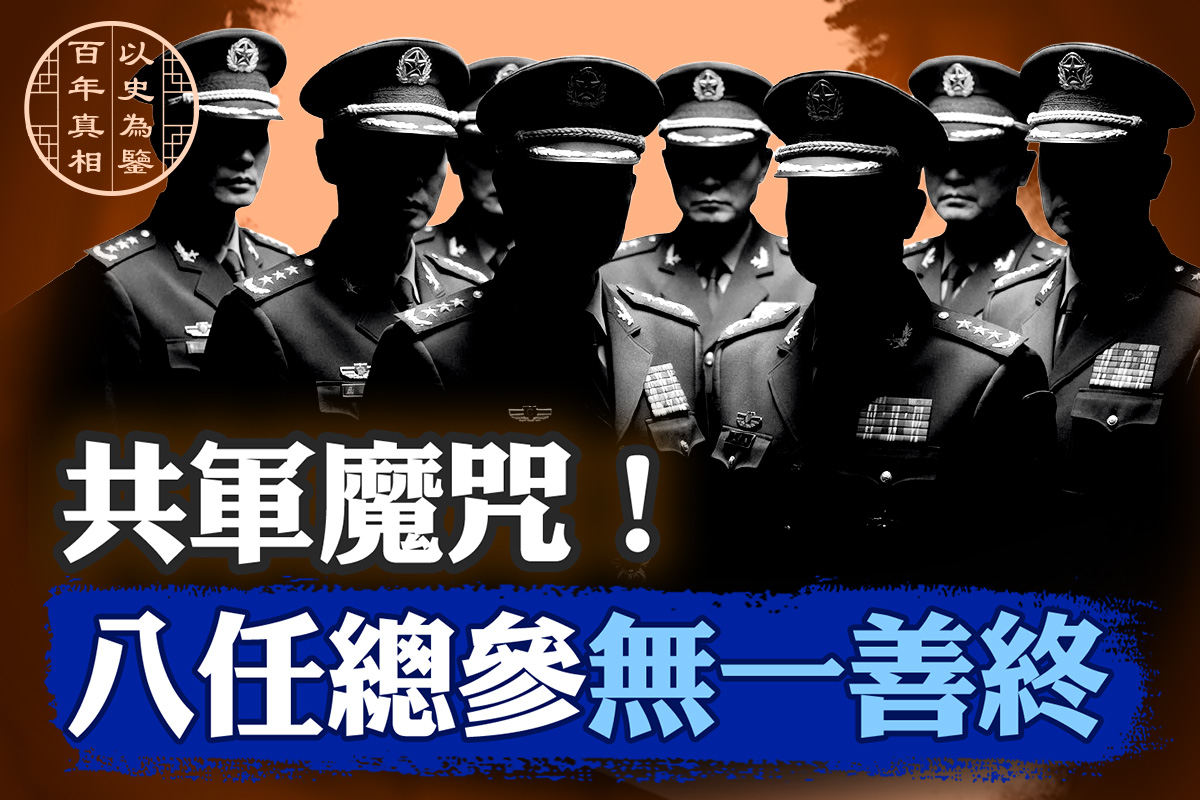
If we look back at history, we will find an intriguing phenomenon: since the establishment of the Communist Party, most of the individuals who have held the position of the Chief of the General Staff of the military have faced difficult endings, and some even found it hard to have a good conclusion.
Is the Chief of the General Staff truly the highest honor in the Communist Party’s military, or is it merely the end of a dangerous road?
Today, let us chronologically review the secret and chilling chain of destinies behind the Chief of the General Staff of the Communist Party.
The first appearance is Su Yu, one of the most capable generals in the Communist Party.
In 1955, when the Communist Party conferred military ranks, Su Yu ranked first among the ten generals. Three generals and over twenty senior officers had once been under his command. In terms of military achievements, Su Yu ranked only after Marshal Lin Biao.
Su Yu also served as the second Chief of the General Staff after the establishment of the Communist Party. After the reconstruction of the Central Military Commission in 1954, Mao Zedong served as the Chairman, Peng Dehuai was responsible for daily military affairs, equivalent to the Vice Chairman of the Military Commission, and Su Yu became the Chief of the General Staff. The Chief of the General Staff is the highest-ranking military officer in charge of actual military power. At this moment, Su Yu had reached the peak of his military career, presumably feeling as if he were on top of the world.
However, good times didn’t last long!
In 1958, Mao Zedong initiated the “anti-dogmatism” movement in the military, ostensibly against blindly copying the Soviet military model, but in reality, it was aimed at suppressing high-ranking officers in the military to prevent them from launching a coup.
During this military cleansing, Su Yu was labeled with accusations such as “seeking power from the Party” and “extreme individualism,” becoming Mao Zedong’s target for removal.
This triumphant general on the battlefield became a complete loser in political struggles. On August 31, 1958, the Politburo of the Communist Party removed Su Yu from the position of Chief of the General Staff, and conveyed his issues orally to the level of army divisions and regional party committees. From then on, Su Yu was marginalized for a long time, and suffered from illness in his old age.
Su Yu’s wife, Chu Qing, summarized it with bitterness, saying: “In the war era, Su Yu suffered in battles, during peace he suffered persecution, and in his old age, he suffered from illness. Following the Communist Party’s ‘revolution’ for 60 years, he spent 30 years in adversity.”
After Su Yu was toppled, Huang Kecheng took over his position. Since the days of Jinggangshan, Huang Kecheng had been following Mao Zedong in orchestrating revolutions. Logically, he should have earned Mao’s trust.
However, in October 1958, Huang Kecheng took over as Chief of the General Staff, but within less than a year, he fell in a more intense political storm!
At the Lushan Conference on July 14, 1959, Peng Dehuai wrote a letter criticizing the issues of the “Great Leap Forward,” which angered Mao Zedong.
Mao decided to overthrow Peng Dehuai, and brought Huang Kecheng to Lushan to expose Peng, wanting Huang Kecheng to speak out against Peng. As the Chief of the General Staff of the military, Huang Kecheng oversaw the daily work of the Central Military Commission in Beijing and was a subordinate of Peng Dehuai.
After Huang Kecheng arrived at Lushan, instead of acting as Mao’s “savior,” he became a staunch supporter of Peng Dehuai. In a meeting on July 19, he spoke for two hours openly supporting Peng Dehuai.
This statement completely infuriated Mao Zedong. On July 30, Mao publicly accused Huang Kecheng of serving as Peng Dehuai’s “political chief of staff,” being the key figure of the so-called “Hunan group,” and the main member of the “military club.”
Facing Mao’s accusations, Huang Kecheng not only refused to comply but also refuted them point by point.
For example, in response to the accusations of being the so-called “political chief of staff of Peng Dehuai,” Huang Kecheng retorted, “I served as Peng’s chief of staff because Chairman Mao wanted me to. At that time, I was working in Hunan and didn’t want to come, but you insisted. Since I became the chief of staff, how can one separate politics and military matters? Peng Dehuai’s letter criticizing the Great Leap Forward was written at Lushan, while I was still in Beijing at that time and hadn’t even gone to the mountains. How could I have acted as his chief of staff in the matter of writing a letter?”
The result of the Lushan Conference was that Huang Kecheng was branded as a member of the “anti-party group led by Peng Dehuai,” and his position as Chief of the General Staff was revoked. He was only vindicated in December 1978, 19 years later.
After Huang Kecheng was deposed, Mao Zedong appointed Luo Ruiqing as Chief of the General Staff and Secretary-General of the Military Commission. However, within a few years, Luo Ruiqing also became a victim of political struggles.
At that time, in order to bring down Liu Shaoqi, Mao Zedong devised a major strategy, launching the Cultural Revolution to continue the revolution under the dictatorship of the proletariat, aiming to eliminate all individuals Mao deemed as posing threats to his supreme power.
However, would others stand by and support him? Mao’s greatest concern was a potential coup by military leaders who held military power and political authority. He was distrustful of senior officers who held the power of the military and political and legal systems.
Luo Ruiqing served as Minister of Public Security for 10 years and then as Chief of the General Staff and Secretary-General of the Military Commission for 6 years, having good connections in the military and political and legal system. Luo Ruiqing was also closer to Liu Shaoqi and Deng Xiaoping, who were working at the forefront of the Central Committee, which raised concerns for Mao.
In December 1965, Mao Zedong chaired the Shanghai Conference and launched a sudden attack on Luo Ruiqing, crafting accusations such as opposing Lin Biao, failure in politics, and power grab desires. Luo Ruiqing was removed from his position as Chief of the General Staff and Secretary-General of the Military Commission.
In March-April 1966, the CCP held a meeting at the Beijing Western Guesthouse, continuing criticism of Luo Ruiqing for 35 days. In despair, Luo Ruiqing attempted to commit suicide by jumping off a building but failed, suffering severe injuries instead.
From May 4 to 26, 1966, the expanded meeting of the Political Bureau of the CCP was held in Beijing, passing a resolution to initiate the Cultural Revolution, and Luo Ruiqing was branded as a member of the “Peng-Luo-Lu-Yang anti-party group,” leading to his imprisonment.
It was not until November 1973 that he was released from confinement, having undergone nearly 8 years of persecution.
After Luo Ruiqing fell from power, in June 1965, Mao Zedong appointed Yang Chengwu as the Acting Chief of the General Staff, becoming one of the powerful figures in the military, second only to Lin Biao and Ye Jianying. Yang Chengwu was once considered one of Mao’s closest confidants, especially during Mao’s inspection tours from 1967 onwards. Many of Mao’s important directives were conveyed through Yang Chengwu.
Just when his glory seemed boundless, Yang Chengwu’s wife coolly analyzed his situation. She said, “The position you hold is like being squeezed on all sides, having to listen to the Chairman, listen to Lin Biao, listen to the Premier and the old leaders, listen to Kang Sheng, Jiang Qing, and the central Cultural Revolution; didn’t you see Luo Ruiqing’s example? With all these forces pressing from every side, you will become a sacrificial pawn.”
Yang Chengwu’s wife truly hit the nail on the head; his good days lasted less than three years. Ironically, the one who eventually dragged him down was his own daughter, Yang Yi. In today’s internet lingo, many people would joke that it’s a classic case of being “set up.”
At the time, Yang Yi was working at the Air Force Daily. In 1968, Zhuang Sumei, the wife of Shan Li, the secretary of the political commissar of the Air Force, accused Yang Yi and Shan Li of having an improper relationship.
How to handle this matter? At the time, there was a conflict between Yang Chengwu, Shan Li, and Air Force Commander Wu Faxian. Behind Wu Faxian was Lin Biao and Ye’s circle. After Lin Biao and his wife reported this matter to Mao Zedong, Mao sided with Lin Biao.
On March 22, 1968, Mao Zedong stripped Yang Chengwu of his position as Acting Chief of the General Staff and all his other duties at the Military Commission. Using this incident, Mao subsequently removed the Air Force political commissar Shan Li, Beijing Garrison commander Fu Chongbi, among others.
It wasn’t until 1974, after the dust settled on the Lin Biao incident, that Yang Chengwu had a chance to return. By then, he had undergone six years of persecution.
In 1968, following his removal from the Acting Chief of the General Staff, Mao Zedong appointed Huang Yingsheng as the Chief of the General Staff.
Originally named Huang Xuquan, he was an old comrade of Mao’s, starting from the Autumn Harvest Uprising of 1927, following Mao in revolutionary activities. For his bravery in battle, Mao renamed him Huang Yingsheng, hoping that he would always win battles. After the establishment of the Communist Party, in 1955, Mao promoted him to the rank of General.
After Yang Chengwu’s downfall, the “Central Military Commission Office” replaced the “Central Military Commission Standing Committee,” with Huang Yingsheng as the head. Serving under the first Vice Chairman of the Military Commission, Lin Biao, Huang Yingsheng had more contact with Lin Biao under direct leadership.
After the Lushan Conference in 1970, public disagreements between Mao and Lin surfaced, leading Mao Zedong to begin preparing to eliminate Lin Biao. On Lin’s side, his son Lin Liguo failed in an attempt to assassinate Mao Zedong. On September 13, 1971, Lin Biao, along with his family, boarded a plane to flee, and the plane crashed in Mongolia, resulting in their deaths.
Following Lin Biao’s death, referred to as the “Four Big Tigers” under Lin Biao, Huang Yingsheng, Wu Faxian, Qiu Huizu, and Li Zuopeng were isolated and investigated due to their connections. Following his involvement in the Lin Biao case, Huang Yingsheng continued to face misfortune even after the reform and opening up of the CCP. On January 25, 1981, Huang Yingsheng was sentenced to 18 years in prison as the “main culprit of the Lin Biao counter-revolutionary group.”
Huang Yingsheng passed away in Qingdao while on medical parole on April 26, 1983. His dying wish was, “I request the Central Party to exonerate me… I did not oppose the Party… I… did not oppose the Chairman!”
However, as of 2026, the CCP has not exonerated him.
After Lin Biao’s death in 1971, Deng Xiaoping, who had been exiled to a tractor repair factory in Jiangxi, immediately wrote to Mao Zedong acknowledging his mistakes and expressing a desire to return and contribute.
After much consideration, Mao agreed to allow Deng to return. In 1973, Deng Xiaoping returned to Beijing and resumed his position as Deputy Premier of the State Council. In 1975, Deng Xiaoping was appointed as a member of the Political Bureau of the Communist Party of China, Vice Chairman of the Central Committee, and Vice-Chairman of the Central Military Commission concurrently serving as Chief of the General Staff.
Yet, Mao still harbored suspicions towards Deng. Deng Xiaoping had been overthrown at the beginning of the Cultural Revolution and how Deng viewed the Cultural Revolution after his return remained Mao Zedong’s primary concern.
Therefore, Mao had Deng lead a resolution on the Cultural Revolution. Overall, the assessment was seven points for achievements and three points for mistakes. However, Deng Xiaoping’s attitude was, “I am a person from the Peach Blossom Spring, oblivious to the world, regardless of the Wei and Jin Dynasties.” This meant that after being exiled to Jiangxi for three years, he wasn’t familiar with external conditions and felt unsuited to lead this effort.
Although Deng Xiaoping’s excuse was clever, it renewed suspicions of distrust in Mao’s mind.
At that time, Mao’s contact, Mao Yuanxin, continuously conveyed messages to Mao, indicating that Deng Xiaoping was unwilling to affirm the Cultural Revolution, and there were even indications of rectifying mistakes.
In the winter of 1975, Mao Zedong launched the “Attacks on Deng and Counter-Attacks on Rightist and Reversal Winds” movement. Deng Xiaoping’s position was once again in jeopardy.
On April 5, 1976, Beijing experienced the “anti-revolutionary incident” known as the “April 5 Movement,” where Deng Xiaoping was believed to be the mastermind behind the event. On April 7, Mao Zedong stripped Deng Xiaoping of all his positions, leaving only his party membership, once again toppling Deng.
The stories we have discussed earlier are related to the Cultural Revolution or pre-Cultural Revolution events. The next character to appear is now part of the so-called “Xi Jinping New Era.”
In 2015, following Xi Jinping’s military reform, the original General Staff Department was split, forming the Joint Staff Department with Fang Fenghui as the first Chief of Staff after the military reform.
Fang Fenghui was once regarded as a prominent star in the Communist Party’s military world: in 2007, at the age of 56, he was promoted to Commander of the Beijing Military Region, the youngest among the seven military regions; in 2010, he was promoted to General; in 2012, he served as Chief of the General Staff; and in 2015, he became the first Chief of Staff after the military reform.
With such a trajectory, it was highly likely that Fang Fenghui would climb further up during the 19th National Congress of the CCP in 2017, becoming a member of the Political Bureau of the CCP, Vice-Chairman of the Central Military Commission.
However, due to his connection to the former Deputy Chairman of the Military Commission, Guo Boxiong, Fang Fenghui was announced to have fallen in August 2017 for serious corruption allegations.
Under Xi Jinping’s rule, military figures associated with Jiang Zemin’s faction were purged under the guise of an anti-corruption campaign. Former Deputy Chairman of the Military Commission, Guo Boxiong, and Xu Caihou were taken down. Fang Fenghui was a personal protege of Guo Boxiong, not Xi Jinping, which external views believe is the real reason for Fang Fenghui’s downfall.
On February 20, 2019, Xinhua reported that Fang Fenghui was sentenced to life imprisonment for bribery, bribery, and unclear sources of huge wealth.
As of 2026, the upper echelon of the CCP’s military power structure has once again seen sudden changes, with the Chief of Staff becoming a dangerous position.
On January 24, the spokesperson of the Ministry of National Defense of the People’s Republic of China announced unexpectedly that Zhang Youxia, Political Bureau members, Vice Chairman of the Central Military Commission, and Liu Zhenli, a member of the Central Military Commission, and Chief of Staff of the Joint Staff Department, were under investigation for “serious violations of discipline and law.”
Liu Zhenli, like Zhang Youxia, is one of the few generals in the CCP’s military who has participated in the Vietnam War and achieved military honors.
He was promoted step by step from a student to a platoon leader, company commander, and gradually elevated in rank. In 2014, he served as the Commander of the “ace army” of the Communist Party- the 38th Group Army. In July 2015, he was appointed as a Chief of Staff of the Armed Police Force; later that year, he was appointed as Chief of Staff of the Army. In 2022, he became a member of the Central Military Commission; in March 2023, he took on the role of Chief of Staff of the Joint Staff Department.
Being in the role of Chief of Staff for less than 3 years, Liu Zhenli was investigated for “serious violations of discipline and law”, once again highlighting the high-risk features of this position in the CCP’s military.
From the era of Mao Zedong to Xi Jinping, the philosophy of “struggle” has always dominated the operational logic of power in the CCP. As the holder of substantive military power, closest to the party’s core, the Chief of Staff is often seen as a potential threat.
When the top figure in the staff system gets embroiled in the whirlpool of power struggles, unable to protect themselves, one cannot help but ask: does this position represent honor or danger?
In such a system, who can truly be secure?
Well, that’s all for today’s program. Thank you for watching. If you enjoyed our show, don’t forget to like, subscribe, and share. Until next time.
Production Team of “Century of Truth”