
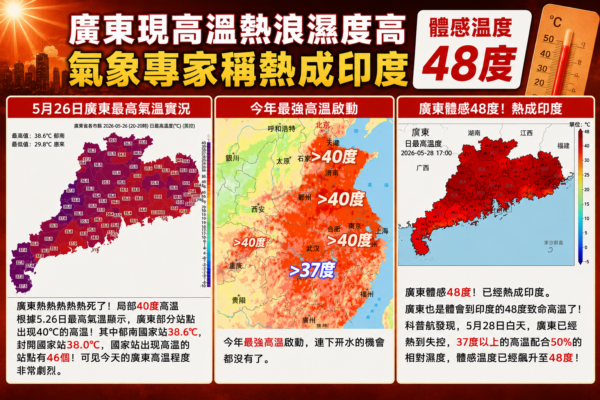
Recently in Guangdong, there has been a heatwave with temperatures exceeding 37 degrees Celsius and humidity levels of over 50%, leading to a heat index of over 48 degrees. Meteorological experts have described the situation as scorching like in India.
As early as the end of April this year, the China Meteorological Administration issued a warning stating that the temperature in the southern regions, including Guangdong, would be significantly higher in May, potentially leading to a heatwave. They emphasized the need to strengthen heat warnings and health risk prevention measures.
On May 25th, Guangzhou issued its first high-temperature warning. The meteorological bureau reported that due to the subtropical high pressure system influencing southern China, there were 67 high-temperature warnings in effect across the province on that day, with temperatures ranging from 35 to 38 degrees Celsius.
A meteorology PhD from Fudan University and popular science blogger “Science Navigation” posted on social media, stating, “The heat index in Guangdong has reached 48 degrees! It’s as hot as in India.”
He further explained, “Guangdong is now experiencing a deadly high temperature of 48 degrees, similar to India! On May 28th, it was reported that Guangdong was already sweltering, with temperatures above 37 degrees Celsius combined with a relative humidity of 50%, resulting in a heat index soaring above 48 degrees.”
Comparing the humid heat in China with the dry heat in India, he pointed out, “In terms of perceived temperature, Guangdong on the 28th has exceeded the hottest place in India this May – the northwestern state of Rajasthan, which recorded a high of 47 degrees.”
He emphasized, “This 47 degrees in India is considered dry heat, with an air relative humidity of only about 15%, resulting in a perceived temperature of around 47.3 degrees. But in Guangdong on the afternoon of the 28th, with temperatures of 38 degrees combined with 49% humidity, the heat index soared to 48.1 degrees; in Fengshun where the temperature reached 38.6 degrees with 45% humidity, the perceived temperature was 47.5 degrees. Additionally, in parts of Yuexiu district in Guangzhou, the temperature peaked at 40.2 degrees. If combined with around 42% humidity, the heat index would easily surpass 50 degrees.”
Therefore, he concluded, “From the perspective of perceived temperature, Guangdong on the 28th has surpassed India and become the hottest place globally.”
According to public data, the perceived temperature is calculated as a composite of temperature, humidity, solar radiation, and wind speed.
Residents in Guangdong expressed feeling lightheaded even when staying indoors, speculating whether they might be experiencing heat stroke.
Some stated that they were sweating profusely even when sitting still at home, with even the tap water feeling scalding hot.
Others remarked on the extreme heat in Guangdong recently, noting that the stifling conditions rival those of India and Africa.
In Guangdong TV news, interviews with African students conveyed their struggle with the heat, with some expressing a desire to return to their hometowns due to the intense heat.
Fortunately, Guangdong is expected to receive heavy rainfall in the coming days, which will help alleviate the high temperatures. However, the meteorological bureau also warned that the downpours may bring secondary disasters.
From May 30th to June 1st, Guangdong is expected to experience a critical period of heavy rainfall and cooling temperatures, with localized outbreaks of heavy rain and even severe rainstorms throughout the province from north to south. The western regions of Guangdong, the Pearl River Delta, and western parts of Guangxi province are expected to receive the most rainfall, with accumulations ranging from 150 to 300 millimeters, locally exceeding 400 millimeters, along with strong gusts of wind reaching 8 to 10 on the Beaufort scale, intense thunderstorms, short but heavy rainfall, potentially leading to flash floods, landslides, and urban waterlogging.
Apart from Guangdong, high temperatures and muggy weather have been observed in Guangxi and Hainan in southern China. Central regions such as Hubei, Hunan, and Jiangxi are experiencing heavy rain combined with humidity. Northern regions including Hebei, Henan, Shandong, Shanxi, and Shaanxi have also seen widespread high temperatures earlier this year.