
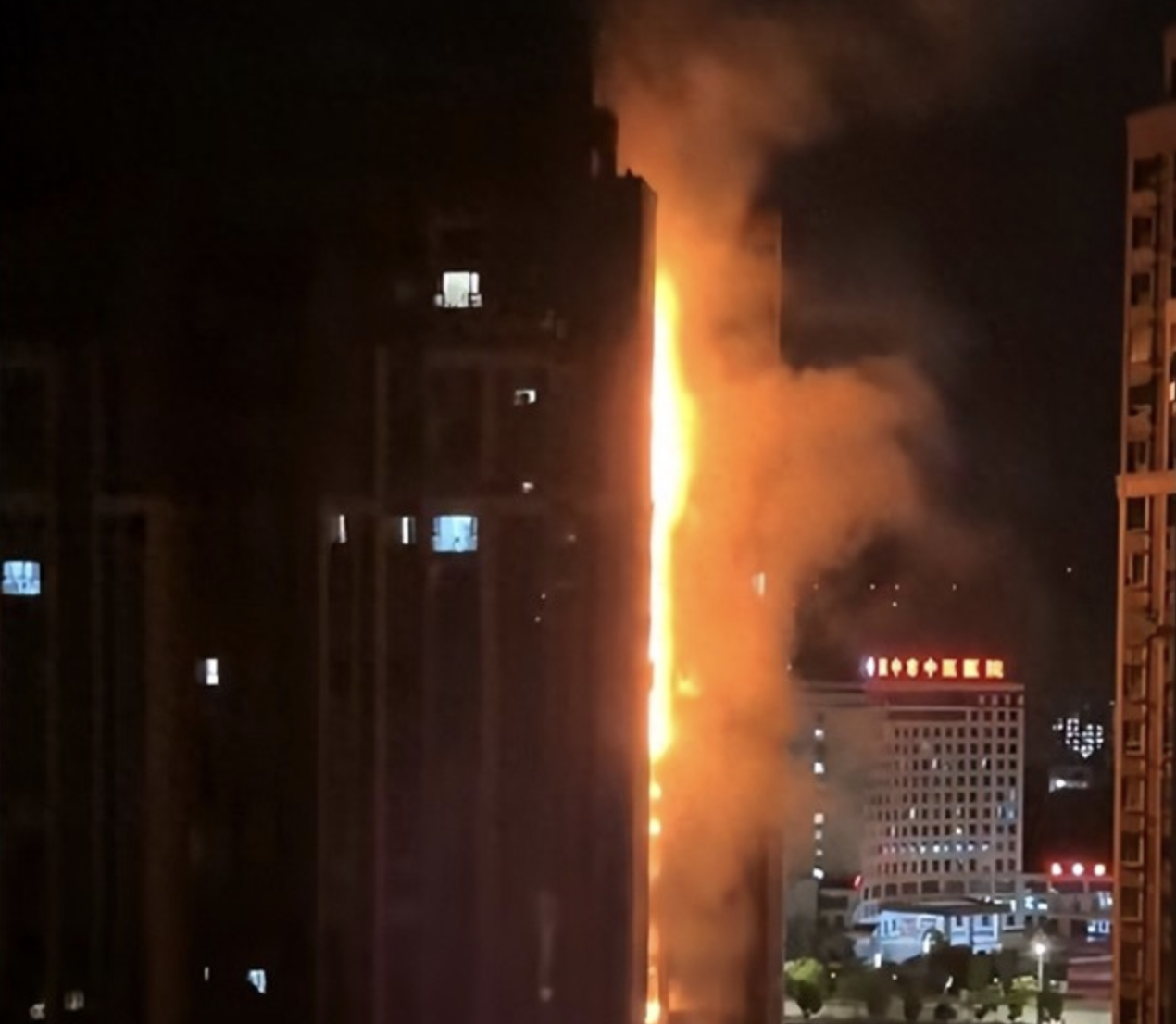
In the early morning of July 13th, a sudden fire broke out in a residential area on Huaxu Road in Langzhong City, Nanchong, Sichuan. The flames quickly spread along the exterior walls of the building, with fire and thick smoke emanating from the windows of multiple floors. Fortunately, there were no casualties as a result of the fire.
According to a report by the Xiaoxiang Morning Post, it was reported from the Lengjiaba Community in Langzhong City that the fire originated from one side of the kitchen exterior wall of a residential building and spread from the bottom to the top floor.
Local neighborhood community workers stated that the burning embers dispersed upwards, igniting the upper floors. Following the fire, residents of the upper floors were evacuated overnight.
A blog post by “Chi Jun Rui Ping” suggested that this early morning high-rise external wall fire seemingly started from a seemingly inconspicuous hidden danger on the exterior wall but rapidly spread due to the chimney effect of the high-rise. Many residents were puzzled as to why the indoor fire would burn all the way up the exterior wall to the top floor, with the main culprit being the chimney effect typical of high-rise residential buildings and the combustible materials on the exterior wall. Once the lower exterior wall ignites, air rapidly convects along the vertical channel of the building, causing the flames to climb much faster than an indoor fire, sweeping through the entire building facade in just a few short minutes.
Upon initial observation at the scene, the fire primarily propagated upwards through combustible carriers such as exterior wall insulation layers, outdoor pipelines, and air conditioning unit brackets. Several high-rise balconies were ignited by flying embers, creating a dangerous situation with multiple points of ignition.
There are widespread vulnerabilities in the daily management of residential communities: some older high-rise exterior wall insulation materials do not meet fire safety standards, balconies are haphazardly stacked with cardboard boxes and miscellaneous items, combustible materials are piled around air conditioning units, and lower-floor residents hang sunshade fabrics and combustible protective nets on the exterior wall, all of which lay the groundwork for the vertical spread of fires.