
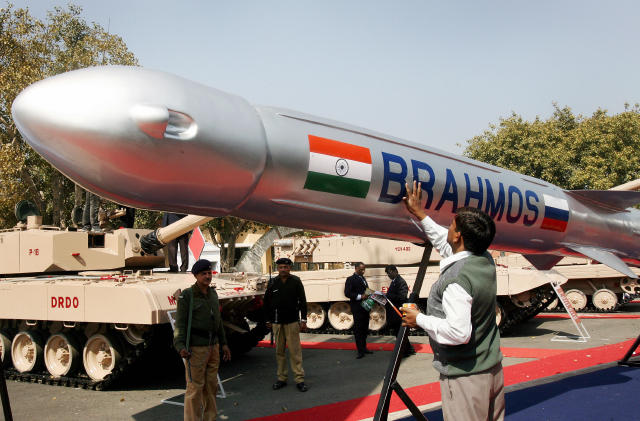
The Chinese Communist Party (CCP) has been conducting military expansion in the Indo-Pacific region and on Monday test-fired submarine-launched missiles into the Pacific, triggering concerns and condemnations from neighboring countries. India has announced plans to provide the BrahMos and Astra missiles to Indonesia in response. This marks the third such military sales agreement India has reached in the Indo-Pacific region.
Weapons experts suggest that the BrahMos missile, with its anti-ship capabilities, has piqued the interest of buyers in the Indo-Pacific region. For countries with limited naval forces but a need to defend disputed territories in the South China Sea, this missile is highly attractive.
A spokesperson from the Indian Ministry of External Affairs stated on Tuesday, “The BrahMos missile and air-to-air missile cooperation are new areas of collaboration for us with Indonesia.” The spokesperson added that the purchase of BrahMos is an important cooperation project, but specific commercial terms have not yet been finalized.
Siemon Wezeman, a senior researcher on arms transfers at the Stockholm International Peace Research Institute (SIPRI), told CNBC that buyers are particularly interested in the anti-ship version of the BrahMos missile. With a range of 300 kilometers and extremely high speed, this model is challenging to intercept.
He added, “It is one of the largest and fastest missiles available on the market today.”
BrahMos Aerospace, the company behind the BrahMos missile, is a joint venture between India’s Defence Research and Development Organisation (DRDO) and Russia’s NPO Mashinostroyenia.
In 2022, the Philippines became the first buyer of the BrahMos missile. Reuters reported in May of this year that India had signed an agreement to sell the missile to Vietnam.
Collin Koh, a senior research fellow at the Institute of Defence and Strategic Studies (IDSS), told CNBC that the reason behind these two transactions is the perceived increasing threat posed by China in the South China Sea.
Koh added that while Indonesia does not see China as its main national security threat, there are disagreements between Jakarta and Beijing over the sovereignty claims in the North Natuna Sea.
On Monday, the Chinese Navy test-fired a ballistic missile into the Pacific Ocean, a move expected to deepen defense ties among countries in the region.
Experts note that this creates opportunities for India to expand its defense exports in the region. India is seen as a practical defense supplier that is not aligned with any major power bloc and is not viewed as a security threat by countries in the region.
Farwa Aamer, Director of the South Asia Program at the Asia Society Policy Institute, told CNBC that strengthening defense partnerships in the Indo-Pacific region is part of efforts to counter the “Chinese threat.”
She added that these countries also aim to establish defense relationships with less reliance on the United States, making India an ideal defense partner and the BrahMos missile system highly attractive.
Wezeman from SIPRI stated that the sale of the BrahMos missile demonstrates India’s position as a significant global arms producer and exporter. However, he also pointed out that India’s defense export effectiveness is still limited in securing large contracts.
He added that if India could secure orders for the Tejas fighter jet or frigates, the value would far exceed multiple BrahMos missile orders.
Despite a growth in export figures over the past decade, India’s total exports only amounted to 384 billion Indian Rupees (approximately 4 billion USD) in the fiscal year ending March 2026. This accounts for just over 1% of the total arms sales of the world’s largest arms supplier, the United States, at 331 billion USD.
According to SIPRI data on major arms trade from 2021 to 2025, India did not rank among the top 25 arms exporting countries globally.
However, according to SIPRI’s “Yearbook 2026,” India is the world’s fifth-largest military spending country and the second-largest arms importer, with an import share exceeding 8%.