
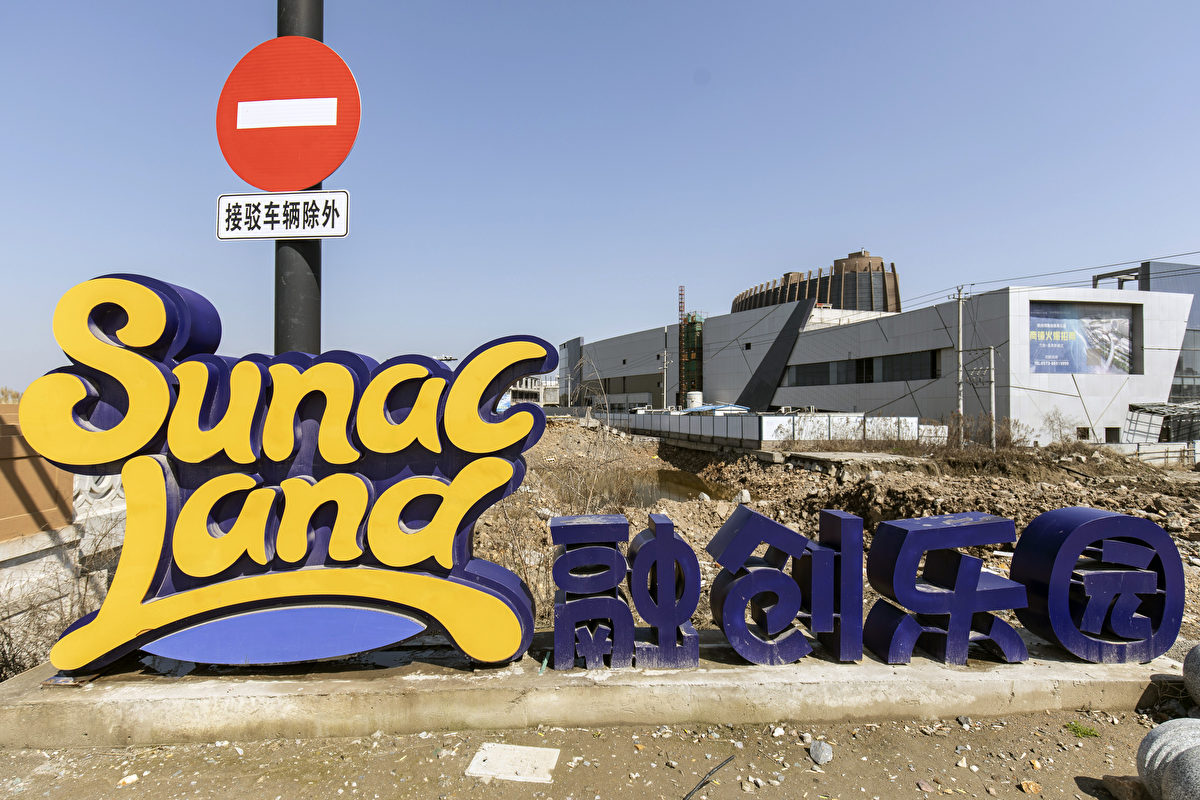
The planned “Chongqing’s First Skyscraper” project, Rongchuang A-ONE, went unsold for the first time at a public auction. The starting price of the project was approximately 2 billion yuan, attracting over 5000 spectators, but no bids were made throughout the process. The failed auction comes at a time when Rongchuang is facing reduced sales, ongoing losses, and unresolved debt risks in the Chinese real estate sector.
According to a report by the “Daily Economic News” on July 10, the auction item included approximately 29,100 square meters of land use rights in Jiangbei City, Chongqing, as well as ongoing construction and foundation pit support projects. The project was valued at around 2.502 billion yuan, with a starting price of about 2.002 billion yuan, equivalent to 80% of the valuation price, and a bidding guarantee deposit of 200 million yuan. The auction concluded on the morning of July 10 without any bids being placed.
A-ONE is located in the central business district of Jiangbei Mouth in Chongqing, with the main tower originally planned at a height of 470 meters, and three additional towers planned at 350 meters, 300 meters, and 250 meters respectively, with a total construction area of approximately 710,000 square meters and a total investment of around 20 billion yuan.
The project was initially named “World Flower”. In 2012, Chongqing Huacheng Furui Real Estate Development Co., Ltd. acquired the land for 1.74 billion yuan but halted construction due to funding issues. In 2017, Rongchuang took over the project for about 2.1 billion yuan, renamed it A-ONE, and resumed construction in 2020. However, with Rongchuang’s own debt crisis erupting, the project once again came to a halt in July 2022.
Auction data shows that only the T4 tower has completed the underground 6 floors and aboveground 25 floors of the main structure, with firefighting, water and electricity, HVAC, and elevator equipment yet to be installed. The other three towers and podium main construction projects have not started. The site’s gate is tightly closed, construction equipment such as tower cranes remains in place, there is stagnant water in the foundation pit, and some areas are overgrown with weeds.
The report mentioned that super-tall project construction involves complex technology and massive capital investment, with a long commercial real estate return period, which adds to the difficulty of finding a buyer.
In addition to paying approximately 2 billion yuan for the auction, the bidder would also need to undertake future construction, infrastructure support costs, outstanding taxes, and operational expenses. As of September 2025, the project owed approximately 1.7476 million yuan in urban land use taxes and was still accruing penalties.
The project is primarily designated for commercial office use, with future income relying mainly on leasing and operation of office buildings, hotels, and commercial facilities. Some commercial and financial land use rights will expire in 2053, with less than 30 years remaining.
The failure of A-ONE’s auction comes against the backdrop of continued exposure to debt risks in China’s leading real estate companies.
Rongchuang China had long been one of the top real estate companies in terms of sales volume on the mainland, but since the debt default in 2022, the company’s sales volume has significantly declined, and its revenue and profitability have been under pressure. Public data shows that the total sales volume reached 597.6 billion yuan in 2021. However, the contracted sales volume in 2025 was only about 36.84 billion yuan, with outstanding interest-bearing debts of around 188.26 billion yuan by year-end.
In March of this year, Rongchuang Real Estate disclosed that the company and its subsidiaries had 4 newly matured but unpaid loans, totaling approximately 614 million yuan, with a default amount of around 246 million yuan. In June, the company revealed 4 new overdue debts, totaling about 260 million yuan in default amount.
Rongchuang’s predicament is not unique. Data from the State Research Institute, a professional real estate research institution, shows that by the end of 2025, 21 insolvent real estate companies had undergone debt restructuring or reorganization, involving a debt scale of approximately 1.2 trillion yuan, with the related companies’ interest-bearing debts nearing 2 trillion yuan.
Industry analysts believe that even if some real estate companies complete restructuring, they still face problems such as declining sales, tight cash flow, and difficulties in revitalizing existing assets.