
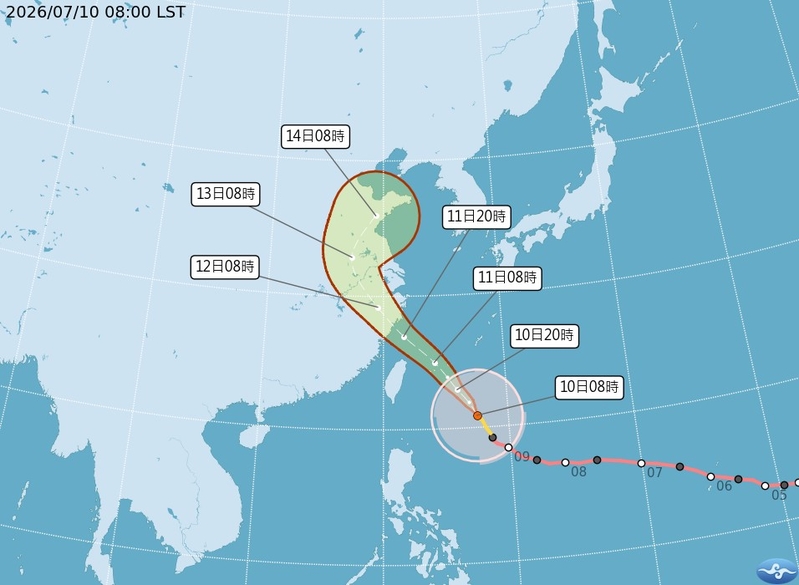
On July 11th, local time, Typhoon “Bavi” made landfall in the eastern coastal city of Taizhou, China, and nearly 2 million residents were evacuated. Prior to hitting Taizhou, “Bavi” had swept through the Sakishima Islands in southern Japan and grazed northern Taiwan.
Despite slowing down and weakening as it moved northwest, “Bavi” still posed a significant risk due to the massive amount of water vapor in its rain band, which spanned roughly the length of France.
According to data from the China Meteorological Administration, when “Bavi” made landfall at 11:20 p.m. local time on the 11th, it had sustained winds of around 144 kilometers per hour (90 miles per hour), equivalent to a Category 1 hurricane on the Saffir-Simpson Hurricane Wind Scale.
State media in China reported that over 1.7 million people had been evacuated in Zhejiang Province where Taizhou is located. Additionally, over 100,000 people were evacuated in Fujian Province and Beijing, and about 34,000 people were evacuated in Shanghai.
In Wenzhou, Zhejiang Province, a few pedestrians were still out in the rain hours before the typhoon hit land. Some locals told Reuters that they planned to head home quickly to seek shelter from the storm and monitor the nighttime developments.
Xing Zhonghao, a migrant worker in Wenzhou, expressed his concerns to Reuters, saying, “I am a little worried. This is my first time experiencing such a situation. I used to live elsewhere, and this is my first time working in Wenzhou.”
“I heard that the typhoon ‘Bavi’ is going to land here in Wenzhou. It will definitely have a big impact on our daily lives. I hope it passes quickly and does not linger for long,” said Zhou Yuqiong, a resident of Wenzhou, to Reuters.
“I plan to finish dinner, buy some snacks, and then go home to hide. Because the wind is expected to strengthen later and there might be trouble on the way back home,” Zhou Yuqiong added.
Huang Xinghuan, a 50-year-old resident of Wenzhou, rushed to a traditional agricultural market to buy food before the typhoon arrived. He told Reuters, “I am a bit worried, but I think it should be fine. We have experienced typhoons before and we can get through this one too.”
Huang mentioned that his household had stored enough water for two to three days’ use and didn’t think there was a need to stockpile large amounts of food or other supplies.
While Typhoon “Bavi” did not make landfall in Taiwan, the government took preventive measures considering the forecasted rainfall of nearly 1 meter (3 feet) in some areas, to prevent casualties.
Authorities in Taiwan evacuated over 14,000 people from mountainous regions and suspended various activities on the island. Evacuees were mainly from the north and east, with a total of 920 international flights canceled, and Taoyuan Airport was effectively closed with all 282 domestic flights grounded.
Almost all counties and cities in Taiwan declared Saturday as a “typhoon holiday,” closing offices and schools that would have been open on the weekend, although some restaurants and convenience stores in Taipei remained open.
The main high-speed rail connecting the north and south continued to operate but with reduced services.
In downtown Taipei, some people were still seen venturing out in the strong winds and heavy rain.
“It’s okay, the situation isn’t too serious,” said 68-year-old Ye Maoxiong, who was out walking his dog despite the weather. “The wind has picked up a bit, that’s all.”
However, in the Beitou District of Taipei, located on the foothills surrounding the city, gusts of around 100 kilometers per hour brought down trees and caused rising river levels.